Question 1161 · 1334 in bank
Select 2Which two functions does a WLC perform in the lightweight access-point architecture that an AP performs independently in an autonomous architecture? (Choose two.)
Show answer
Answer: AB
Cisco Certified Network Associate (CCNA)1,334 questions across 134 pages are complete and free, with no account or card.
1334 questions in this bank
Free access · progress saved on this device
Which two functions does a WLC perform in the lightweight access-point architecture that an AP performs independently in an autonomous architecture? (Choose two.)
Answer: AB
What is the difference in data transmission delivery and reliability between TCP and UDP?
Answer: B
UDP speeds up transmissions by enabling the transfer of data before an agreement is provided by the receiving party. As a result, UDP is beneficial in time- sensitive communications, including voice over IP (VoIP), domain name system (DNS) lookup, and video or audio playback.
Source: Adapted from community discussion — Hanagaki_Shinjiro
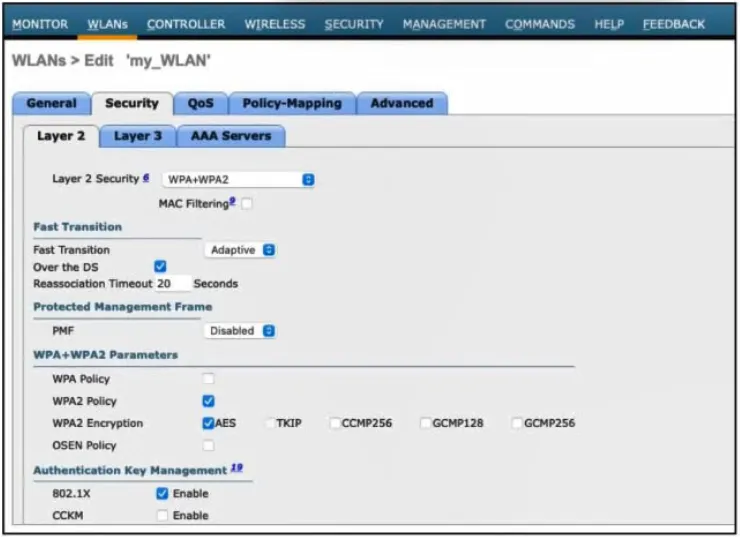
Refer to the exhibit. A network engineer is configuring a wireless LAN with Web Passthrough Layer 3 Web Policy. Which action must the engineer take to complete the configuration?
Answer: D
Out of the three options (A. Set the Layer 2 Security to None, B. Disable Web Passthrough, and C. Enable the WPA Policy), enabling the WPA Policy (option C) is the most suitable approach to complete the configuration of a wireless LAN (WLAN) with Web Passthrough Layer 3 Web Policy. Here's why: WPA Policy: Enabling WPA (Wi-Fi Protected Access) policy provides Layer 2 security for the WLAN. This means data transmissions between devices and the access point are encrypted, protecting them from eavesdropping and unauthorized access. Compatibility with Web Passthrough: WPA (specifically WPA2-PSK with AES encryption) is compatible with Web Passthrough functionality. Users can still connect initially without full authentication, but WPA secures the data transmission after the initial connection.
Source: Adapted from community discussion — onyia.edward
A network administrator plans an update to the WI-FI networks in multiple branch offices. Each location is configured with an SSID called “Office”. The administrator wants every user who connects to the SSID at any location to have the same access level. What must be set the same on each network to meet the requirement?
Answer: D
D. security policies must be set the same on each network to meet the requirement of providing every user who connects to the SSID at any location with the same access level. Security policies define the level of access granted to users on the network, including authentication, encryption, and authorization rules. By ensuring that the same security policies are applied to the SSID at all locations, the administrator can ensure that users have the same level of access, regardless of which branch office they are connecting from. Radio policies (A) control the radio settings of the Wi-Fi network, such as channel, power, and data rates. Profile name (B) refers to the name assigned to a specific network configuration profile. NAS-ID configuration (C) is a setting used in RADIUS authentication, which is not directly related to Wi-Fi network access levels.
Source: Adapted from community discussion — Ciscoman021
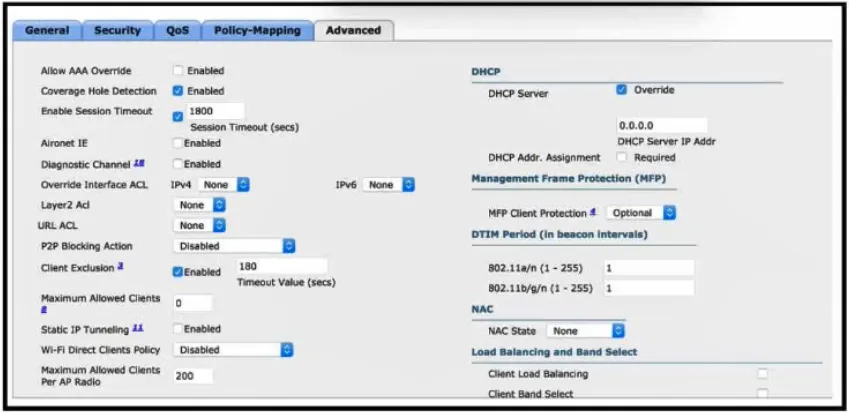
Refer to the exhibit. The P2P Blocking Action option is disabled on the WLC. The security team has a new requirement for each client to retain their assigned IP addressing as the clients move between locations in the campus network. Which action completes this configuration?
Answer: A
Static IP Tunneling - allows clients to travel between different WLC on the network and retain connectivity even if the static ip is in a different subnet. https://mrncciew.com/2013/03/25/static-ip-clients-mobility/
Source: Adapted from community discussion — ike110

Refer to the exhibit. A multivendor network exists and the company is implementing VoIP over the network for the first time. Which configuration is needed to implement the neighbor discovery protocol on the interface and allow it to remain off for the remaining interfaces?
Answer: B
B is correct because the commands "SW1(config-if)#lldp transmit - SW1(config-if)#lldp receive" enable LLDP directly on the specific interface, without needing the command "SW1(config)#lldp run" which would also work, as it enables LLDP on all interfaces. CDP is enabled on all interfaces with the command "(config)#cdp run" and we disable or enable it only on a specific interface with "(config-if)#cdp enable" or "(config-if)#no cdp enable" , but in LLDP the "lldp enable" command does not exist, because we have more options like defining "transmit" and "receive" on the interface, while CDP can only enable or disable a CDP interface with "cdp enable", that's why LLDP has more options. Correct me if I'm wrong on any point!
Source: Adapted from community discussion — dropspablo

Refer to the exhibit. Routers R1, R2, and R3 use a protocol to identify the neighbors’ IP addresses, hardware platforms, and software versions. A network engineer must configure R2 to avoid sharing any neighbor information with R3, and maintain its relationship with R1. What action meets this requirement?
Answer: C
Examtopics , please correct your answers , we are paying our money to receive false answers !!!!! And may be somebody will be dropped off the exam because of your answers !!!!!!!!
Source: Adapted from community discussion — purenuker
SIP-based Call Admission Control must be configured in the Cisco WLC GUI. SIP call-snooping ports are configured. Which two actions must be completed next? (Choose two.)
Answer: CD
B is incorrect, we already set the QoS level to platinum for voice traffic and for this question nothing needs to be done for data traffic. The correct answers are C and D, the question literally references the call-snooping ports but you still have to enable snooping
Source: Adapted from community discussion — oatmealturkey
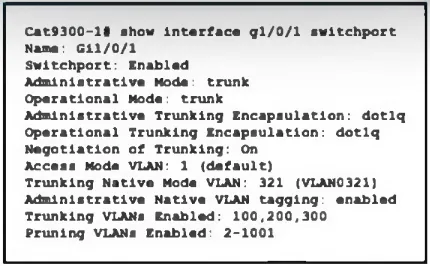
Refer to the exhibit. A network administrator configures an interface on a new switch so that it connects to interface Gi1/0/1 on switch Cat9300-1. Which configuration must be applied to the new interface?
Answer: A
Why B? The switch port in the exhibit was configured with "switchport mode trunk", as can be seen by Administrative Mode: trunk. So why not do same configuration on the new switch? Also I believe Cisco recommends statically configuring trunks and not using DTP for security reasons
Source: Adapted from community discussion — oatmealturkey
Which command enables HTTP access to the Cisco WLC?
Answer: D
D is correct: To access GUI over browser, webmode must be enable on WLC. By default it is disabled. You can enable it with below command on CLI: config network webmode enable
Source: Adapted from community discussion — Goena
Keyboard:J Kmove between questionsA–Dselect an answerRshow or hide the answer← →change page
200-301 practice, question 1161. 1334 questions available.
Version 1.0.0. How we source questions