Question 81 · 1003 in bank
Refer to the exhibit.

Which statement about the OSPF debug output is true?
Show answer
Answer: A
Implementing Cisco Enterprise Network Core Technologies (ENCOR)1,003 questions across 101 pages are complete and free, with no account or card.
1003 questions in this bank
Free access · progress saved on this device
Refer to the exhibit.
Which statement about the OSPF debug output is true?
Answer: A
Which statement about multicast RPs is true?
Answer: D
Answer is D from the linked doc. n most cases, the placement of the RP in the network is not a complex decision. By default, the RP is needed only to start new sessions with sources and receivers. Consequently, the RP experiences little overhead from traffic flow or processing. In PIM-SM version 2, the RP requires less processing than in PIM-SM version 1 because sources must only periodically register with the RP to create state.
Source: Adapted from community discussion — spittin_venom
To increase total throughput and redundancy on the links between the wireless controller and switch, the customer enabled LAG on the wireless controller. Which EtherChannel mode must be configured on the switch to allow the WLC to connect?
Answer: C
C https://www.cisco.com/c/en/us/td/docs/wireless/controller/7-4/configuration/guides/consolidated/b_cg74_CONSOLIDATED/b_cg74_CONSOLIDATED_chapter_010100001.html LAG requires the EtherChannel to be configured for 'mode on' on both the controller and the Catalyst switch.
Source: Adapted from community discussion — skh
Based on this interface configuration, what is the expected state of OSPF adjacency?
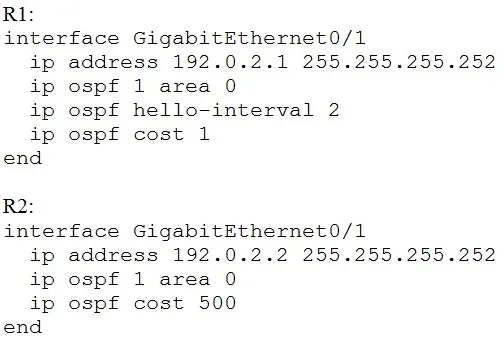
Answer: B
No source given, when the config is applied between 2 routers: *Sep 25 13:36:55.438: %OSPF-5-ADJCHG: Process 1, Nbr 4.4.4.4 on GigabitEthernet0/0 from FULL to DOWN, Neighbor Down: Dead timer expired When you set the hello the dead is automatically changed to 4x the hello: Timer intervals configured, Hello 2, Dead 8 The other side is default (Hello of 10s) hence sends it too late every time. B is correct
Source: Adapted from community discussion — TheNetworkStudent
Refer to the exhibit.
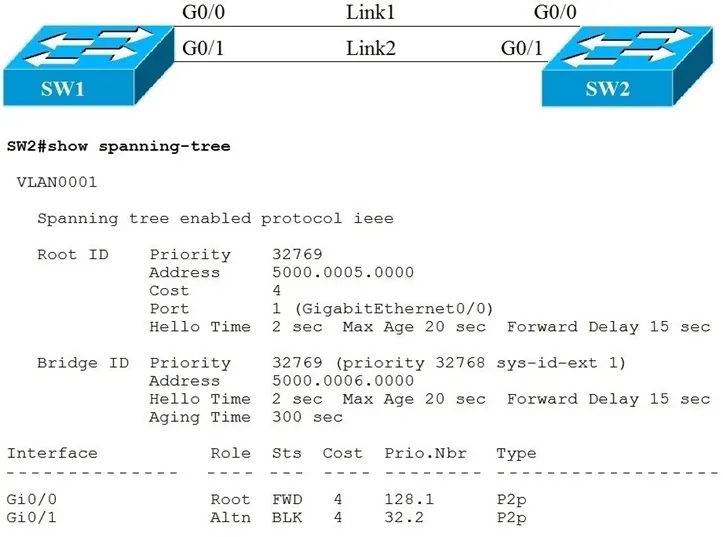
Link1 is a copper connection and Link2 is a fiber connection. The fiber port must be the primary port for all forwarding. The output of the show spanning-tree command on SW2 shows that the fiber port is blocked by spanning tree. An engineer enters the spanning-tree port-priority 32 command on G0/1 on SW2, but the port remains blocked. Which command should be entered on the ports that are connected to Link2 to resolve the issue?
Answer: B
B is correct. whenever a tie happens on two ports that receiving the same advertised cost and want to choose the RP , the port that is receiving the bpdu from the upstream switch port with lower priority will win the race and will becom the root port. so, in order to change the root port on SW2 you have to lower the port priority on switch 1.
Source: Adapted from community discussion — rezavage
When a wired client connects to an edge switch in a Cisco SD-Access fabric, which component decides whether the client has access to the network?
Answer: B
poor question if asked that way since both are technically correct (B & C). ISE is of course a radius server, and you can leverage a third party radius server + ISE for SDA. If they had used creative wording then maybe they were trying to trick you, you can't run SDA with only a third party radius server, you still need ISE. ex. https://community.cisco.com/t5/networking-documents/how-to-use-group-based-policies-with-3rd-party-radius-using/ta-p/3930041
Source: Adapted from community discussion — P1Z7C
Which behavior can be expected when the HSRP version is changed from 1 to 2?
Answer: C
Option C is correct - Even though HSRP version 2 uses the new IP multicast address 224.0.0.102 to send hello packets instead of the multicast address of 224.0.0.2, used by HSRP version 1; when the HSRP version is changed, each group will reinitialize because it now has a new virtual MAC address.
Source: Adapted from community discussion — Sparks026
Refer to the exhibit.
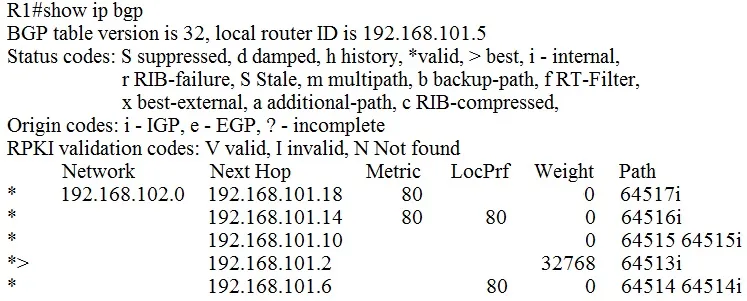
Which IP address becomes the active next hop for 192.168.102.0/24 when 192.168.101.2 fails?
Answer: D
An empty LocPrf is set at 100, the highest number wins for next hop selection. So the two values of 80 for LocPrf can be ignored. That means you can thow away .6 and .14. This leaves .18 and .10 Next look at the Path. Shortest path wins! Between .18 and .10, .18 has a shorter path, 64517i vs 64515 64515i The right answer is D
Source: Adapted from community discussion — DJOHNR
Which PAgP mode combination prevents an EtherChannel from forming?
Answer: D
Reference: https://www.omnisecu.com/cisco-certified-network-associate-ccna/etherchannel-pagp-and-lacp-modes.php
Source: Adapted from community discussion — skh
If a VRRP master router fails, which router is selected as the new master router?
Answer: B
https://www.cisco.com/assets/sol/sb/Switches_Emulators_v2_3_5_xx/help/350_550/index.html#page/tesla_350_550_olh/ts_vrrp_18_09.html In the “Basic VRRP Topology” figure, if Router A, the virtual router master, fails, a selection process takes place to determine if virtual router backups B or C must take over. If Routers B and C are configured with the priorities of 101 and 100, respectively, Router B is elected to become virtual router master because it has the higher priority. If both have the same priority, the one with the higher IP address value is selected to become the virtual router master.
Source: Adapted from community discussion — edg
Keyboard:J Kmove between questionsA–Dselect an answerRshow or hide the answer← →change page
350-401 practice, question 81. 1003 questions available.
Version 1.0.0. How we source questions