You are creating a new business process flow to qualify leads. You create an action. The action is not available inside the Action Step. You need to make the action available to the Action Step. Which two steps must you perform? Each correct answer presents part of the solution. NOTE: Each correct selection is worth one point.
Show answer
Answer: AD
Explanation
Believe the correct is AD. There is no requirement for the custom action to have any steps to show-up in the BPF designer, but must it be activated.
Source: Adapted from community discussion — rrrrrrrrrrrr
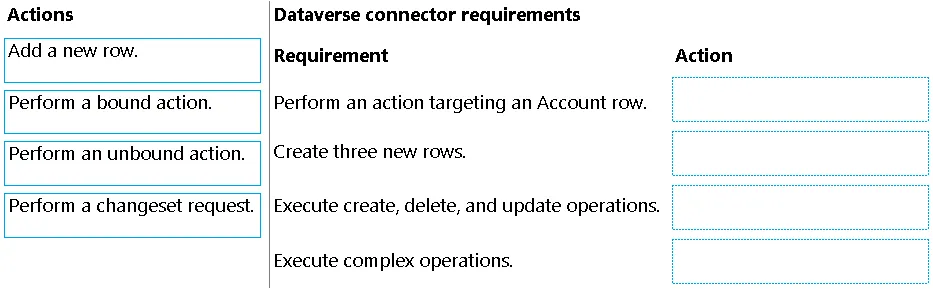
DRAG DROP - You are creating Power Automate automations targeting Dataverse. The automations must meet the following requirements: • Run a custom API created by a developer. The API performs an action against an existing Account row in the system. • Create three rows in Dataverse. If an error occurs when you create the second row, the first row must be deleted. • Run several create, update, and delete operations as part of a single transaction without writing custom code. • Run several complex operations targeting multiple rows in the system as part of a single transaction. You need to configure the actions. Which actions should you configure? To answer, move the appropriate actions to the correct requirements. You may use each action once, more than once, or not at all. You may need to move the split bar between panes or scroll to view content.
This is an interactive task on the real exam — a drag-and-drop, hotspot or ordering question. There is nothing to select here, so the answer is shown below for reference.
Show the answer figure
Answer: See figure below
Explanation
1st is Perform a bound action. 2nd, 3rd and 4th is Perform a changeset request. Because changeset request handle multiple operations and handle complex operations. https://learn.microsoft.com/en-us/power-automate/dataverse/change-set
Source: Adapted from community discussion — Evincible
DRAG DROP - A company has a business process flow that executes on the Contact table. The company requires that the steps in the flow be executed in real time when users create a new task and update the status of a Contact row. You need to implement a solution that automates the steps. Which three actions should you perform in sequence? To answer, move the appropriate actions from the list of actions to the answer area and arrange them in the correct order. NOTE: More than one order of answer choices is correct. You will receive credit for any of the correct orders you select.
This is an interactive task on the real exam — a drag-and-drop, hotspot or ordering question. There is nothing to select here, so the answer is shown below for reference.
Show the answer figure
Answer: See figure below
Explanation
Given that the company 'requires that the steps in the flow be executed...', I would opt for: - Modify the business proecss flow - Add a flow step - Create a new custom action with action steps
Source: Adapted from community discussion — Evan123123
Question 174 · 289 in bank
Select 2
This is a case study. Case studies are not timed separately. You can use as much exam time as you would like to complete each case. However, there may be additional case studies and sections on this exam. You must manage your time to ensure that you are able to complete all questions included on this exam in the time provided. To answer the questions included in a case study, you will need to reference information that is provided in the case study. Case studies might contain exhibits and other resources that provide more information about the scenario that is described in the case study. Each question is independent of the other questions in this case study. At the end of this case study, a review screen will appear. This screen allows you to review your answers and to make changes before you move to the next section of the exam. After you begin a new section, you cannot return to this section. To start the case study - To display the first question in this case study, click the Next button. Use the buttons in the left pane to explore the content of the case study before you answer the questions. Clicking these buttons displays information such as business requirements, existing environment, and problem statements. If the case study has an All Information tab, note that the information displayed is identical to the information displayed on the subsequent tabs. When you are ready to answer a question, click the Question button to return to the question. Background - ADatum Corporation provides verification and investigation services that are used by insurance companies, law firms, and other organizations in the public sector. Services include verifying an individual’s background, qualifications, and specific scenarios that require onsite visit. The thorough work ADatum Corporation performs results in highly accurate cases with minimal critical information missing. Because of these high-quality results, ADatum Corporation is quickly proving itself as one of the best in the industry. In recent months, business has significantly increased, with most new business coming from high-profile companies and individuals. Management has decided to create a new qualification verification (QV) role to help ensure that clients get the most accurate results. This role examines completed work to ensure that nothing is missed. Current environment - Data storage and retention - • All information sent by clients for services is stored in Microsoft Dataverse with a model-driven app as the interface. • Clients enter their data in a website, which then uses a service account to create the records in the Dataverse database. • Team members currently have full access to all Service Request records. Service requests - • The Service Request table includes header information about the individual or organization that is the subject of verification. • New Service Request records are assigned to a queue. All potential users who will be performing the verifications have access to these records. • A service request is assigned to a single user who will ensure that all qualifications are verified. This single user is the only one able to process Qualification records related to their own service requests. • Many required tasks when performing verification services are currently done by using manual processes. • To keep up with demand, ADatum Corporation identifies several processes that can be replaced by using Power Automate flows to hire fewer new staff and keep costs down. Qualification verification - • The qualification table contains details about an individual school degree, professional qualifications, and other qualifications that must be verified. • A service request can have one or more Qualification records associated with it. • Record status is pending verification until the initial team member finishes, at which point the member changes the status to Complete. • When all qualification records related to a service request are verified either by manual or automated processes, the results are made available to ADatum Corporation’s client. • In the rare event that results are questioned, a new service request is created and verified independently of the previous work that took place. • To complete a service request, users perform the following actions: o Send a templated email by using Microsoft Outlook to the client after all qualifications for a service request are checked. o Change the service request status to Completed. Currently, service requests do not indicate when all Qualification records are addressed. Microsoft Power platform environment • The following environments exist: development, testing, user acceptance testing (UAT), and production. • Managed solutions are used to move customizations from the development environment to other higher-level environments. These solutions are created and maintained by the power users and provided to internal IT for deployment when they are ready. • Two managed solutions, Verification Process Automation and Onsite Visit, share several components. • All customizations to Power Platform components are performed by several power users who have received training and are certified as subject matter experts. • Power users have been granted the System Administrator security role in the development environment. • Corporate policy prohibits power users from writing code due to lack of a formal code review process. • Internal IT will not be able to supply any development resources for this project due to a lack of staff. This means that any customizations and automation created for this project must be low-code/no-code for the power users to implement them. • Customizations created by power users are deployed by internal IT. Requirements - Process automation - ADatum Corporation plans to establish a new QV department to verify completed work so that the quality of work is maintained. The new process for verifying professional qualifications must automate the following: • Enter data and navigate the authority’s website. The authority website UI changes frequently because the company constantly improves the user experience. • Search page contents for a specified value to determine validity. • Update the corresponding Qualification record in Dataverse. The new process for completing a service request must automate the following: • Set the Service Request record status to Complete when work on all Qualification records is finished. • Send an email to the client with the results when the service request is completed. The email must list each qualification as either Valid or Not Valid, depending on the verification. Qualification verification - • Service request results will not be released to clients until all related Qualification records are set to a Complete status. • To check work done by a wide array of users, 10 percent of Qualification records must be double checked. • Qualification records must be automatically assigned to a queue. • Qualification records must be flagged with a new status field named Assigned to ensure that records are rechecked. • Ensure that only QV team members can change the status from Assigned to In Progress to Complete. • Record the name of the QV team member who performed the work and the date completed. Governance and security - • All components required for the verification process must be included in a new solution. • Corporate security requires that deployments to non-development environments must be automated using service accounts. • User security and data access must also be consistent across environments, except for the elevated access of the power users in the development environment. • The Onsite Visit managed solution has a table that is not in the Verification Process Automation managed solution. This table must be upgraded prior to the go-live date without the other shared components. • A VP of sales requires a test environment to demonstrate to potential clients the security policies that are included in their initial offering. Issues - • More employees than are required can access individual client information and continue to have access after a service request is completed. • When users go on vacation, all their outstanding Service Request records are assigned to a substitute employee. The substitute employees are unable to see all the qualifications related to their service requests. • Currently, testing the new QV functionality outside the development environment is not possible due to corporate security policies requiring the same security role across all environments. • Internal IT reports that the solution import to the test environment failed because of missing dependencies related to the flow for completing service requests. You need to create the automation for the qualification verification process. Which two actions should you perform? Each correct answer presents a complete solution. NOTE: Each correct selection is worth one point.
Show answer
Answer: AB
Explanation
To create the automation for the qualification verification process, you should perform the following actions: A. Add a Dataverse connector: This will allow you to interact with the Dataverse to update the Qualification records based on the verification results. B. Add an Outlook connector: This will enable you to send templated emails to clients after all qualifications for a service request are checked and the service request status is set to Complete.
Source: Adapted from community discussion — 33a7f9e
Question 175 · 289 in bank
DRAG DROP - A company is using the Account table and a main form named Account Main. The company defines the following requirements for the Account Main form: • Evaluate a single value selected as part of a drop-down list. • Display a message and suggestion based on business intelligence if the drop-down list value equals a specific value. • Logic must run against this form only. You need to implement the logic. Which four actions should you perform in sequence? To answer, move the appropriate actions from the list of actions to the answer area and arrange them in the correct order. NOTE: More than one order of answer choices is correct. You will receive credit for any of the correct orders you select.
This is an interactive task on the real exam — a drag-and-drop, hotspot or ordering question. There is nothing to select here, so the answer is shown below for reference.
Show the answer figure
Answer: See figure below
Explanation
The first step should be 'Create a choice column' not 'Create a choices column'. Choice fields allow a single value to be selected, Choices fields are multi select. The question states 'Evaluate a single value selected...'.
Source: Adapted from community discussion — Ginge
Question 176 · 289 in bank
A company creates a Power Automate cloud flow for a Power Apps app. The cloud flow must send an email to each active contact. You need to configure the flow. Which feature should you use?
Show answer
Answer: B
Question 177 · 289 in bank
You are creating a cloud flow for an automation targeting Dataverse. When a new account is created in Dataverse, the name of the account must be updated based on the following logic: • If the Account Category Code equals Preferred Customer (1), pre append the value Preferred | to the name. • If the Account Category Code equals Standard (2) or is not populated, pre-append Standard | to the name. You need to define the correct formula to use for the automation. Which formula should you use?
Show answer
Answer: A
Explanation
A. if(equals(triggerOutputs()?['body/accountcategorycode'], 1), concat('Preferred | ', triggerOutputs()?['body/name']), concat('Standard | ', triggerOutputs()?['body/name'])) To define the correct formula for your automation targeting Dataverse, you should use the following logic: If the Account Category Code equals Preferred Customer (1), pre-append the value "Preferred | " to the name. If the Account Category Code equals Standard (2) or is not populated, pre-append "Standard | " to the name.
Source: Adapted from community discussion — 5f14337
Question 178 · 289 in bank
A cloud flow you authored failed several times in production due to a transient network issue. The issue is now resolved. You need to reprocess the failed flow runs with the least amount of administrative effort. What should you do?
You are creating a Power Automate cloud flow. The cloud flow will create several SharePoint Online list items based on a variety of conditions. If any of the dependent SharePoint Online actions fail, you must revert the changes while the automation runs. You need to design the cloud flow to meet the requirement. Which two actions should you implement for the design? Each correct answer presents part of the solution. NOTE: Each correct selection is worth one point.
Show answer
Answer: AB
Explanation
A. Add a scope: Scopes are used to group actions together. This allows you to control the execution of a set of actions collectively and handle the success or failure of the entire group. By grouping actions within a scope, you can easily implement rollback logic if any action within the scope fails. B. Set Run After to Has failed: By setting the "Run After" condition to "Has failed" for specific actions, you can define actions that should run only if a preceding action fails. This is useful for implementing rollback logic, such as deleting items that were created if subsequent actions fail. C. Perform a changeset request action: Changesets are used in some contexts to batch requests, but this is not directly related to handling failure and rollback logic in a cloud flow with SharePoint actions. D. Retrigger the flow run: Retriggering the flow would start the entire process again, but it doesn't directly help in reverting changes that have already been made in the current run.
Source: Adapted from community discussion — 5f14337
Question 180 · 289 in bank
Case Study - This is a case study. Case studies are not timed separately. You can use as much exam time as you would like to complete each case. However, there may be additional case studies and sections on this exam. You must manage your time to ensure that you are able to complete all questions included on this exam in the time provided. To answer the questions included in a case study, you will need to reference information that is provided in the case study. Case studies might contain exhibits and other resources that provide more information about the scenario that is described in the case study. Each question is independent of the other questions in this case study. At the end of this case study, a review screen will appear. This screen allows you to review your answers and to make changes before you move to the next section of the exam. After you begin a new section, you cannot return to this section. To start the case study - To display the first question in this case study, click the Next button. Use the buttons in the left pane to explore the content of the case study before you answer the questions. Clicking these buttons displays information such as business requirements, existing environment, and problem statements. If the case study has an All Information tab, note that the information displayed is identical to the information displayed on the subsequent tabs. When you are ready to answer a question, click the Question button to return to the question. Background - Contoso Suites is an animal shelter that specializes in finding homes for dogs that have been given up by their owners. The shelter can house up to 20 dogs. The shelter is implementing one model-driven Power Apps app to track the dogs and schedule meetings with potential adopters. No other apps will be created. The model-driven app uses Dataverse with out-of-the-box functionality when possible. Dataverse is set up with the following configuration: • The solution prefix “cs” is used for all new components. • Only the root business unit is used. • All tables are stored in Dataverse and do not require rapid scaling. • Exchange server-side sync is not configured. Adopters - • Adopter information is stored in a Contact table. • Contacts are considered to be duplicates if they have the same email address and last name. • Adopters are often late to meetings, so a reminder email is sent to them two hours before their meeting. • The email reminders must not be tracked in the system. Dogs - • Dog information is stored in a Dog table, which is organization owned. • Breed, size, and weight are fields in the table. Dog residency - • A Resident table tracks the stay of each dog. • Each resident record has a lookup for the dog and its food. • The food type and amount are logged on each resident record. Auto-posting is not configured for changes to food type and amount. • A fee of $120 is in a currency column named Adoption Fee. This fee can be changed depending on the adoption circumstances. • A formula column named Deposit is automatically populated with 20% of the adoption fee. • A resident record is generated automatically when a dog record is created. This is the only way a resident record can be created. Exercise and feedings - • Exercise for the dogs is tracked in an Exercise table. • Feedings are tracked in a Feeding table. • Exercise and feeding records appear in a resident record timeline. Care staff - • The care staff must be able to view who changed the food type and the amount that was given, for up to three months ago. • The staff must be able to update the weight of a dog on the resident record. • The staff report that the buttons are too small on the touch screen they use to log exercise and feeding. • The staff must be able to view who the adopters are for upcoming meetings. The staff must not be able to update adopter information. Administrative staff - • Administrative staff must receive a weekly list of duplicate contacts. Duplicate alerts must not appear when a staff member saves a new contact. • When an adopter wants to adopt a dog, the staff must perform a series of adoption duties in order. The following duty list must be displayed on the screen: o Commitment: - Obtain adopter signature in a commitment document. - Collect deposit. o Pre-pickup: - Document spay or neutering date. - Perform spay or neutering. - Document pickup date. o Pickup: - Collect full payment. - Verify dog is picked up. o A dog must be picked up no sooner than two days after spaying or neutering. o A pop-up window must appear with an error message if the Pickup date is too soon. o Only administrative staff must be able to add new adopters and dogs. You need to create adoption duties for the administrative staff. What should you create?
Show answer
Answer: B
Explanation
The best choice for creating adoption duties for the administrative staff is A. A business process flow, as it provides the needed structure and guidance for completing tasks in the required order.
Source: Adapted from community discussion — mujib5march
Keyboard:J Kmove between questionsA–Dselect an answerRshow or hide the answer← →change page