Question 331 · 496 in bank
You have an Azure subscription named Subscription1. You deploy a Linux virtual machine named VM1 to Subscription1. You need to monitor the metrics and the logs of VM1. What should you use?
Show answer
Answer: C
Microsoft Azure Security Technologies496 questions across 50 pages are complete and free, with no account or card.
496 questions in this bank
Free access · progress saved on this device
You have an Azure subscription named Subscription1. You deploy a Linux virtual machine named VM1 to Subscription1. You need to monitor the metrics and the logs of VM1. What should you use?
Answer: C
You have an Azure subscription that contains a resource group named RG1 and a security group named ServerAdmins. RG1 contains 10 virtual machines, a virtual network named VNET1, and a network security group (NSG) named NSG1. ServerAdmins can access the virtual machines by using RDP. You need to ensure that NSG1 only allows RDP connections to the virtual machines for a maximum of 60 minutes when a member of ServerAdmins requests access. What should you configure?
Answer: B
B is the answer. https://learn.microsoft.com/en-us/azure/defender-for-cloud/just-in-time-access-usage#enable-jit-on-your-vms-from-microsoft-defender-for-cloud For each port, you can set the: - Protocol - The protocol that is allowed on this port when a request is approved - Allowed source IPs - The IP ranges that are allowed on this port when a request is approved - Maximum request time - The maximum time window during which a specific port can be opened
Source: Adapted from community discussion — zellck
HOTSPOT - You have an Azure subscription named Subscription1 that contains the resources shown in the following table.

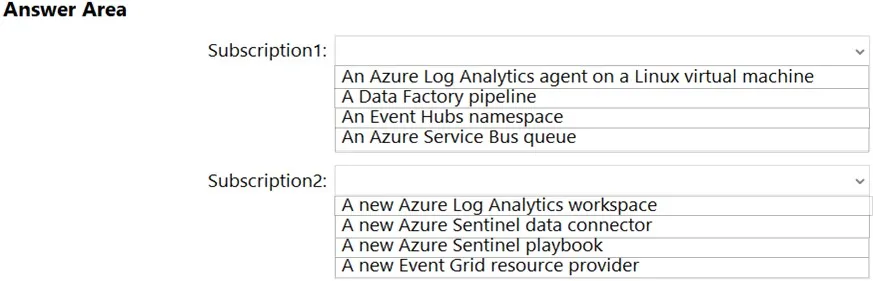
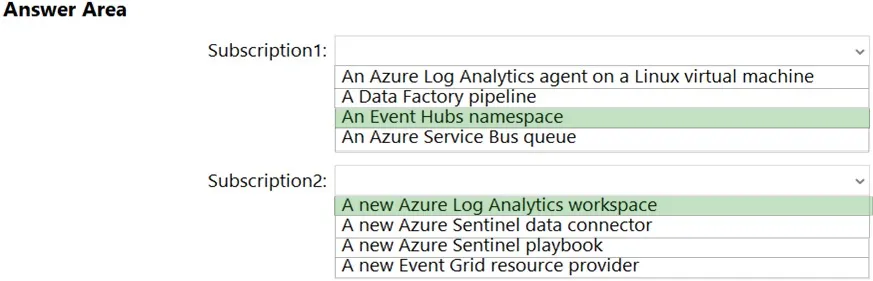
You have an Azure subscription named Subscription2 that contains the following resources: ✑ An Azure Sentinel workspace ✑ An Azure Event Grid instance You need to ingest the CEF messages from the NVA1 to Azure Sentinel. What should you configure for each subscription? To answer, select the appropriate options in the answer area. NOTE: Each correct selection is worth one point. Hot Area:
This is an interactive task on the real exam — a drag-and-drop, hotspot or ordering question. There is nothing to select here, so the answer is shown below for reference.
Answer: See figure below
CEF= Linux VM Hence answer is An Azure Log Analytics agent on a Linux virtual machine Sentinel Connector Link: https://learn.microsoft.com/en-us/azure/sentinel/connect-common-event-format
Source: Adapted from community discussion — Pamban
HOTSPOT - You have an Azure subscription named Subscription1 that contains a resource group named RG1 and a user named User1. User1 is assigned the Owner role for RG1. You create an Azure Blueprints definition named Blueprint1 that includes a resource group named RG2 as shown in the following exhibit.
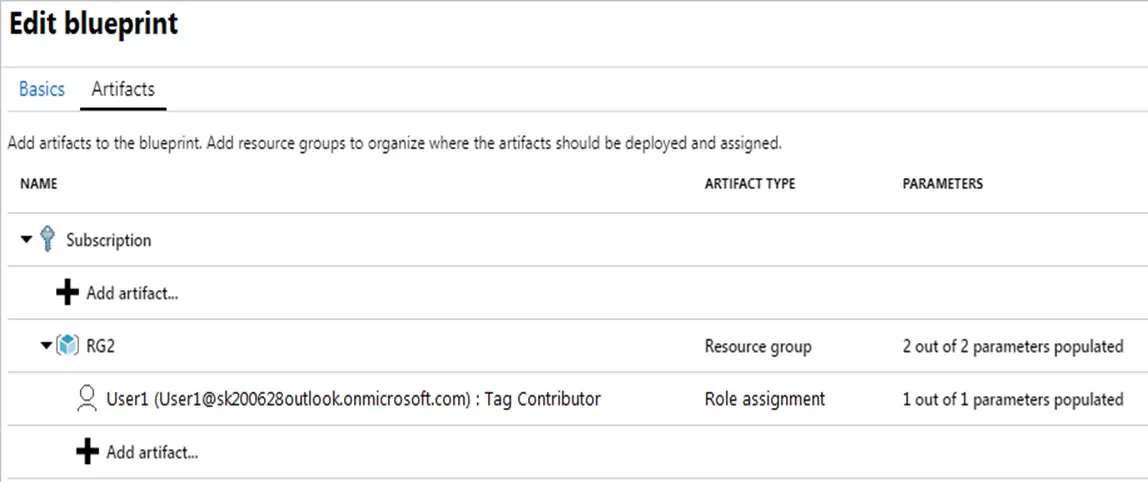
You assign Blueprint1 to Subscription1 by using the following settings: ✑ Lock assignment: Read Only ✑ Managed Identity: System assigned For each of the following statements, select Yes if the statement is true. Otherwise, select No. NOTE: Each correct selection is worth one point. Hot Area:

This is an interactive task on the real exam — a drag-and-drop, hotspot or ordering question. There is nothing to select here, so the answer is shown below for reference.
Answer: See figure below
Reference: https://docs.microsoft.com/en-us/azure/governance/blueprints/concepts/resource-locking
Source: Adapted from community discussion — Daniel9527

You have an Azure Sentinel deployment. You need to create a scheduled query rule named Rule1. What should you use to define the query rule logic for Rule1?
Answer: D
You have an Azure subscription named Subscription1 that contains a resource group named RG1 and the users shown in the following table.

You perform the following tasks: ✑ Assign User1 the Network Contributor role for Subscription1. ✑ Assign User2 the Contributor role for RG1. To Subscription1 and RG1, you assign the following policy definition: External accounts with write permissions should be removed from your subscription. What is the Compliance State of the policy assignments?
Answer: A
A is the answer. https://learn.microsoft.com/en-us/azure/role-based-access-control/built-in-roles#contributor Grants full access to manage all resources, but does not allow you to assign roles in Azure RBAC, manage assignments in Azure Blueprints, or share image galleries. https://learn.microsoft.com/en-us/azure/role-based-access-control/built-in-roles#network-contributor Lets you manage networks, but not access to them.
Source: Adapted from community discussion — zellck
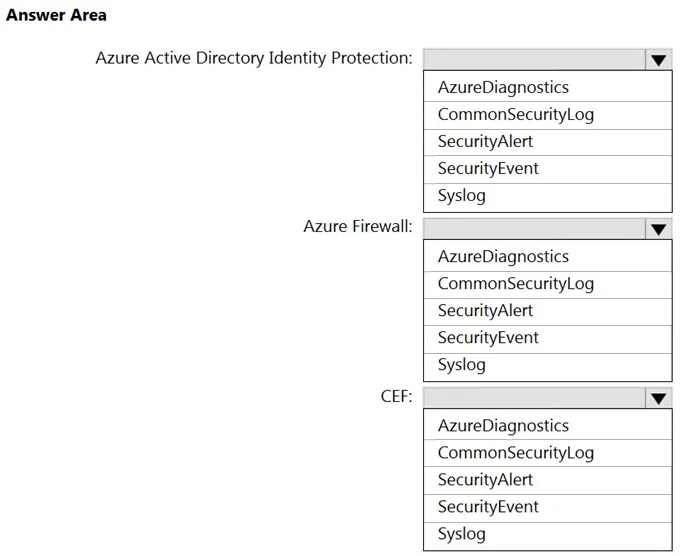
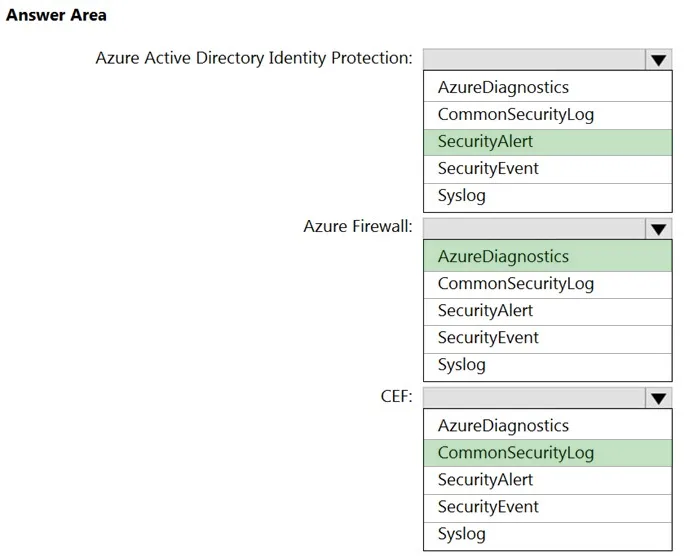
HOTSPOT - You have an Azure Sentinel workspace that has the following data connectors: ✑ Azure Active Directory Identity Protection ✑ Common Event Format (CEF) Azure Firewall -

You need to ensure that data is being ingested from each connector. From the Logs query window, which table should you query for each connector? To answer, select the appropriate options in the answer area. NOTE: Each correct selection is worth one point. Hot Area:
This is an interactive task on the real exam — a drag-and-drop, hotspot or ordering question. There is nothing to select here, so the answer is shown below for reference.
Answer: See figure below
Reference: https://docs.microsoft.com/en-us/azure/sentinel/connect-azure-ad-identity-protection https://docs.microsoft.com/en-us/azure/sentinel/connect-azure-firewall https://docs.microsoft.com/en-us/azure/sentinel/connect-data-sources
Source: Adapted from community discussion — zellck
You have 10 on-premises servers that run Windows Server 2019. You plan to implement Azure Security Center vulnerability scanning for the servers. What should you install on the servers first?
Answer: A
A is the answer. https://learn.microsoft.com/en-us/azure/azure-arc/servers/overview#supported-cloud-operations When you connect your machine to Azure Arc-enabled servers, you can perform many operational functions, just as you would with native Azure virtual machines. Below are some of the key supported actions for connected machines. - Protect non-Azure servers with Microsoft Defender for Endpoint, included through Microsoft Defender for Cloud, for threat detection, for vulnerability management, and to proactively monitor for potential security threats. https://learn.microsoft.com/en-us/azure/defender-for-cloud/deploy-vulnerability-assessment-defender-vulnerability-management#availability Machine types: - Azure virtual machines - Azure Arc-enabled machines
Source: Adapted from community discussion — zellck
HOTSPOT - You have an Azure subscription that contains three storage accounts, an Azure SQL managed instance named SQL1, and three Azure SQL databases. The storage accounts are configured as shown in the following table.

SQL1 has the following settings: ✑ Auditing: On ✑ Audit log destination: storage1 The Azure SQL databases are configured as shown in the following table.

For each of the following statements, select Yes if the statement is true. Otherwise, select No. NOTE: Each correct selection is worth one point. Hot Area:

This is an interactive task on the real exam — a drag-and-drop, hotspot or ordering question. There is nothing to select here, so the answer is shown below for reference.
Answer: See figure below
Reference: https://docs.microsoft.com/en-us/azure/azure-sql/managed-instance/auditing-configure https://docs.microsoft.com/en-us/azure/azure-sql/database/auditing-overview
Source: Adapted from community discussion — xavi1

You have an Azure subscription name Sub1 that contains an Azure Policy definition named Policy1. Policy1 has the following settings: ✑ Definition location: Tenant Root Group ✑ Category: Monitoring You need to ensure that resources that are noncompliant with Policy1 are listed in the Azure Security Center dashboard. What should you do first?
Answer: B
If I understood correctly this goal is accomplishled by adding a policy to a custom initiative, then the non-compliant resources could be displayed on the dashboard. See: https://docs.microsoft.com/en-us/azure/defender-for-cloud/custom-security-policies "you can add your own custom initiatives. You'll then receive recommendations if your environment doesn't follow the policies you create. Any custom initiatives you create will appear alongside the built-in initiatives in the regulatory compliance dashboard." In my opinion the option D is wrong as the policy has been already assigned (to Tenant Root Group) - "As discussed in the Azure Policy documentation, when you specify a location for your custom initiative, it must be a management group or a subscription."
Source: Adapted from community discussion — licna
Keyboard:J Kmove between questionsA–Dselect an answerRshow or hide the answer← →change page
AZ-500 practice, question 331. 496 questions available.
Version 1.0.0. How we source questions