Question 241 · 334 in bank
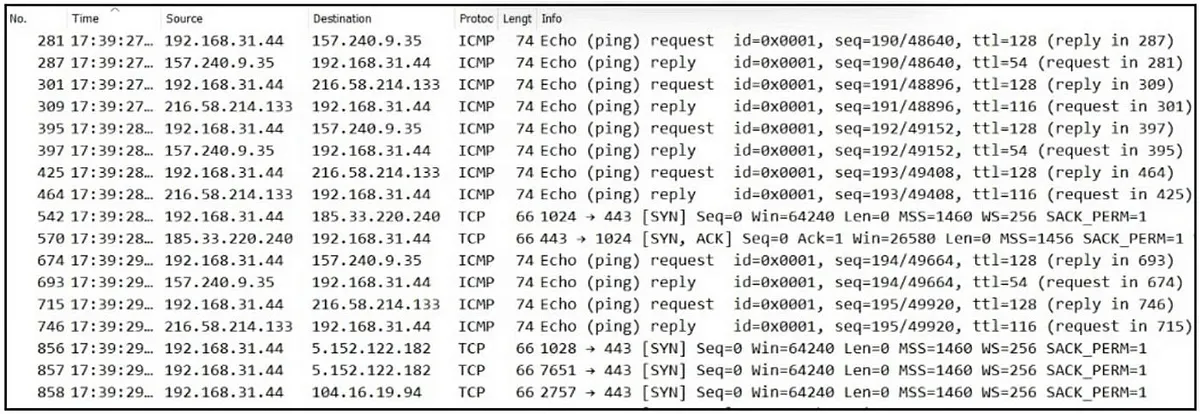
Refer to the exhibit. What is occurring in this network traffic?
Show answer
Answer: D
Understanding Cisco Cybersecurity Operations Fundamentals (CBROPS)334 questions across 34 pages are complete and free, with no account or card.
334 questions in this bank
Free access · progress saved on this device
Refer to the exhibit. What is occurring in this network traffic?
Answer: D
An analyst performs traffic analysis to detect data exfiltration and identifies a high frequency of DNS requests in a small period of time. Which technology makes this behavior feasible?
Answer: D
In the context of detecting data exfiltration, tunnels can be used to encapsulate and hide network traffic within another protocol, such as DNS. This allows attackers to transfer data out of a network without being easily detected, as DNS traffic is common and often not closely inspected for performance reasons. The high number of DNS requests in a short period of time could be indicative of an attempt at covert data exfiltration using DNS tunnels, where data is hidden within DNS traffic to avoid detection.
Source: Adapted from community discussion — KevinCondor
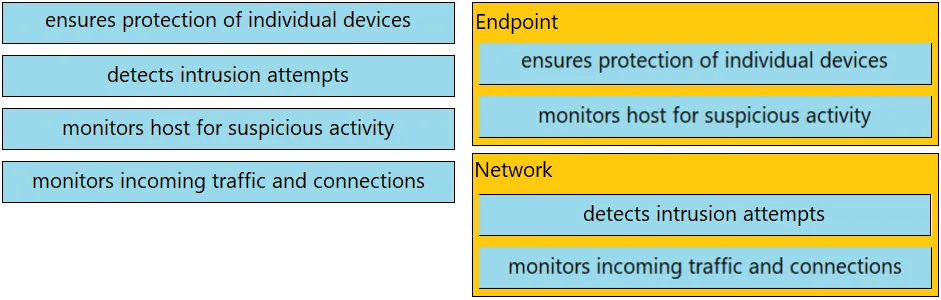
DRAG DROP - Drag and drop the uses on the left onto the type of security system on the right. Select and Place:

This is an interactive task on the real exam — a drag-and-drop, hotspot or ordering question. There is nothing to select here, so the answer is shown below for reference.
Answer: See figure below
A forensic investigator is analyzing a recent breach case. An external USB drive was discovered to be connected and transmitting the data outside of the organization, and the owner of the USB drive could not be identified. Video surveillance shows six people during a two-month period had close contact with the affected asset. How must this type of evidence be categorized?
Answer: D
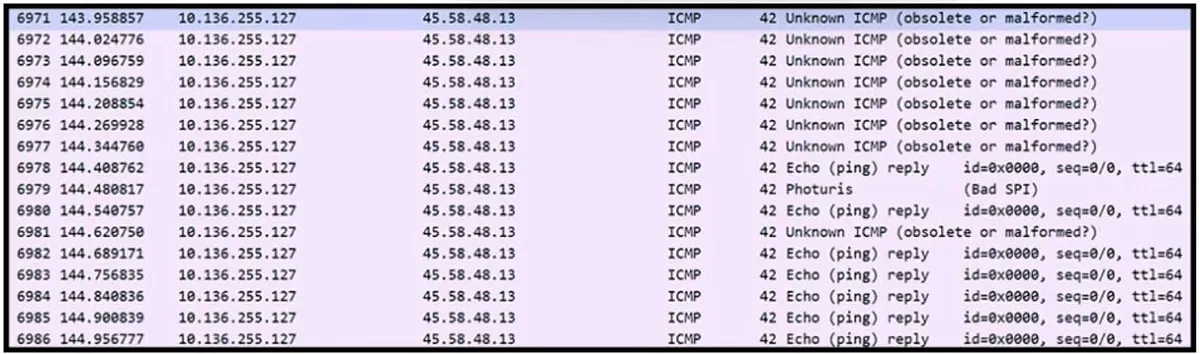
Refer to the exhibit. An engineer received a ticket to analyze unusual network traffic. What is occurring?
Answer: C
Answer should be C considering that its the same Source and Destination IP's along with the ICMP protocol being continuously used.
Source: Adapted from community discussion — cecb9b9
What is a benefit of agent-based protection when compared to agentless protection?
Answer: C
Answer is C. Host-based antivirus protection is also known as agent-based. Agent-based antivirus runs on every protected machine. Agentless antivirus protection performs scans on hosts from a centralized system. Agentless systems have become popular for virtualized environments in which multiple OS instances are running on a host simultaneously. Agent-based antivirus running in each virtualized system can be a serious drain on system resources. Agentless antivirus for virtual hosts involves the use of a special security virtual appliance that performs optimized scanning tasks on the virtual hosts. An example of this is VMware’s vShield.
Source: Adapted from community discussion — skysoft
What is the difference between the rule-based detection when compared to behavioral detection?
Answer: B
Isn't the correct answer B, it says it has a predefined collection of paterns which it uses to detect the attack but as far as I know the Behavioral Detection keeps analysing the network and changes the baseline accordingly. Here (https://www.cisco.com/c/en/us/products/security/what-is-network-detection-response.html) it says "NDR solutions continuously monitor and analyze raw enterprise network traffic to generate a baseline of normal network behavior." So that would suggest that answer B is more correct because C would suggest that after the baseline is generated it doesn't change at all anymore. It also says this in the stealthwatch documentation "After the initial 7 days, Stealthwatch tracks 14 key attributes to create a rolling 28-day baseline. This baseline is the average of the daily attribute values for the past 28 days, heavily weighted for the last 7 days. Since the baseline incorporates the last seven days, these are used to represent weekly values. Therefore, the baseline includes values for the previous month, but is heavily weighted to the most recent week. " So I would really say B is the right answer.
Source: Adapted from community discussion — Leo_Visser
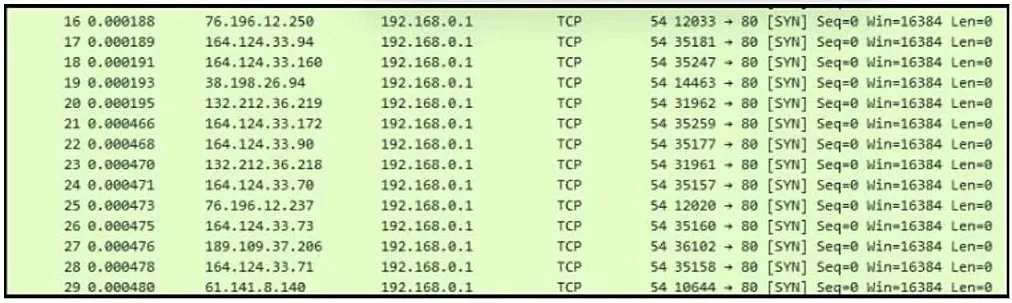
Refer to the exhibit. What is occurring?
Answer: D
The exhibit shows a series of TCP SYN packets being sent from a range of public IP addresses to a single destination, `192.168.0.1`, on port 80 (HTTP). Each connection attempt starts with a SYN flag, and no subsequent flags (such as SYN-ACK or ACK) are visible. This pattern indicates a **Denial-of-Service (DoS) attack**, specifically a **SYN flood**. In a SYN flood attack, the attacker sends a large number of SYN requests to a target but does not complete the three-way TCP handshake. This causes the target's resources to become overwhelmed by the half-open connections, potentially leading to service disruption. ### Correct Answer: **D. denial-of-service attack**
Source: Adapted from community discussion — Hellome123
What technology should be used for the verified and secure exchange of public keys between entities Tom0123456789 and Dan9876543210?
Answer: C
A security incident occurred with the potential of impacting business services. Who performs the attack?
Answer: A
Reference: https://www.paubox.com/blog/what-is-threat-actor/#:~:text=The%20term%20threat%20actor%20refers,CTA)%20when%20referencing% 20cybersecurity%20issues
Keyboard:J Kmove between questionsA–Dselect an answerRshow or hide the answer← →change page
200-201 practice, question 241. 334 questions available.
Version 1.0.0. How we source questions