Question 211 · 334 in bank
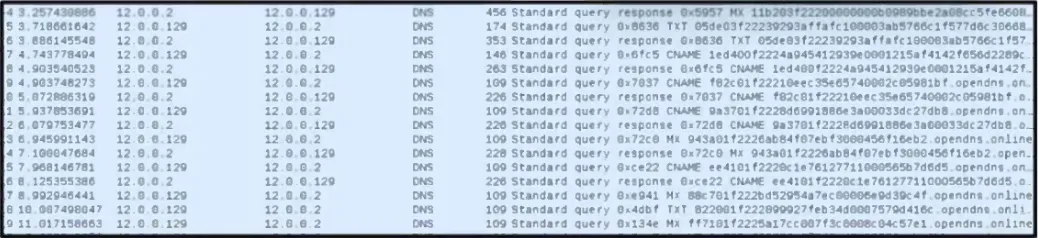
Refer to the exhibit. What is occurring?
Show answer
Answer: B
Understanding Cisco Cybersecurity Operations Fundamentals (CBROPS)334 questions across 34 pages are complete and free, with no account or card.
334 questions in this bank
Free access · progress saved on this device
Refer to the exhibit. What is occurring?
Answer: B
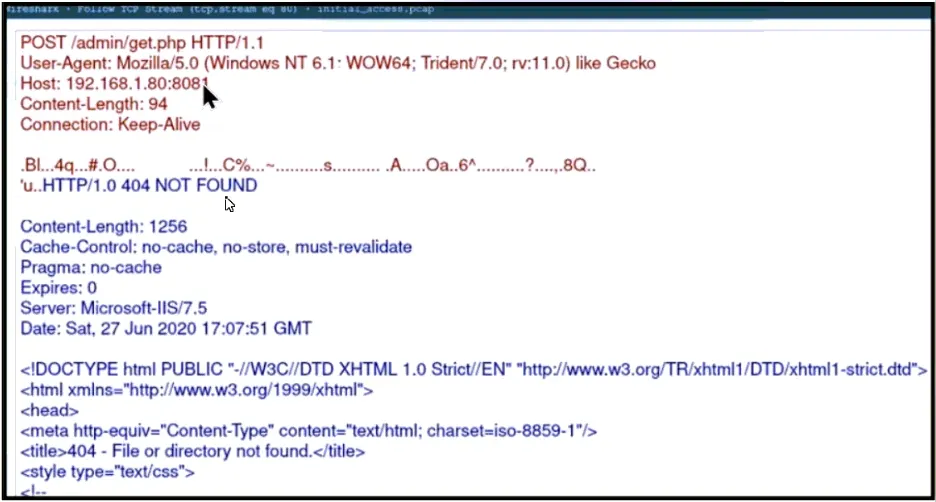
Refer to the exhibit. A security analyst received a ticket about suspicious traffic from one of the workstations. During the investigation, the analyst discovered that the workstation is communicating with an external IP The analyst was not able to investigate further and escalated the case to a T2 security analyst. What are the two data visibility challenges that the security analyst should identify? (Choose two.)
Answer: AC
What is email greylisting by the mail transfer agent?
Answer: A
greylisting is a method of defending e-mail users against spam. A mail transfer agent (MTA) using greylisting will "temporarily reject" any email from a sender it does not recognize
Source: Adapted from community discussion — c79ecd3
According to CVSS, which metric group does user interaction belong to?
Answer: C
DRAG DROP - Cisco’s Zero Trust Architecture simplifies the Zero Trust journey into three critical areas. Drag the definitions onto the graphic to describe Zero Trust from the Cisco perspective
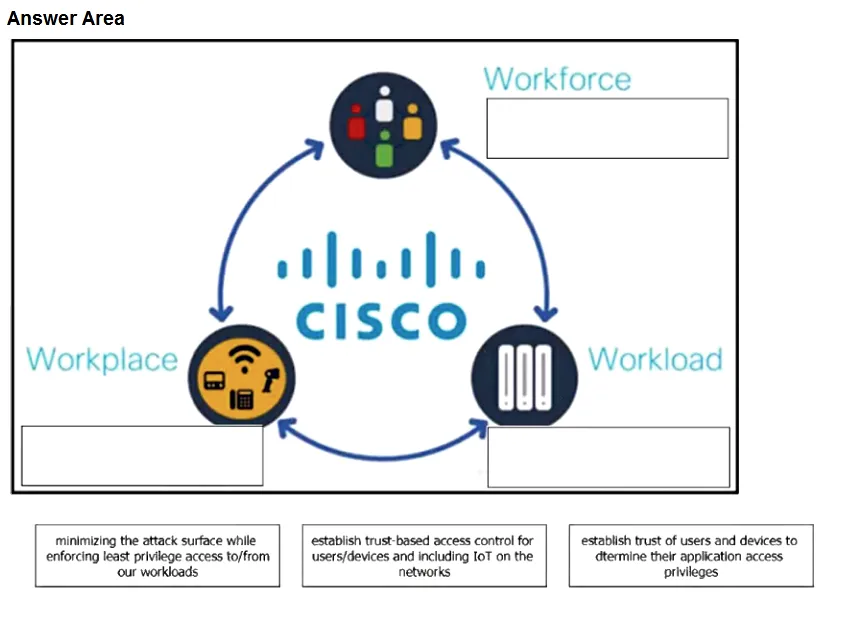
This is an interactive task on the real exam — a drag-and-drop, hotspot or ordering question. There is nothing to select here, so the answer is shown below for reference.
Answer: See figure below
Workload: Minimizing the attack surface while enforcing least privilege access to/from our workloads Workforce: Establish trust of users and devices to determine their application access privilege Workplace:On networks you control, establish trust-based access control for users/devices and including IoT
Source: Adapted from community discussion — Pif80

When trying to evade IDS/IPS devices, which mechanism allows the user to make the data incomprehensible without a specific key, certificate, or password?
Answer: C
By the Book, I believe Fragmentation would be correct. Traditional IDS and IPS devices also suffer from many evasion attacks. The following are some of the most common evasion techniques against traditional IDS and IPS devices: Fragmentation: Attackers can evade the IPS box by sending fragmented packets. Using low-bandwidth attacks: Attackers can use techniques that use low-bandwidth or a very small number of packets to evade the system. Address spoofing/proxying: Attackers can use spoofed IP addresses or sources, as well as intermediary systems such as proxies to evade inspection. Pattern change evasion: Attackers may use polymorphic techniques to create unique attack patterns. Encryption: Attackers can use encryption to hide their communication and information.
Source: Adapted from community discussion — anonymous1966
What are two types of cross site scripting attacks? (Choose two.)
Answer: CD
What is a Heartbleed vulnerability?
Answer: B
correct The Heartbleed Bug is a serious vulnerability in the popular OpenSSL cryptographic software library. This weakness allows stealing the information protected, under normal conditions, by the SSL/TLS encryption used to secure the Internet.
Source: Adapted from community discussion — RoBery
A user received a suspicious email and reported it to the SOC team. After analysis, the team concluded that it was a spear phishing attack. According to the Diamond Model, how is the phishing email categorized?
Answer: A
Capability: What skills do the attackers have to do reconnaissance, deliver their attacks, attack exploits and vulnerabilities, deploy their remote-controlled malwares and backdoors, and develop their tools?
Source: Adapted from community discussion — c79ecd3
An engineer must investigate suspicious connections. Data has been gathered using a tcpdump command on a Linux device and saved as sandboxmalware2022-12-22.pcaps file. The engineer is trying to open the tcpdump in the Wireshark tool. What is the expected result?
Answer: D
Linux based machines does not "read" after . characters like extensions (we write them just for human semplicity). The file type remains pcap for the machine, so it will be open.
Source: Adapted from community discussion — ciola89
Keyboard:J Kmove between questionsA–Dselect an answerRshow or hide the answer← →change page
200-201 practice, question 211. 334 questions available.
Version 1.0.0. How we source questions