Question 991 · 1003 in bank
How does a Type 2 hypervisor function?
Show answer
Answer: C
Implementing Cisco Enterprise Network Core Technologies (ENCOR)1,003 questions across 101 pages are complete and free, with no account or card.
1003 questions in this bank
Free access · progress saved on this device
How does a Type 2 hypervisor function?
Answer: C
Which element is unique to a Type 2 hypervisor?
Answer: C
It is oddly worded. It should be "Which element is unique in a Type 2 hypervisor vs a Type 1 hypervisor." Answer is C From MS Co-Pilot A key element unique to a Type 2 hypervisor is the host operating system. Type 2 hypervisors run on top of an existing OS, which serves as the intermediary layer between the hypervisor and the underlying hardware. This contrasts with Type 1 hypervisors, which run directly on the hardware without requiring a host OS, providing direct access to physical resources.
Source: Adapted from community discussion — Taskmaster79
How do OSPF and EIGRP compare?
Answer: C
What do Chef and Ansible have in common?
Answer: B
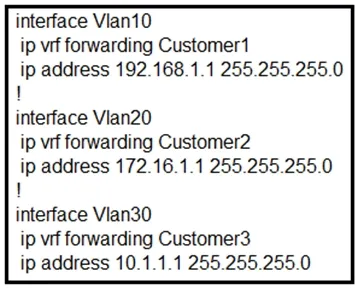
Refer to the exhibit. Which configuration allows Customer2 hosts to access the FTP server of Customer1 that has the IP address of 192.168.1.200?
Answer: A
A. ip route vrf Customer1 172.16.1.0 255.255.255.0 172.16.1.1 global ip route vrf Customer2 192.168.1.200 255.255.255.255 192.168.1.1 global ip route 192.168.1.0 255.255.255.0 Vlan10 ip route 172.16.1.0 255.255.255.0 Vlan20 B. ip route vrf Customer1 172.16.1.1 255.255.255.255 172.16.1.1 global ip route vrf Customer2 192.168.1.200 255.255.255.0 192.168.1.1 global ip route 192.168.1.0 255.255.255.0 Vlan10 ip route 172.16.1.0 255.255.255.0 Vlan20 C. ip route vrf Customer1 172.16.1.0 255.255.255.0 172.16.1.1 Customer2 ip route vrf Customer2 192.168.1.200 255.255.255.255 192.168.1.1 Customer1 D. ip route vrf Customer1 172.16.1.0 255.255.255.0 172.16.1.1 Customer1 ip route vrf Customer2 192.168.1.200 255.255.255.255 192.168.1.1 Customer2
Source: Adapted from community discussion — xziomal9

Refer to the exhibit. A client requests a new SSID that will use web-based authentication and external RADIUS servers. Which Layer 2 security mode must be selected?
Answer: B
Compatibility between L2 and L3 security methods: Static WEP (L2 security) + web authentication (L3 security) = valid WPA + WPA2 + web authentication = invalid none + web authentication = valid 802.1x + web authentication = invalid To configure the WLC for web authentication: "Click the Layer 2 tab and set the security to None" https://www.cisco.com/c/en/us/support/docs/wireless-mobility/wlan-security/71881-ext-web-auth-wlc.html#:~:text=Click%20the%20Layer%202%20tab%20and%20set%20the%20security%20to%C2%A0None https://www.cisco.com/c/en/us/support/docs/wireless/4400-series-wireless-lan-controllers/106082-wlc-compatibility-matrix.html#:~:text=are%20more%20secure).-,Wireless%20LAN%20Controller%20Layer%202%20%E2%80%93%20Layer%203%20Security%20Compatibility%20Matrix,-When%20you%20configure
Source: Adapted from community discussion — AbdullahMohammad251
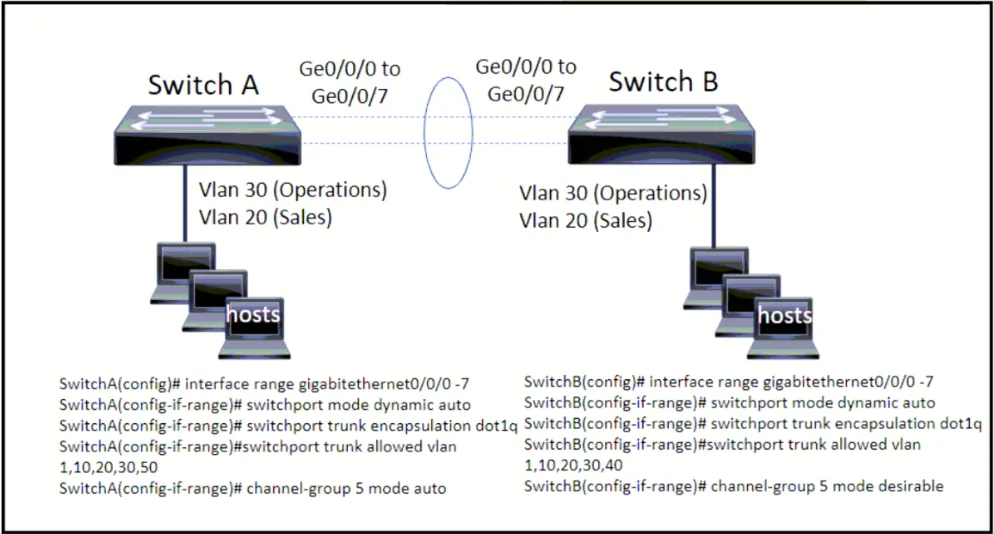
Refer to the exhibit. Users in the Operations VLAN on Switch A are unable to communicate with users in the Operations VLAN on Switch B. Which action resolves the issue?
Answer: A
C is not correct. This is because the Operations VLAN (VLAN 30) is already allowing in both switches. The switchport is not in desirable already, only the channel group. The switchport command decides if it will be in trunk or access. Desirable means it will actively try to be in trunk as long as the other side is also "desirable" or "auto." We see both A and B are in dynamic auto so one of them needs to be switched to desirable. The only answer that does that is A. A is the correct answer.
Source: Adapted from community discussion — Reavr
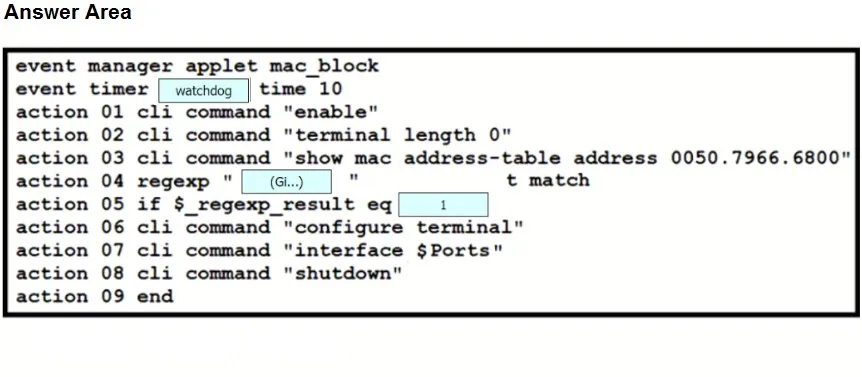
DRAG DROP - Drag and drop the snippets onto the blanks within the code to construct a script that blocks a MAC address.
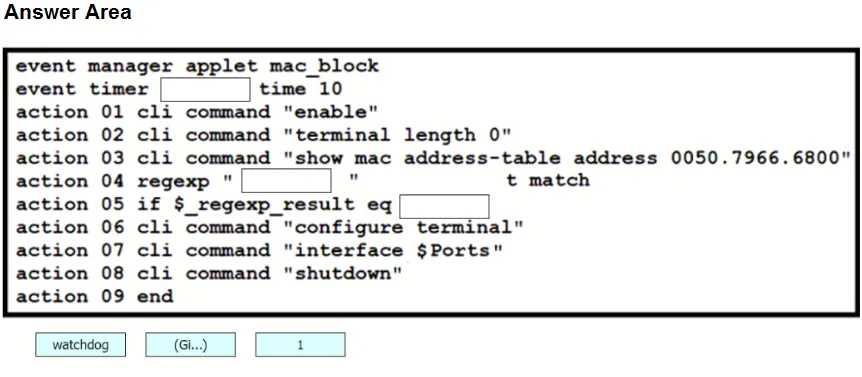
This is an interactive task on the real exam — a drag-and-drop, hotspot or ordering question. There is nothing to select here, so the answer is shown below for reference.
Answer: See figure below
A script contains the statement "while loop != 999:" Which value terminates the loop?
Answer: C
tricky question :) , pls be careful from all chatbots : The statement “while loop != 999:” creates a loop that continues executing as long as the value of the variable “loop” is not equal to 999. In other words, the loop will terminate when the value of “loop” becomes equal to 999. Therefore, the correct answer is C. A value equal to 999. When the value of “loop” reaches 999, the loop condition becomes false, and the loop stops executing.
Source: Adapted from community discussion — shefo1
Which method ensures the confidentiality of data exchanged over a REST API?
Answer: B
Keyboard:J Kmove between questionsA–Dselect an answerRshow or hide the answer← →change page
350-401 practice, question 991. 1003 questions available.
Version 1.0.0. How we source questions