Question 221 · 450 in bank
What is the traffic classification for voice and video conferencing?
Show answer
Answer: B
Implementing Cisco Collaboration Core Technologies (CLCOR)450 questions across 45 pages are complete and free, with no account or card.
450 questions in this bank
Free access · progress saved on this device
What is the traffic classification for voice and video conferencing?
Answer: B
Where would an administrator update learned patterns from the DNA UI?
Answer: C
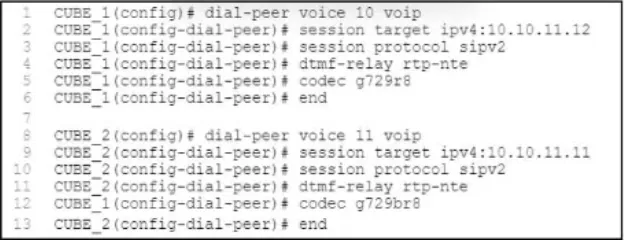
Refer to the exhibit. CUBE_1 and CUBE_2 must use the G.729r8 codec when communicating. Which action completes the configuration?

Answer: B
Question states that the call must use G.729r8, which means CUBE_2 needs to be able to "speak" G.729r8, instead of G.729br8 currently configured. The first step towards CUBE_2 supporting G.729r8 is configuring a voice class with G.729r8 as one of the options. Hence I am going with Answer B. A codec voice class is a construct within which a codec preference order can be defined. A codec voice class can then be applied to a dial peer, which then follows the preference order defined in the codec voice class. https://www.cisco.com/c/en/us/td/docs/ios-xml/ios/voice/cube/configuration/cube-book/voi-negt-aud-code.html
Source: Adapted from community discussion — MaxG

Refer to the exhibit. An engineer is integrating Cisco UCM with Cisco Unity Connection via SIP. Which two boxes should be checked to complete the configuration of the SIP trunk security profile? (Choose two.)
Answer: CE
When configuring Cisco UCM, which configuration enables phones to automatically reregister to a Cisco UCM publisher when the connection to the subscriber is lost?
Answer: D
I believe this should be D. Cisco UCM Group dictates which server to register to. SRST pertains to the router registration when all servers have failed.
Source: Adapted from community discussion — pasangawa
What is the maximum one-way latency and jitter tor voice before quality issues arise?
Answer: A

Refer to the exhibit. In Cisco UCM, an engineer must create a new SIP route pattern that must be reachable by all Internal callers. The internal callers have a calling search space named CSS_INTERNAL that includes a partition named PT_INTERNAL. The SIP trunk has a calling search space named CSS_SIP_RP that includes the two partitions named PT_SIP_INTERNAL and PT_SIP_LOCAL. What must be used as the route partition for the SIP route pattern?
Answer: D
Answer is D Routepattern or SIP Route pattern is something that is directing from CUCM to a different/outside destination - > Phone has to reach this pattern. Sip-Trunk CSS is not required at all, because SIP-Trunk only use "incoming CSS" for routing decisions Phone CSS_INTERNAL PT_INTERNAL Trunk CSS_SIP_RP PT_SIP_INTERNAL PT_SIP_LOCAL
Source: Adapted from community discussion — DaKenjee
An engineer must configure a dial plan tor a new Cisco UCM cluster. Standard local route groups must be used for all local calls. After the route pattern, route list and route groups are configured, which settings must the engineer configure for the standard local route groups?
Answer: A

Refer to the exhibit. An engineer is troubleshooting an NTP synchronization issue that returns a message of ‘unsynchronized’ when the utils ntp status command is run on the Cisco UCM subscriber node. The connectivity between the subscriber and the NTP server was verified as working, and the NTP server is running. Which action resolves the issue?

Answer: D
Definitely D. CUCM publisher needs an NTP source that is not a member of the CUCM cluster; therefore the CUCM publisher synchronizes its time with the NTP server. In this exchange, the CUCM publisher is an NTP client. The CUCM subscribers synchronize their time with the CUCM publisher. In this exchange, the CUCM publisher is an NTP server where the CUCM subscribers are NTP clients. https://www.cisco.com/c/en/us/support/docs/unified-communications/unified-communications-manager-callmanager/215537-network-time-protocol-ntp-on-cucm.html .INIT. means that initialization has not yet succeeded. Probable causes of NTP issues in CUCM: - External NTP server is not reachable. - NTP stratum is higher than the acceptable limit. - Publisher is down, so the Subscriber NTP is unsynchronized. https://www.cisco.com/c/en/us/support/docs/unified-communications/unified-communications-manager-callmanager/118718-technote-cucm-00.html
Source: Adapted from community discussion — MaxG
Keyboard:J Kmove between questionsA–Dselect an answerRshow or hide the answer← →change page
350-801 practice, question 221. 450 questions available.
Version 1.0.0. How we source questions