Question 121 · 407 in bank
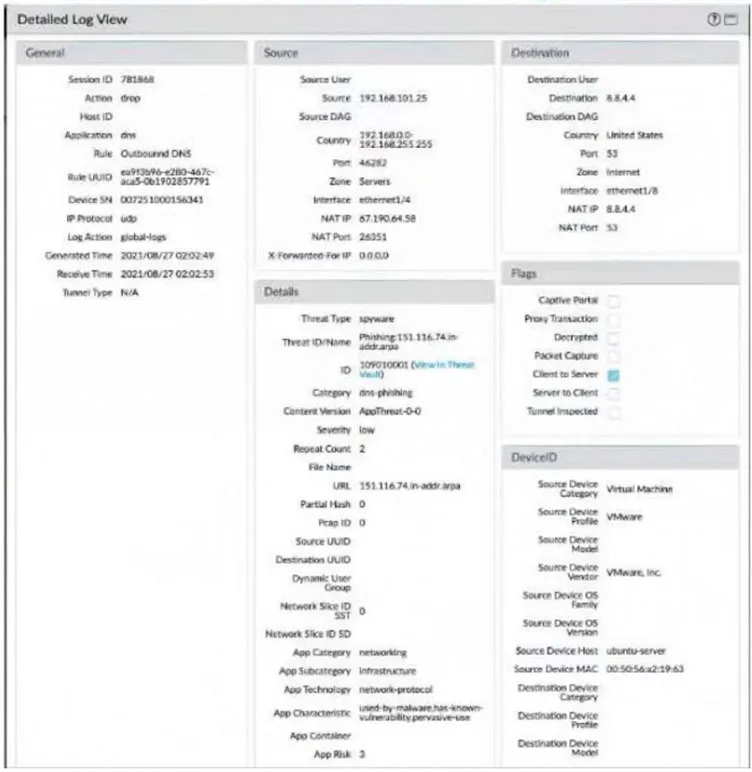
Given the detailed log information above, what was the result of the firewall traffic inspection?
Show answer
Answer: D
Palo Alto Networks Certified Network Security Administrator407 questions across 41 pages are complete and free, with no account or card.
407 questions in this bank
Free access · progress saved on this device
Given the detailed log information above, what was the result of the firewall traffic inspection?
Answer: D
An administrator wants to create a No-NAT rule to exempt a flow from the default NAT rule. What is the best way to do this?
Answer: D
What can be achieved by selecting a policy target prior to pushing policy rules from Panorama? *
Answer: B
Option B: You can specify the firewalls in a device group to which to push policy rules12. The Target tab allows you to apply the rule to specific firewalls or descendant device groups of the Device Group (or Shared location) where the rule is defined1.
Source: Adapted from community discussion — cjace
When an ethernet interface is configured with an IPv4 address, which type of zone is it a member of?
Answer: A
An administrator would like to create a URL Filtering log entry when users browse to any gambling website. What combination of Security policy and Security profile actions is correct?
Answer: C
An administrator is investigating a log entry for a session that is allowed and has the end reason of aged-out. Which two fields could help in determining if this is normal? (Choose two.)
Answer: AB
Answer: AB When monitoring the traffic logs using Monitor > logs > Traffic, some traffic is seen with the Session End Reason as aged-out. Any traffic that uses UDP or ICMP is seen will have session end reason as aged-out in the traffic log. This is because unlike TCP, there is there is no way for a graceful termination of UDP session and so aged-out is a legitimate session-end reason for UDP (and ICMP) sessions. Link: https://knowledgebase.paloaltonetworks.com/KCSArticleDetail?id=kA10g000000PMjLCAW
Source: Adapted from community discussion — Alex48694
What are three characteristics of the Palo Alto Networks DNS Security service? (Choose three.)
Answer: CDE
CDE are correct: DNS Security subscription enables users to access real-time protections using advanced predictive analytics. When techniques such as DGA/DNS tunneling detection and machine learning are used, threats hidden within DNS traffic can be proactively identified and shared through an infinitely scalable cloud service. Because the DNS signatures and protections are stored in a cloud-based architecture, you can access the full database of ever-expanding signatures that have been generated using a multitude of data sources. This list of signatures allows you to defend against an array of threats using DNS in real-time against newly generated malicious domains. To combat future threats, updates to the analysis, detection, and prevention capabilities of the DNS Security service will be available through content releases. To access the DNS Security service, you must have a Threat Prevention license and DNS Security license.
Source: Adapted from community discussion — Oteslar
After making multiple changes to the candidate configuration of a firewall, the administrator would like to start over with a candidate configuration that matches the running configuration. Which command in Device > Setup > Operations would provide the most operationally efficient way to accomplish this?
Answer: A
Restores the current running configuration. This operation undoes all changes that every administrator made to the candidate configuration since the last commit. To revert only the changes of specific administrators
Source: Adapted from community discussion — J2J2J2J
Which two App-ID applications will you need to allow in your Security policy to use facebook-chat? (Choose two.)
Answer: BC
Should be B and C From Palo Alto if you go to facebook-chat and look dependencies Depends on Applications: facebook-base,mqtt-base
Source: Adapted from community discussion — yurakoresh
What are three valid ways to map an IP address to a username? (Choose three.)
Answer: ADE
you're confusing what the question is asking. Username mapping to IP addressing falls under USER-ID I recommend you review this document: https://docs.paloaltonetworks.com/pan-os/9-1/pan-os-admin/user-id/map-ip-addresses-to-users
Source: Adapted from community discussion — [Removed]
Keyboard:J Kmove between questionsA–Dselect an answerRshow or hide the answer← →change page
PCNSA practice, question 121. 407 questions available.
Version 1.0.0. How we source questions