Question 271 · 359 in bank
Select 2Which two Cisco ISE use cases typically involve the highest level of implementation complexity? (Choose two.)
Show answer
Answer: CD
Designing Cisco Enterprise Networks (ENSLD)359 questions across 36 pages are complete and free, with no account or card.
359 questions in this bank
Free access · progress saved on this device
Which two Cisco ISE use cases typically involve the highest level of implementation complexity? (Choose two.)
Answer: CD
Which design consideration must be made when using IPv6 overlay tunnels?
Answer: B
B is correct - he use of overlay tunnels should be considered as a transition technique toward a network that supports both the IPv4 and IPv6 protocol stacks or just the IPv6 protocol stack.
Source: Adapted from community discussion — kudasay
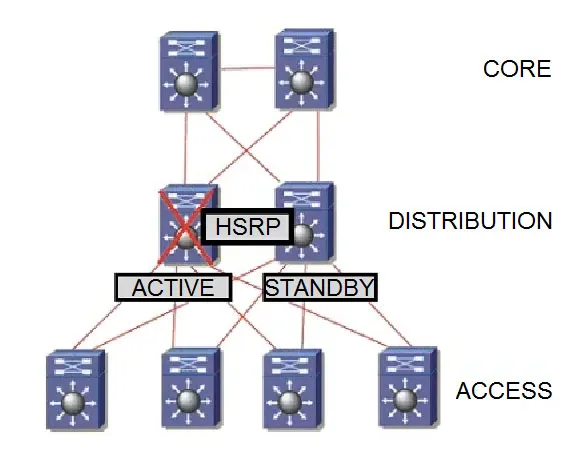
Refer to the exhibit. The distribution switches serve as the Layer 3 boundary. HSRP preemption is enabled. When the primary switch comes back after a failure, traffic is initially dropped. Which solution must be implemented to improve the design?
Answer: C
Sorry it is C. we will delayed active router to become active again for specific amount of delay that we configured so that there could be IGP running on it it will form their adjacency before becoming active and run will properly before taking over everything.
Source: Adapted from community discussion — DOSKIM
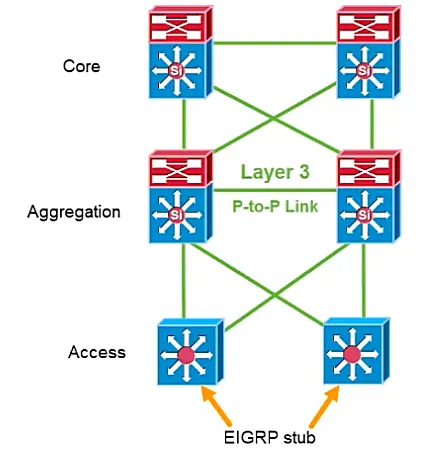
Refer to the exhibit. Where must an architect plan for route summarization for the topology?
Answer: D
Soo.... this question is basically "you have 3 layers: core, aggregation, access. At which layer would you AGGREGATE routes?" :)
Source: Adapted from community discussion — bogd

Refer to the exhibit. The connection between SW2 and SW3 is fiber and occasionally experiences unidirectional link failure. An architect must optimize the network to reduce the change of Layer 2 forwarding loops when the link fails. Which solution should the architect include?
Answer: D
Refer to the exhibit.
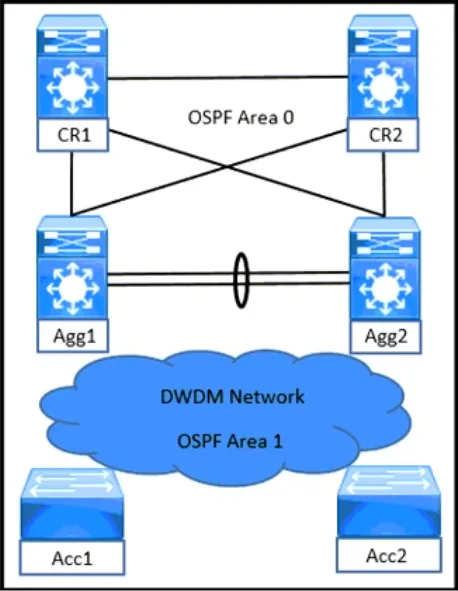
A network engineer must design a highly available OSPF solution based on these requirements: • Traffic disruptions caused by link or node failures in Area-1 must be resolved in milliseconds. • In the event of a failure, traffic must switch to another path without waiting for the OSPF dead interval. Which fault detection solution must the engineer choose?
Answer: C
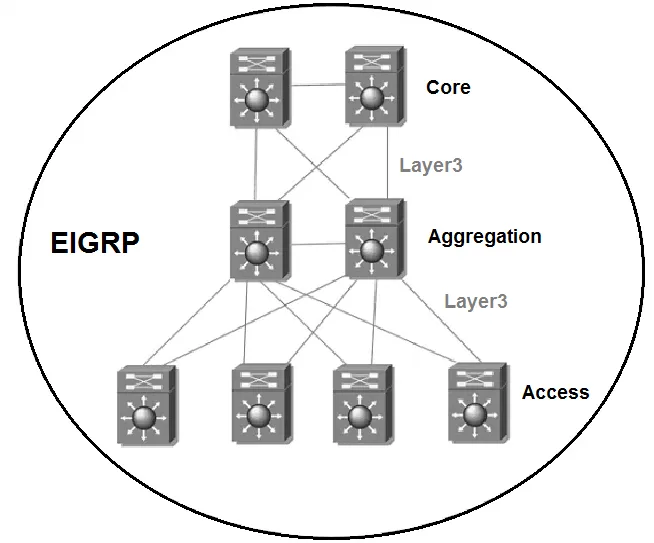
Refer to the exhibit. The full EIGRP routing table is advertised throughout the network. Currently, users experience data loss when any one link in the network fails. An architect must optimize the network to reduce the impact when a link fails. Which solution should the architect include in the design?
Answer: D
The correct solution for this scenario is D. The architect should summarize the access layer networks from the aggregation layer toward the core layer to optimize the network and reduce the impact when a link fails. EIGRP is a distance-vector routing protocol that can support automatic summarization at network boundaries to reduce the size of the routing table and improve network performance. In this scenario, by summarizing the access layer networks from the aggregation layer toward the core layer, the full EIGRP routing table would be reduced in size and complexity, which would minimize the impact when a link fails.
Source: Adapted from community discussion — SpicyMochi
What is the purpose of a control plane node in a Cisco SD-Access network fabric?
Answer: A
Answer A is correct. See: https://www.cisco.com/c/en/us/td/docs/solutions/CVD/Campus/cisco-sda-design-guide.html Endpoint registration—Each edge node has a LISP control-plane session to all control plane nodes. After an endpoint is detected by the edge node, it is added to a local database called the EID-table. Once the host is added to this local database, the edge node also issues a LISP map-register message to inform the control plane node of the endpoint so the central HTDB is updated.
Source: Adapted from community discussion — brzl

Refer to the exhibit. An architect reviews the low-level design of a company's enterprise network and advises optimizing the STP convergence time. Which functionality must be applied to Gi1/0/1-10 to follow the architect's recommendation?
Answer: D
I think that the answer is D. Portfast is a spanning tree's functionality, once configured It avoids the stp states (blocking, listening, learining, forwarding) every time any port among Gi1/0/1 Gi1/0/10 is connetcted again
Source: Adapted from community discussion — Hope66
An engineer must design a large Layer 2 domain that contains hundreds of switches and VLANs. The engineer's primary goals are to: ✑ Efficiently utilize the bandwidth of all links ✑ Avoid Layer 2 loops ✑ Cause minimal impact on switch CPU and memory Which technology should the engineer include in the design?
Answer: A
I believe it is MST. MST groups a large amount of VLANS into single instances which lower the amount of CPU and memory utilization. https://www.cisco.com/c/en/us/support/docs/lan-switching/spanning-tree-protocol/24248-147.html#mst
Source: Adapted from community discussion — MangoBingsu
Keyboard:J Kmove between questionsA–Dselect an answerRshow or hide the answer← →change page
300-420 practice, question 271. 359 questions available.
Version 1.0.0. How we source questions