Question 1 · 359 in bank
Select 2Which two BGP features will result in successful route exchanges between eBGP neighbors sharing the same AS number? (Choose two.)
Show answer
Answer: DE
Designing Cisco Enterprise Networks (ENSLD)359 questions across 36 pages are complete and free, with no account or card.
359 questions in this bank
Free access · progress saved on this device
Which two BGP features will result in successful route exchanges between eBGP neighbors sharing the same AS number? (Choose two.)
Answer: DE
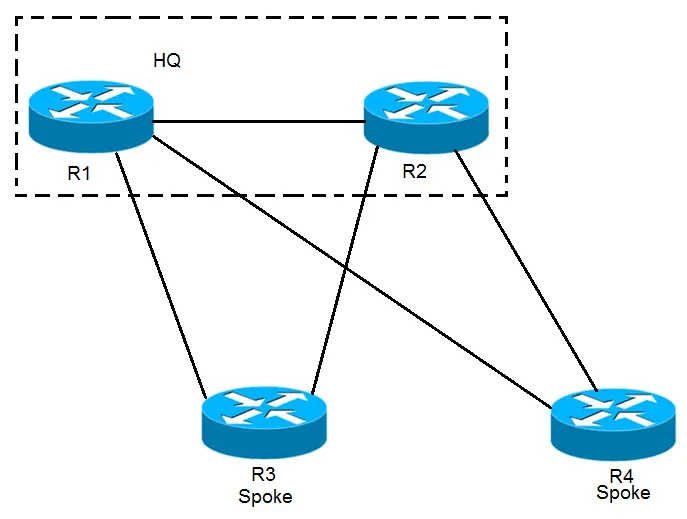
Refer to the exhibit. EIGRP has been configured on all links. The spoke nodes have been configured as EIGRP stubs, and the WAN links to R3 have higher bandwidth and lower delay than the WAN links to R4. When a link failure occurs at the R1-R2 link, what happens to traffic on R1 that is destined for a subnet attached to R2?
Answer: A
should be A. R1 has no route to R2 and drops the traffic Stub router only advertise Connected and Summary - it will not re-advertise route
Source: Adapted from community discussion — Mardouk
An engineer is upgrading a company's main site to include a connection to a second ISP. The company will receive full Internet routing tables from both ISPs via BGP. The engineer must ensure that the company does not become a transit autonomous system. Which solution should be included in this design?
Answer: A
As far as I know there are 4 methods how you can prevent becoming a transit AS: Filter-list with AS PATH access-list. No-Export Community. Prefix-list Filtering Distribute-list Filtering https://networklessons.com/bgp/bgp-prevent-transit-as
Source: Adapted from community discussion — ExodiaNecross59
An architect is working on a design to connect a company's main site to several small to medium-sized remote branches. The solution must include redundant WAN links, but the customer has a limited budget and wants the ability to increase the link speed easily in the future. QoS will run on the branch routers, so there is no need for consistent end-to-end QoS. Which solution does the architect propose?
Answer: B
First of all, these answers suck. An internet connection is usually cheaper than an MPLS 2 routers cost more to operate/own than 1 That being said C & D are out because both solution state "dual-edge" routers. The cheapest solution between A & B is B because B is an internet link, and A is an MPLS link. Further more it mention that "there is no need for consistent end-to-end QoS.", well with MPLS we can ask/require for SLA's in our contract, with an internet connection we cannot. That leaves me with answer B.
Source: Adapted from community discussion — iLikeHamburgers
An engineer must design a solution to connect a customer to the Internet. The solution will include a Layer 3 circuit with a CIR of 50 Mbps from the service provider. The hand-off from the provider's switch to the customer's router is 1Gbps. Which solution should the engineer include to prevent potential issues with choppy voice traffic?
Answer: C
The answer is C. Always SHAPE on egress towards a service provider in the parent policy, then use child policies to set priorities as you see fit (in this case VoiP). Generally, shaping = egress (i.e. towards ISP), policing = ingress (this is how ISPs drop traffic that exceed the CIR you are paying them for). Sources: https://www.cisco.com/c/en/us/support/docs/quality-of-service-qos/qos-policing/19645-policevsshape.html#anc17
Source: Adapted from community discussion — jzzmth
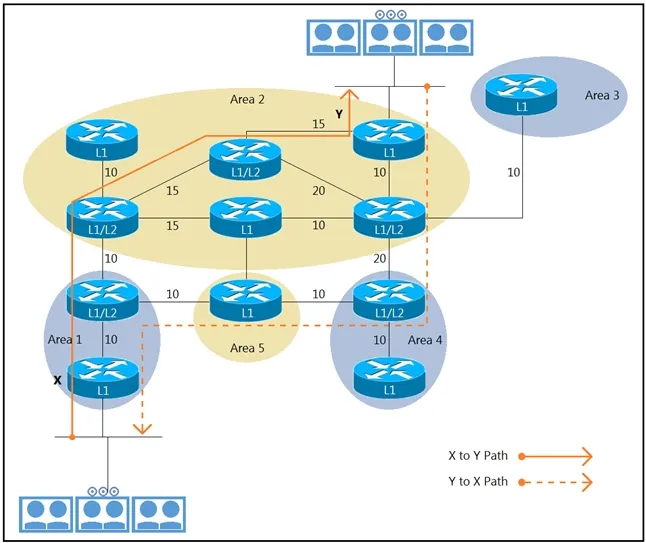
Refer to the exhibit. Customers report low video quality and delays when having point-to-point telepresence video calls between the two locations. An architect must optimize a design so that traffic follows the same path for egress and ingress traffic flows. Which technique optimizes the design?
Answer: A
The correct answer is A: IS-IS Level1 Router allways take the route towards the closest L2 Router, when trying to reach a destination outside the AS. That is the reason why the return-traffic takes a different way here. The problem occurs because Level1 and Level2 topologies are examied separatly by the respective routers. The solution is to hand down Level2 routing-information about the destination networks into Layer1 routing, so it can be included into path selection.
Source: Adapted from community discussion — andit
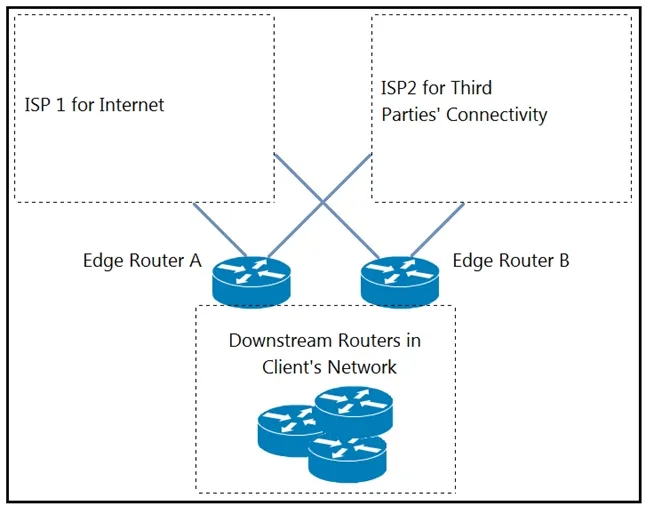
Refer to the exhibit. An engineer is designing a BGP solution for a client that peers with ISP1 for full Internet connectivity and with ISP2 for direct exchange of routes for several third parties. Which action, when implemented on the edge routers, enables the client network to reach the Internet through ISP1?
Answer: B
Default route for all internet traffic, for third party there will be more specific routes from ISP2. Anything else non-specific would take default route.
Source: Adapted from community discussion — vins0
An engineer must propose a solution for a campus network that includes the capability to create multiple Layer 3 virtual networks. Each network must have its own addressing structure and routing table for data forwarding. The solution must be scalable to support hundreds of virtual networks and allow simple configuration and management with minimal administrative overhead. Which solution does the engineer recommend?
Answer: B
I found the Cisco White Papers that talks about EVNs - You are correct when you say we can only use 32VNs, but this is only limited to one IP Infrastructure. Since each Branch will have it's own IP Infrastructure then we can do 32VNs at each branch, so if you have 10 branches x 32VNs that puts you well over hundreds of VNs that can be supported with this feature. - MPLS Core requires tons of Administrative Overhead. - VRF Lite supports up to 8 VNs. - Only Clear answer here is A, keep in mind they also mention Easy to configure, EVN is known for easy configuration.
Source: Adapted from community discussion — Clauster
An engineer must design a VPN solution for a company that has multiple branches connecting to a main office. What are two advantages of using DMVPN instead of IPsec tunnels to accomplish this task? (Choose two.)
Answer: BE
How is Internet access provided to a WAN Edge router that is connected to a MPLS transport link?
Answer: D
"What is TLOC Extension? TLOC extension is a feature that allows a WAN Edge router to communicate over the WAN transport connected to the adjacent WAN Edge router through a TLOC-extension interface" Link: https://www.networkacademy.io/ccie-enterprise/sdwan/tloc-extension
Source: Adapted from community discussion — Sickcnt
Keyboard:J Kmove between questionsA–Dselect an answerRshow or hide the answer← →change page
300-420 practice, question 1. 359 questions available.
Version 1.0.0. How we source questions