Question 221 · 359 in bank
What is the purpose of the fabric management plane in a Cisco SD-Access architecture?
Show answer
Answer: B
Designing Cisco Enterprise Networks (ENSLD)359 questions across 36 pages are complete and free, with no account or card.
359 questions in this bank
Free access · progress saved on this device
What is the purpose of the fabric management plane in a Cisco SD-Access architecture?
Answer: B

Refer to the exhibit. An engineer with an employee ID: 1234:56:789 must design a WoL deployment for a client, and the design must ensure that the Windows PCs are responsive to the WoL magic packets with no delays when the server-side initiates the instruction. Which action must the engineer choose?
Answer: C
Which two considerations must be made regarding the overlay network for a Cisco SD-Access architecture? (Choose two.)
Answer: CD
An enterprise needs to enhance its WAN availability after a recent outage with its only MPLS provider. The proposed solution must have a quick deployment, be affordable, be reliable, and work as a backup for the enterprise's primary MPLS connection. Which solution meets these requirements?
Answer: B
A company is planning to open two new branches and allocate the 2a01:c30:16:7009::3800/118 IPv6 network for the region. Each branch should have the capacity to accommodate a maximum of 200 hosts. Which two networks should the company use? (Choose two.)
Answer: AE
Answers A, E are correct: Network range for 2a01:c30:16:7009::3800/118 2a01:0c30:0016:7009:0000:0000:0000:3800- 2a01:0c30:0016:7009:0000:0000:0000:3bff Network Range for 2a01:0c30:0016:7009::3a00/120 2a01:0c30:0016:7009:0000:0000:0000:3a00- 2a01:0c30:0016:7009:0000:0000:0000:3aff Network range for 2a01:0c30:0016:7009::3b00/120 2a01:0c30:0016:7009:0000:0000:0000:3b00- 2a01:0c30:0016:7009:0000:0000:0000:3bff (As you see it ends with 2a01:0c30:0016:7009:0000:0000:0000:3bff So that means 2a01:0c30:0016:7009:0000:0000:0000:3c00/120 is out of the picture)
Source: Adapted from community discussion — Sickcnt
What is the purpose of Cisco vBond as a Session Traversal Utilities for NAT server?
Answer: C
Refer to the exhibit.

A network engineer must improve the current IS-IS environment. The Catalyst switch is equipped with dual supervisors. Each time a stateful switchover occurs, the network experiences unnecessary route recomputation. Which solution addresses this issue if the upstream router does not understand graceful restart messaging?
Answer: B
Graceful Restart (GR) (also known as Non Stop Forwarding (NSF)) and Non Stop Routing (NSR) are two different mechanisms to prevent routing protocol re-convergence during a processor switchover. When Graceful Restart (NSF) is used, peer networking devices are informed, via protocol extensions prior to the event (so peers should also be NSF (GR) capable). The peer routers are aware of a failure and so will give the switching over router a "grace" period to re-establish the neighbor relationship, while continuing to forward to the routes from that peer. When NSR is used, peer networking devices have no knowledge of any event on the switching over router. All information needed to continue the routing protocol peering state is transferred to the standby processor so it can "pick up" immediately upon a switchover. NSR is desirable in cases where the routing protocol peer doesn't support the RFCs necessary to support Graceful Restart. Following this logic, the answer is B (NSR)
Source: Adapted from community discussion — Mohali98
Refer to the exhibit.

An architect must design an IGP solution for an enterprise customer. The design must support: ✑ Physical link flaps should have minimal impact. ✑ Access routers should converge quickly after a link failure. Which two ISIS solutions should the architect include in the design? (Choose two.)
Answer: CE
C and E seems to be the correct Answers: Answer C should be responsible for timer optimalization Answer E should be the proper design in an "IS-IS Hybrid topology design" (L1/L2 routers maintain a separate lin-state database for L1 routes and L2 routes > This increases their CPU > So Access routes should never be both L1/L2 devices, only pure L1 devices) (Source ENSLD 300-420 official cert book page: 119)
Source: Adapted from community discussion — Sickcnt
Refer to the exhibit.
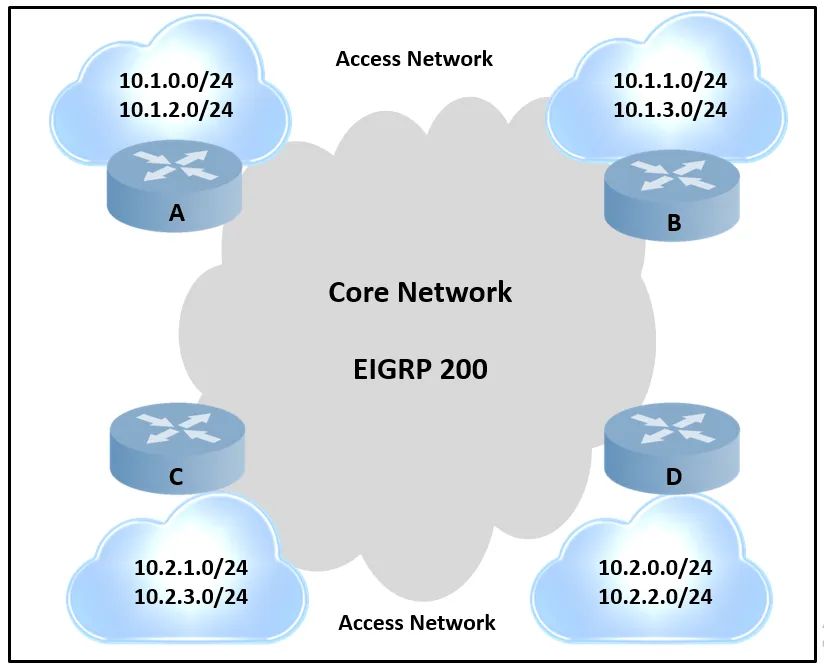
An engineer is designing a routing solution for a customer. The design must ensure that a failure of network 10.1.0.0/24, 10.1.2.0/24, 10.2.1.0/24, or 10.2.3.0/24 does not impact the core. It also requires fast convergence time during any link failover in the core or access networks. Which solution must the engineer select?
Answer: C
The answers are B & C GraceFul Restart a feature in EIGRP that allows a router to gracefully restart without disrupting network traffic. When a router is configured for graceful restart, it will send a notification to its neighbors before it restarts. This allows the neighbors to prepare for the restart by building alternate routes to the networks that the router is advertising, it won't impact the core this way. For Fast Convergence: (FRR) is a feature in EIGRP that allows a router to quickly reroute traffic around a failed link. FRR uses a technique called Feasible Successors to pre-calculate backup routes that can be used in the event of a link failure.
Source: Adapted from community discussion — Clauster
Refer to the exhibit.

A network engineer is designing a network for AS100. The design should ensure that all traffic enters AS100 via link 1 unless there is a network failure. In the event of a failure, link 2 should function as the path for incoming traffic. Which solution should the design include?
Answer: D
Keyboard:J Kmove between questionsA–Dselect an answerRshow or hide the answer← →change page
300-420 practice, question 221. 359 questions available.
Version 1.0.0. How we source questions