Question 321 · 359 in bank
In PIM sparse mode, if an RPF check is successful on a multicast-enabled device, what happens to the multicast packet?
Show answer
Answer: C
Designing Cisco Enterprise Networks (ENSLD)359 questions across 36 pages are complete and free, with no account or card.
359 questions in this bank
Free access · progress saved on this device
In PIM sparse mode, if an RPF check is successful on a multicast-enabled device, what happens to the multicast packet?
Answer: C
An architect is designing a network solution for a customer. The customer wants a design with redundancy at the distribution layer and the fastest convergence time possible during a failover. In addition, the company has a small IT support team, so the deployment process must be simple and quick. Which solution must the architect select?
Answer: B
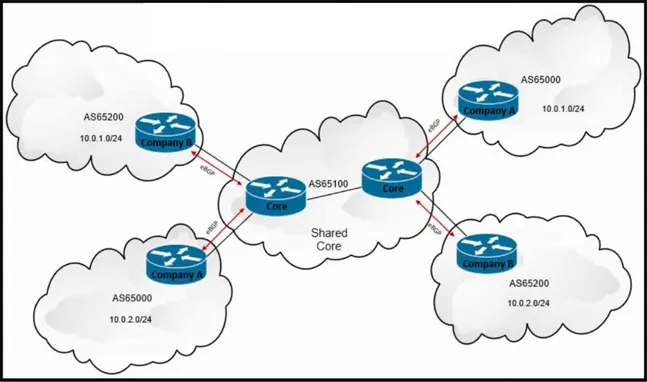
Refer to the exhibit. Company A acquired Company B, and the companies want to use the same shared core. However, the companies must not learn each other's prefixes. Which two address family solutions meet these requirements? (Choose two.)
Answer: BD

Refer to the exhibit. A company architect proposed this network design as a part of the IPv6 migration strategy. What are two advantages of this design? (Choose two.)
Answer: AD

Refer to the exhibit. An enterprise uses dual-homed MPLS connectivity for critical branch locations and single-homed MPLS connectivity for smaller, less essential branch sites. Against the enterprise security policy, Branch A experiences traffic flow from Branch B toward HQ when the MPLS2 network fails. Which technique resolves this issue?
Answer: C
An architect is designing an IPv4 plan for a branch office using 10.224.4.0/23. The design must maximize the number of subnets and allow for the doubling of hosts. The solution has these requirements: • 40 hosts for the data subnet • 24 hosts for the camera subnet • 15 hosts for the voice subnet Which plan meets these requirements?
Answer: B
An architect is designing an IPv6 plan using the 2001:adb8:8086:265::/64 network for three branch locations. The design must maximize the number of subnets and minimize the number of wasted IP addresses. The plan must allocate a subnet to these branches: • Branch A, which supports 1,000 hosts • Branch B, which supports 256 hosts • Branch C, which supports 60 hosts Which configuration set meets these requirements?
Answer: B
A company plans to deploy a new application across the campus network and asks an engineer to create a QoS policy. The application has these characteristics: • UDP-based • inelastic flows • sensitive to delay over 100 milliseconds • sensitive to jitter over 50 milliseconds The appropriate bandwidth is allocated and assigned to the queues. Which mechanism must the engineer use to manage the flows that exceed the configured threshold?
Answer: A
What is a feature of the IaaS model?
Answer: A
A network engineer discovers that an alternate or root port on a Cisco Layer 2 switch intermittently becomes the designated port, which causes an STP loop. What must be configured to resolve the issue?
Answer: C
Keyboard:J Kmove between questionsA–Dselect an answerRshow or hide the answer← →change page
300-420 practice, question 321. 359 questions available.
Version 1.0.0. How we source questions