Question 1281 · 1334 in bank
The clients and DHCP server reside on different subnets. Which command must be used to forward requests and replies between clients on the 10.10.0.1/24 subnet and the DHCP server at 192.168.10.1?
Show answer
Answer: D
Cisco Certified Network Associate (CCNA)1,334 questions across 134 pages are complete and free, with no account or card.
1334 questions in this bank
Free access · progress saved on this device
The clients and DHCP server reside on different subnets. Which command must be used to forward requests and replies between clients on the 10.10.0.1/24 subnet and the DHCP server at 192.168.10.1?
Answer: D

Refer to the exhibit. Which command set configures ROUTER-1 to allow Internet access for users on the 192.168.1.0/24 subnet while using 209.165.202.129 for Port Address Translation?
Answer: D
This question is a total mess - 2 same subnets on different router ports - impossible ! How can answer 'A' be correct when it defines such a dumb range - 192.168.ZERO.0 - 192.168.ONE.0 with netmask for 255 addresses !?! Examtopics - I will never pay you again !
Source: Adapted from community discussion — purenuker
Which IP header field is changed by a Cisco device when QoS marking is enabled?
Answer: C
Sorry I would go with answer C. The IPv4 Header has a 1 byte field called Type of Service, and DSCP lives inside that byte, that's why I think the best answer is C.
Source: Adapted from community discussion — sdmejia01
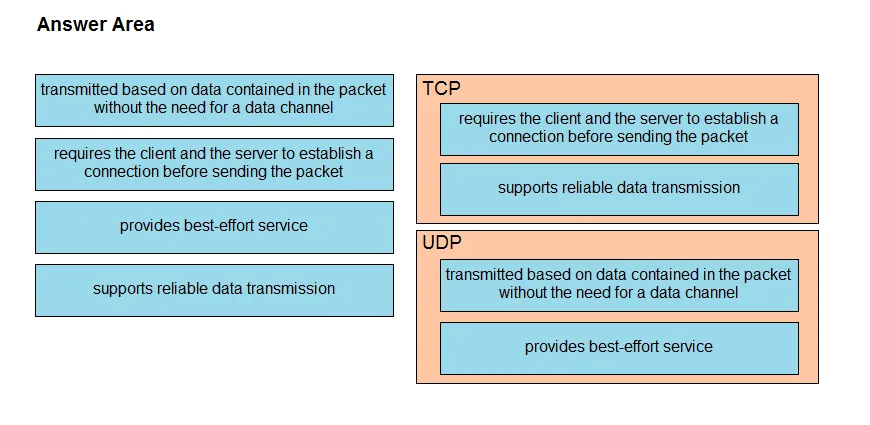
DRAG DROP - Drag and drop the TCP or UDP details from the left onto their corresponding protocols on the right. Select and Place:
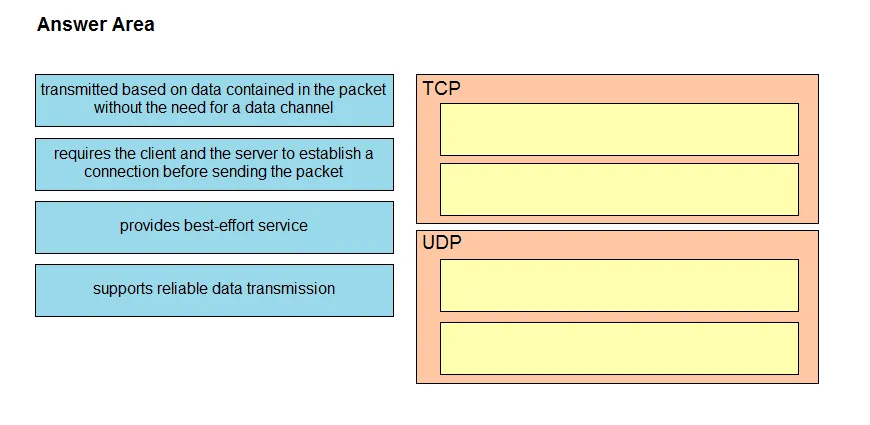
This is an interactive task on the real exam — a drag-and-drop, hotspot or ordering question. There is nothing to select here, so the answer is shown below for reference.
Answer: See figure below
DRAG DROP - Drag and drop the SNMP components from the left onto the descriptions on the right.
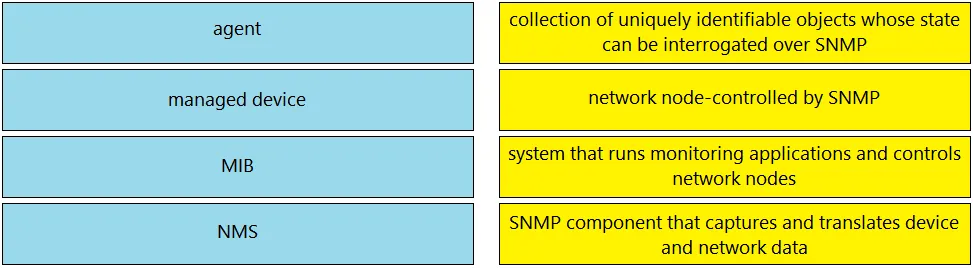
This is an interactive task on the real exam — a drag-and-drop, hotspot or ordering question. There is nothing to select here, so the answer is shown below for reference.
Answer: See figure below
given naswers are incorrect collection of uniquely identifiable objects whose state can be interrogated over SNMP == MIB network node-controlled by SNMP == managed device system that runs monitoring applications and controls network nodes == NMS SNMP component that captures and translates device and network data == agent
Source: Adapted from community discussion — [Removed]

Which DSCP per-hop forwarding behavior is divided into subclasses based on drop probability?
Answer: C
Expedited Forwarding (EF) The expedited forwarding (EF) per-hop behavior assures that any traffic class with EF's related DSCP is given highest priority and is not queued. EF provides low loss, latency, and jitter. The recommended DS codepoint for EF is 101110. A packet that is marked with 101110 receives guaranteed low-drop precedence as the packet traverses diffserv-aware networks en route to its destination. Use the EF DSCP when assigning priority to customers or applications with a premium SLA. Assured Forwarding (AF) The assured forwarding (AF) per-hop behavior provides four different forwarding classes that you can assign to a packet. Each forwarding class provides three drop precedences, as shown in Table 6–2. The various AF codepoints provide the ability to assign different levels of services to customers and applications. In the QoS policy you can prioritize traffic and services on your network when you plan the QoS policy. You can then assign different AF levels to the prioritized traffic.
Source: Adapted from community discussion — Starlord2535
What are two features of the DHCP relay agent? (Choose two.)
Answer: BD
The DHCP relay agent itself does not assign anything locally or otherwise DNS or otherwise, so A is incorrect. It does minimize the number of DHCP servers because it means we don't need a DHCP server on every subnet, so B is correct. You actually can configure more than one IP helper command under an individual Layer 3 interface, so C is incorrect and D is correct.
Source: Adapted from community discussion — oatmealturkey
A DHCP pool has been created with the name CONTROL. The pool uses the next to last usable IP address as the default gateway for the DHCP clients. The server is located at 172.16.32.15. What is the next step in the process for clients on the 192.168.52.0/24 subnet to reach the DHCP server?
Answer: A
The question states that the pool has been created and that it uses the next to last usable IP address as the default gateway for the DHCP clients. So that already implies that B is not the answer. But just to confirm once and for all, 192.168.52.253 is NOT the last usable address, that would be 192.168.52.254. The answer is A because we need to configure a helper address since the DHCP server is on a different subnet.
Source: Adapted from community discussion — oatmealturkey
Which two transport layer protocols carry syslog messages? (Choose two.)
Answer: CD
What is the purpose of classifying network traffic in QoS?
Answer: B
Keyboard:J Kmove between questionsA–Dselect an answerRshow or hide the answer← →change page
200-301 practice, question 1281. 1334 questions available.
Version 1.0.0. How we source questions