Question 231 · 370 in bank
You have an Azure Synapse Analytics job that uses Scala. You need to view the status of the job. What should you do?
Show answer
Answer: C
Data Engineering on Microsoft Azure370 questions across 37 pages are complete and free, with no account or card.
370 questions in this bank
Free access · progress saved on this device
You have an Azure Synapse Analytics job that uses Scala. You need to view the status of the job. What should you do?
Answer: C
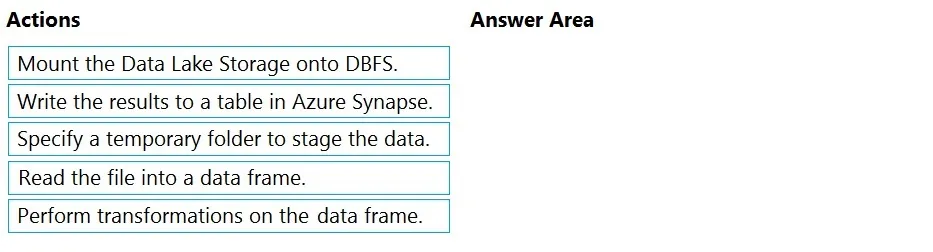
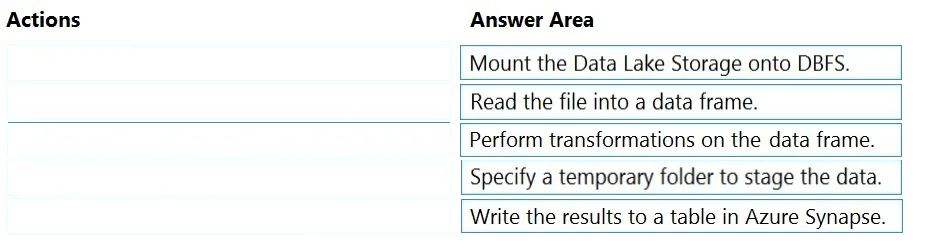
DRAG DROP - You have an Azure Data Lake Storage Gen2 account that contains a JSON file for customers. The file contains two attributes named FirstName and LastName. You need to copy the data from the JSON file to an Azure Synapse Analytics table by using Azure Databricks. A new column must be created that concatenates the FirstName and LastName values. You create the following components: ✑ A destination table in Azure Synapse ✑ An Azure Blob storage container ✑ A service principal In which order should you perform the actions? To answer, move the appropriate actions from the list of actions to the answer area and arrange them in the correct order. Select and Place:
This is an interactive task on the real exam — a drag-and-drop, hotspot or ordering question. There is nothing to select here, so the answer is shown below for reference.
Answer: See figure below
Step 1: Mount the Data Lake Storage onto DBFS Begin with creating a file system in the Azure Data Lake Storage Gen2 account. Step 2: Read the file into a data frame. You can load the json files as a data frame in Azure Databricks. Step 3: Perform transformations on the data frame. Step 4: Specify a temporary folder to stage the data Specify a temporary folder to use while moving data between Azure Databricks and Azure Synapse. Step 5: Write the results to a table in Azure Synapse. You upload the transformed data frame into Azure Synapse. You use the Azure Synapse connector for Azure Databricks to directly upload a dataframe as a table in a Azure Synapse. Reference: https://docs.microsoft.com/en-us/azure/azure-databricks/databricks-extract-load-sql-data-warehouse
Source: Adapted from community discussion — Karl_Cen
You have an Azure data factory named ADF1. You currently publish all pipeline authoring changes directly to ADF1. You need to implement version control for the changes made to pipeline artifacts. The solution must ensure that you can apply version control to the resources currently defined in the UX Authoring canvas for ADF1. Which two actions should you perform? Each correct answer presents part of the solution. NOTE: Each correct selection is worth one point.
Answer: AB
To implement version control for changes made to pipeline artifacts in ADF1 while ensuring that version control can be applied to the resources currently defined in the UX Authoring canvas, you should perform the following two actions: A. From the UX Authoring canvas, select Set up code repository: This will allow you to configure ADF1 to integrate with a version control system such as Git, which will enable you to track changes made to pipeline artifacts over time. B. Create a Git repository: This will provide the version control system needed to track changes made to pipeline artifacts in ADF1. Therefore, options A and B are the correct answers. C, D, E, and F are not relevant to implementing version control for changes made to pipeline artifacts in ADF1.
Source: Adapted from community discussion — esaade
DRAG DROP - You have an Azure subscription that contains an Azure Synapse Analytics workspace named workspace1. Workspace1 connects to an Azure DevOps repository named repo1. Repo1 contains a collaboration branch named main and a development branch named branch1. Branch1 contains an Azure Synapse pipeline named pipeline1. In workspace1, you complete testing of pipeline1. You need to schedule pipeline1 to run daily at 6 AM. Which four actions should you perform in sequence? To answer, move the appropriate actions from the list of actions to the answer area and arrange them in the correct order. NOTE: More than one order of answer choices is correct. You will receive credit for any of the correct orders you select. Select and Place:

This is an interactive task on the real exam — a drag-and-drop, hotspot or ordering question. There is nothing to select here, so the answer is shown below for reference.
Answer: See figure below
why not this? 1.merge th echanges from branch1 into main 2.publish the contents of main 3.create a schedule trigger 4.associate the schedule trigger with pipeline1
Source: Adapted from community discussion — vrodriguesp

DRAG DROP - You have the following table named Employees.

You need to calculate the employee_type value based on the hire_date value. How should you complete the Transact-SQL statement? To answer, drag the appropriate values to the correct targets. Each value may be used once, more than once, or not at all. You may need to drag the split bar between panes or scroll to view content. NOTE: Each correct selection is worth one point. Select and Place:

This is an interactive task on the real exam — a drag-and-drop, hotspot or ordering question. There is nothing to select here, so the answer is shown below for reference.
Answer: See figure below
Box 1: CASE - CASE evaluates a list of conditions and returns one of multiple possible result expressions. CASE can be used in any statement or clause that allows a valid expression. For example, you can use CASE in statements such as SELECT, UPDATE, DELETE and SET, and in clauses such as select_list, IN, WHERE, ORDER BY, and HAVING. Syntax: Simple CASE expression: CASE input_expression - WHEN when_expression THEN result_expression [ ...n ] [ ELSE else_result_expression ] END - Box 2: ELSE - Reference: https://docs.microsoft.com/en-us/sql/t-sql/language-elements/case-transact-sql

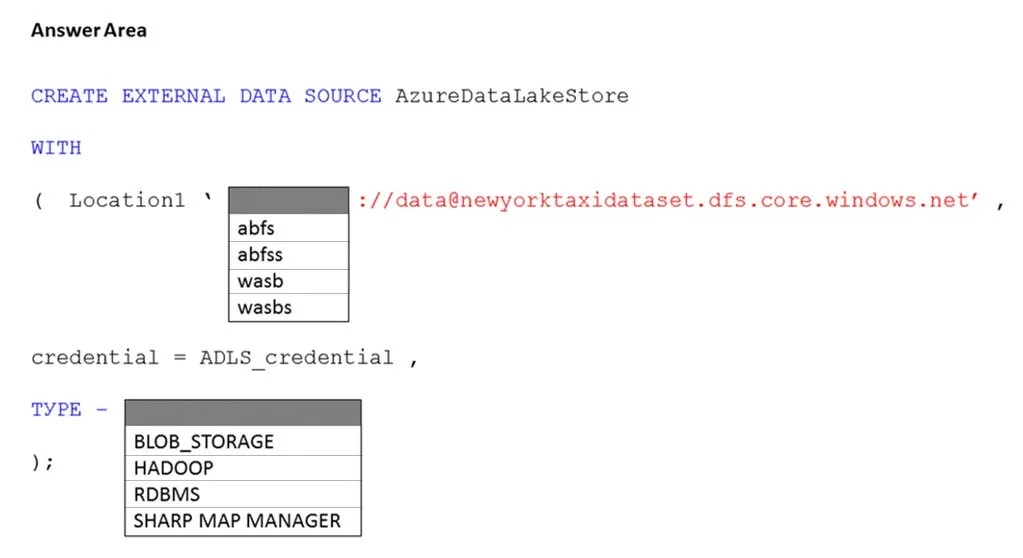
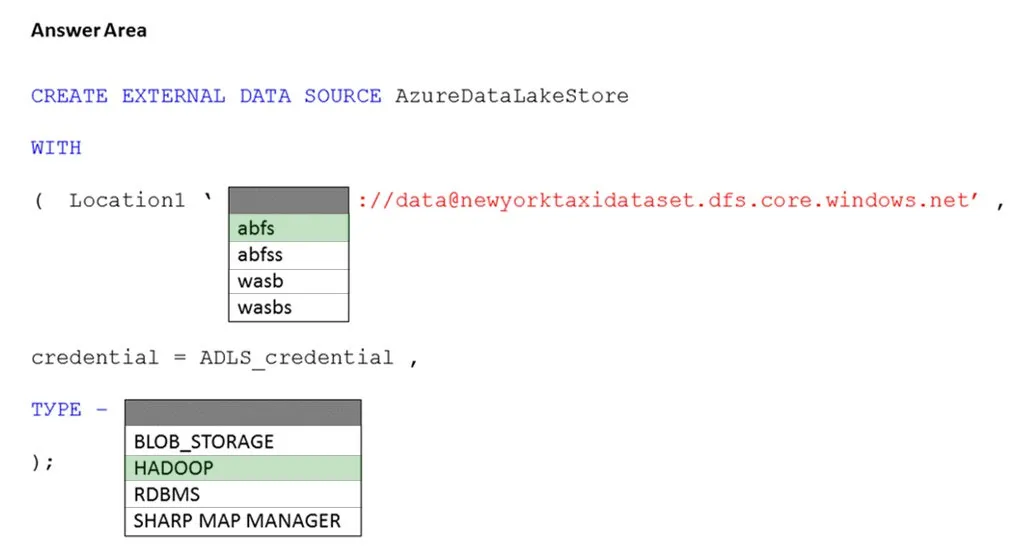
HOTSPOT - You have an Azure subscription that contains an Azure Synapse Analytics dedicated SQL pool named Pool1 and an Azure Data Lake Storage account named storage1. Storage1 requires secure transfers. You need to create an external data source in Pool1 that will be used to read .orc files in storage1. How should you complete the code? To answer, select the appropriate options in the answer area. NOTE: Each correct selection is worth one point. Hot Area:
This is an interactive task on the real exam — a drag-and-drop, hotspot or ordering question. There is nothing to select here, so the answer is shown below for reference.
Answer: See figure below
Reference: https://docs.microsoft.com/en-us/sql/t-sql/statements/create-external-data-source-transact-sql?view=azure-sqldw-latest&preserve-view=true&tabs=dedicated
Source: Adapted from community discussion — Hema_V
You have an Azure subscription that contains an Azure Synapse Analytics dedicated SQL pool named SQLPool1. SQLPool1 is currently paused. You need to restore the current state of SQLPool1 to a new SQL pool. What should you do first?
Answer: C
You wont be able to create restore point when the SQL pool is paused. The the correct answer is Result SQL Pool. See below from Microsoft documentation. User-defined restore points can also be created through Azure portal. Sign in to your Azure portal account. Navigate to the dedicated SQL pool (formerly SQL DW) that you want to create a restore point for. Select Overview from the left pane, select + New Restore Point. If the New Restore Point button isn't enabled, make sure that the dedicated SQL pool (formerly SQL DW) isn't paused. https://learn.microsoft.com/en-us/azure/synapse-analytics/sql-data-warehouse/sql-data-warehouse-restore-points
Source: Adapted from community discussion — yogiazaad
You are designing an Azure Synapse Analytics workspace. You need to recommend a solution to provide double encryption of all the data at rest. Which two components should you include in the recommendation? Each correct answer presents part of the solution. NOTE: Each correct selection is worth one point.
Answer: BE
To provide double encryption of all the data at rest in an Azure Synapse Analytics workspace, you should include the following components in the recommendation: A. An X.509 certificate: X.509 certificates are commonly used for securing communication channels and can be used for encrypting data at rest in conjunction with other encryption mechanisms. B. An RSA key: RSA keys are widely used for encryption purposes, including encrypting data at rest. By using an RSA key, you can encrypt the data before storing it, providing an additional layer of security.
Source: Adapted from community discussion — Nitin9in
You have an Azure Synapse Analytics serverless SQL pool named Pool1 and an Azure Data Lake Storage Gen2 account named storage1. The AllowBlobPublicAccess property is disabled for storage1. You need to create an external data source that can be used by Azure Active Directory (Azure AD) users to access storage from Pool1. What should you create first?
Answer: C
You have an Azure Data Factory pipeline named Pipeline1. Pipeline1 contains a copy activity that sends data to an Azure Data Lake Storage Gen2 account. Pipeline1 is executed by a schedule trigger. You change the copy activity sink to a new storage account and merge the changes into the collaboration branch. After Pipeline1 executes, you discover that data is NOT copied to the new storage account. You need to ensure that the data is copied to the new storage account. What should you do?
Answer: A
Because the pull request is already implicit in the statement as it is said to be merged into the collaborating branch: "You change the copy activity sink to a new storage account and MERGE the CHANGES INTO the COLLABORATION BRANCH."
Source: Adapted from community discussion — DataEX
Keyboard:J Kmove between questionsA–Dselect an answerRshow or hide the answer← →change page
DP-203 practice, question 231. 370 questions available.
Version 1.0.0. How we source questions