Question 31 · 104 in bank
An administrator does not want to report the login events of service accounts to FortiGate. Which setting on the collector agent is required to achieve this?
Show answer
Answer: A
NSE 4 — FortiOS 7.2 Network Security Professional104 questions across 11 pages are complete and free, with no account or card.
104 questions in this bank
Free access · progress saved on this device
An administrator does not want to report the login events of service accounts to FortiGate. Which setting on the collector agent is required to achieve this?
Answer: A
Refer to the exhibit.

Based on the ZTNA tag, the security posture of the remote endpoint has changed. What will happen to endpoint active ZTNA sessions?
Answer: C
C. They will be re-evaluated to match the ZTNA policy. FortiGate Infrastructure 7.2 Study Guide (p.182): "Endpoint posture changes trigger active ZTNA proxy sessions to be re-verified and terminated if the endpoint is no longer compliant with the ZTNA policy." Reference and download study guide: https://ebin.pub/fortinet-fortigate-infrastructure-study-guide-for-fortios-72.html
Source: Adapted from community discussion — raydel92
Refer to the exhibit. The exhibit shows a diagram of a FortiGate device connected to the network and the firewall policy and IP pool configuration on the FortiGate device.
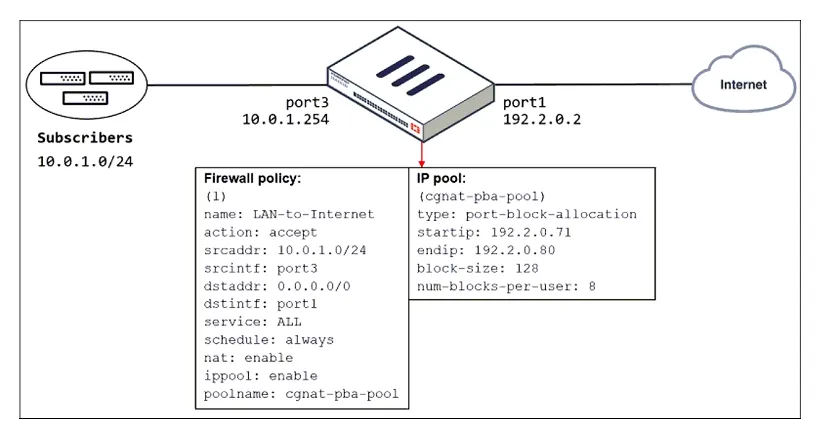
Which two actions does FortiGate take on internet traffic sourced from the subscribers? (Choose two.)
Answer: BC
Not A: FortiGate allocates a block size and number per host for a range of external addresses B: FortiGate allocates port blocks on a first-come, first-served basis C: For logging purposes, when FortiGate allocates a port block to a host, it generates a system event log to inform the administrator Not D: It allows 8 blocks of 128 ports per host
Source: Adapted from community discussion — BoostBoris
Which two statements about the Security Fabric rating are true? (Choose two.)
Answer: CD
Security rating is a subscription service that requires a security rating license. It provides executive summaries of THREE largest areas of security focus.
Source: Adapted from community discussion — BoostBoris
An administrator wants to configure timeouts for users. Regardless of the user's behavior, the timer should start as soon as the user authenticates and expire after the configured value. Which timeout option should the administrator configure on FortiGate?
Answer: C
Hard: time is an absolute value. Regardless of the user’s behavior, the timer starts as soon as the user authenticates and expires after the configured value.
Source: Adapted from community discussion — BoostBoris
Which two statements explain antivirus scanning modes? (Choose two.)
Answer: CD
Correct: C. In flow-based inspection mode, FortiGate buffers the file, but also simultaneously transmits it to the client. D. In proxy-based inspection mode, antivirus scanning buffers the whole file for scanning, before sending it to the client. FortiGate Security 7.2 Study Guide (p.350 & 352): "In flow-based inspection mode, the IPS engine reads the payload of each packet, caches a local copy, and forwards the packet to the receiver at the same time. Because the file is ransmitted simultaneously, flow-based mode consumes more CPU cycles than proxy-based." "Each protocol’s proxy picks up a connection and buffers the entire file first (or waits until the oversize limit is reached) before scanning. The client must wait for the scanning to finish." Reference and download study guide: https://ebin.pub/fortinet-fortigate-security-study-guide-for-fortios-72.html
Source: Adapted from community discussion — raydel92
Refer to the exhibits. The exhibits show a network diagram and firewall configurations. An administrator created a Deny policy with default settings to deny Webserver access for Remote-User2. Remote-User1 must be able to access the Webserver. Remote-User2 must not be able to access the Webserver.
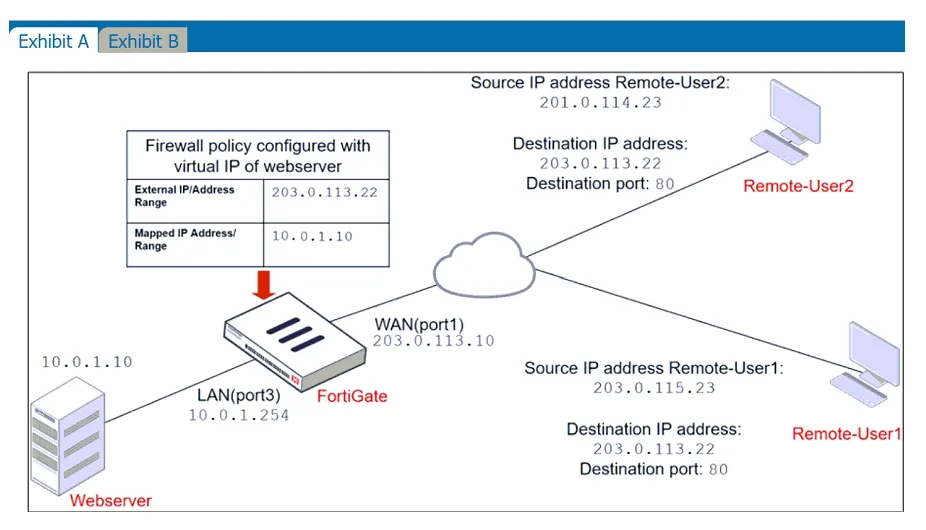
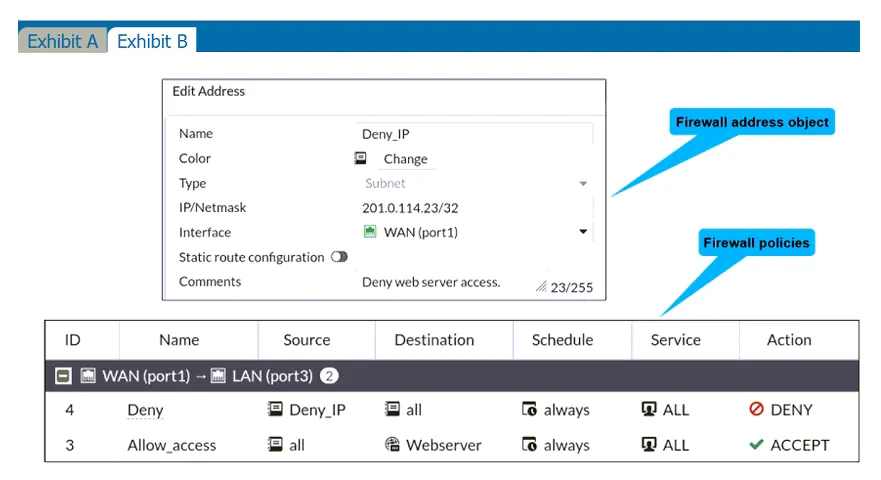
In this scenario, which two changes can the administrator make to deny Webserver access for Remote-User2? (Choose two.)
Answer: BC
Answer should be BC. It makes sense that the destination address be the webserver which needs to be denied for IP Deny_IP
Source: Adapted from community discussion — Poseidon458
Refer to the exhibit. Examine the intrusion prevention system (IPS) diagnostic command shown in the exhibit.
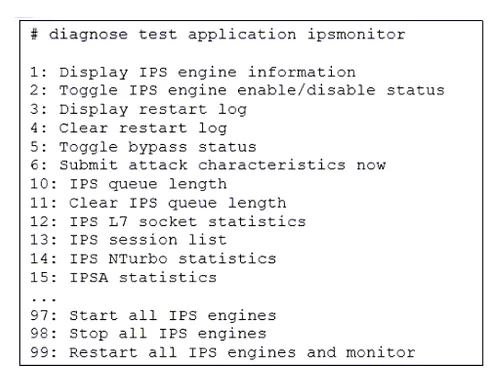
If option 5 is used with the IPS diagnostic command and the outcome is a decrease in the CPU usage, what is the correct conclusion?
Answer: B
B is correct. IPS engine remains active, but doesn't inspect traffic. If the CPU use decreases after that, it usually indicates that the volume of traffic being inspected is too high for that FortiGate model.
Source: Adapted from community discussion — BoostBoris
An administrator has configured a strict RPF check on FortiGate. How does strict RPF check work?
Answer: B
According to FortiGate_Infrastructure_7.2_Study_Guide page 40 Strict: In this mode, Fortigate also verifies that the matching route is the best route in the routing table. That is, if the route in table contains a matching route for the source address and the incoming interface, but there is a better route for the source address through another interface the the rpf check fails.
Source: Adapted from community discussion — Wrath4980
Which two protocols are used to enable administrator access of a FortiGate device? (Choose two.)
Answer: BC
Keyboard:J Kmove between questionsA–Dselect an answerRshow or hide the answer← →change page
NSE4_FGT-7.2 practice, question 31. 104 questions available.
Version 1.0.0. How we source questions