Question 211 · 610 in bank
Which of the following network traffic types is sent to all nodes on the network?
Show answer
Answer: B
CompTIA Network+610 questions across 61 pages are complete and free, with no account or card.
610 questions in this bank
Free access · progress saved on this device
Which of the following network traffic types is sent to all nodes on the network?
Answer: B
Which of the following cable types provides the highest possible transmission speed?
Answer: C
C. fiber-optic cable A high-speed physical medium for transmitting data that uses light rather than electricity to transmit data and is made of high-purity glass fibers sealed within a flexible opaque tube. Much faster than conventional copper wire.
Source: Adapted from community discussion — HeatSquad77
Which of the following layers of the OSI model is responsible for end-to-end encryption?
Answer: A
The correct answer is: A. Presentation The Presentation layer (Layer 6) of the OSI model is responsible for functions like data formatting, translation, and encryption/decryption. End-to-end encryption is typically handled at this layer to ensure that data is securely encoded before being transmitted and properly decoded upon receipt.
Source: Adapted from community discussion — ba10f26
A network security administrator needs to monitor the contents of data sent between a secure network and the rest of the company. Which of the following monitoring methods will accomplish this task?
Answer: A
The correct answer is: A. Port mirroring Port mirroring is a technique used on a network switch to duplicate (or "mirror") the traffic from one or more ports to another port where a monitoring device, such as a network analyzer or intrusion detection system, is connected. This allows the administrator to monitor the contents of data being sent between the secure network and the rest of the company.
Source: Adapted from community discussion — ba10f26
Which of the following does a full-tunnel VPN provide?
Answer: C
C. Corporate inspection of all network traffic Explanation: A full-tunnel VPN routes all network traffic from the user's device through the VPN server, meaning all internet traffic (not just traffic destined for corporate resources) goes through the VPN. This allows the corporate network or the VPN provider to inspect and monitor all traffic, providing a higher level of security and control over the data.
Source: Adapted from community discussion — HeatSquad77
Which of the following does a hash provide?
Answer: B
The correct answer is: B. Integrity A hash provides integrity by generating a fixed-length unique representation (hash value) of data. If the data is altered, even slightly, the hash value will change, allowing verification that the data has not been tampered with. Hashes do not provide confidentiality, non-repudiation, or availability.
Source: Adapted from community discussion — ba10f26
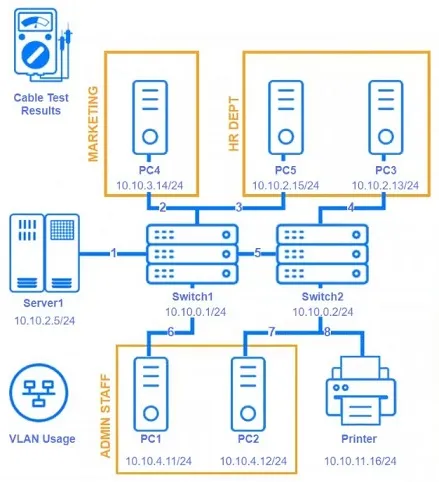
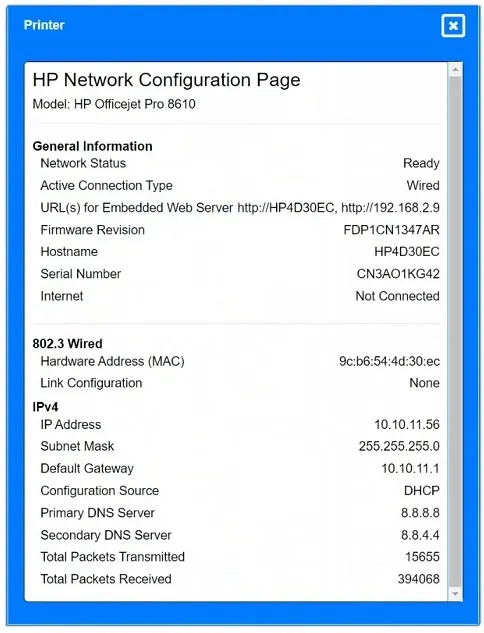
SIMULATION - A network technician needs to resolve some issues with a customer's SOHO network. The customer reports that some of the devices are not connecting to the network, while others appear to work as intended. INSTRUCTIONS - Troubleshoot all the network components and review the cable test results by clicking on each device and cable. Type help in each terminal to view a list of available commands. Diagnose the appropriate component(s) by identifying any components with a problem and recommend a solution to correct each problem. If at any time you would like to bring back the initial state of the simulation, please click the Reset All button.




This is an interactive task on the real exam — a drag-and-drop, hotspot or ordering question. There is nothing to select here, so the answer is shown below for reference.
Answer: See figure below
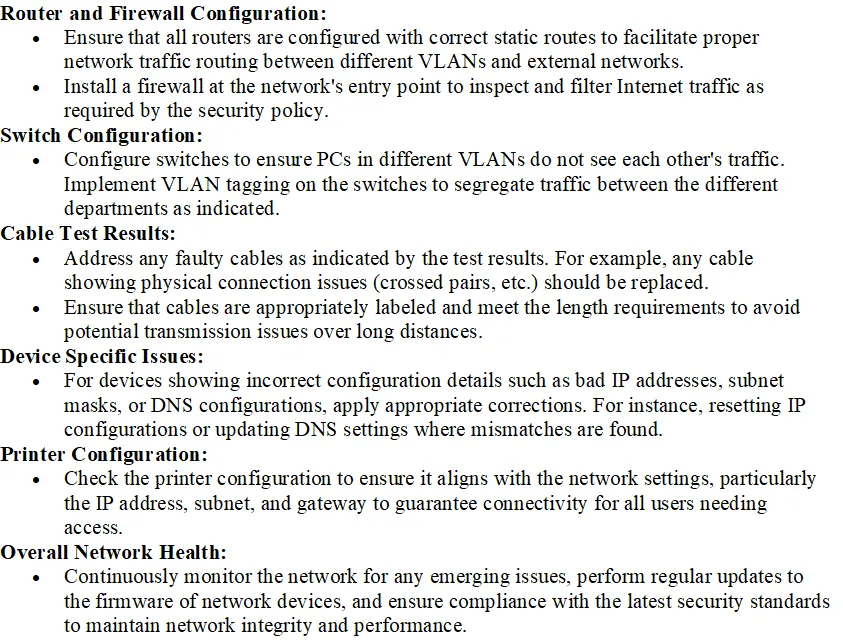
We have 8 Cables we can click on. Cable 2 is too long, at 103 meters. Cable 5, which is a crossover cable, has a break. All other cables are physically fine. However there seems to be a few incorrect VLAN assignments VLAN assignments Cable 1 seems fine. Going from server to switch. VLAN 2 is correct. Cable 2 Going from Marketing to Switch. VLAN 3 is correct Cable 3. Going from HR to Switch. VLAN 2 is correct Cable 4. Going from HR to Switch. VLAN is Wrong. Should be VLAN 2 for HR. Cable 5. Going from Switch to Switch. VLAN 1 is correct Cable 6. Going from Admin to Switch. VLAN 4 is correct Cable 7. Going from Admin to Switch. VALN is Wrong. Should be VLAN 4 for Admin Cable 8. Going from Printer to Switch, VLAN is wrong. Should be VLAN 11 for Printers You can seemingly click on PC1 to PC 5. Maybe there’s other problems, I just cannot see from here. Look at the IP addresses. Subnet masks, default gateways etc.. carefully. If you even can! From what we can see all the IP addresses seem Ok.
Source: Adapted from community discussion — PatrickH
A company wants to implement a disaster recovery site for non-critical applications, which can tolerate a short period of downtime. Which of the following types of sites should the company implement to achieve this goal?
Answer: C
C. Warm Explanation: A warm site is suitable for non-critical applications that can tolerate a short period of downtime. Warm sites typically have some infrastructure and equipment already in place, but they may need additional setup or data synchronization before they can be fully operational. This makes warm sites a balanced choice for companies that need faster recovery than a cold site but do not require the immediate availability of a hot site.
Source: Adapted from community discussion — TreyPar3
Which of the following is an XML-based security concept that works by passing sensitive information about users, such as log-in information and attributes, to providers?
Answer: D
SAML (Security Assertion Markup Language) is an open standard used for exchanging authentication and authorization data between different parties, primarily between an identity provider (IdP) and a service provider (SP). It is often used in Single Sign-On (SSO) systems to allow users to authenticate once and gain access to multiple applications or services without having to log in again.
Source: Adapted from community discussion — LilJuneBug
Which of the following routing technologies uses unequal cost load balancing and port 88?
Answer: A
EIGRP (Enhanced Interior Gateway Routing Protocol) is a Cisco proprietary routing protocol that supports unequal cost load balancing (UCLB) through its variance feature. With UCLB, EIGRP can send traffic over multiple routes, even if those routes have unequal costs (i.e., different metrics), as long as the variance multiplier is configured to allow for it. In addition, EIGRP uses UDP port 88 for communication between routers.
Source: Adapted from community discussion — ebcd6a1
Keyboard:J Kmove between questionsA–Dselect an answerRshow or hide the answer← →change page
N10-009 practice, question 211. 610 questions available.
Version 1.0.0. How we source questions