Question 741 · 1003 in bank
Which language defines the structure or modeling of data for NETCONF and RESTCONF?
Show answer
Answer: D
Implementing Cisco Enterprise Network Core Technologies (ENCOR)1,003 questions across 101 pages are complete and free, with no account or card.
1003 questions in this bank
Free access · progress saved on this device
Which language defines the structure or modeling of data for NETCONF and RESTCONF?
Answer: D
Refer to the exhibit.

What is displayed when the code is run?
Answer: C
If num is not a number then the method will throw out exception then the answer will be 100, for example putting a character "a" in to method - magic("a") But the main() method has statically defined the num as 5 - magic(5), which will never throw out an exception. answer should always be num + 2 * 10, which is 25 in this program So the answer is C
Source: Adapted from community discussion — kmb192006
What is the purpose of an integration API in Cisco DNA Center?
Answer: C
Integration capabilities are part of Westbound interfaces. The Catalyst Center platform provides mechanisms for integrating Assurance workflows and data with third-party IT Service Management (ITSM) solutions. ITSM also integrates the Catalyst Center platform into approval and pre-approval chains, linking it with formal change and maintenance window schedules. https://developer.cisco.com/docs/dna-center/overview/#integration-api-westbound:~:text=Integration%20capabilities%20are%20part%20of%20Westbound%20interfaces.
Source: Adapted from community discussion — AbdullahMohammad251
Refer to the exhibit.

What is the value of the variable list after the code is run?
Answer: B
After the code is run, the value of the variable list will be [1, 2, 3, 10]. The code creates a list containing the values [1, 2, 3, 4]. Then, it modifies the fourth element of the list (which has an index of 3, since Python uses 0-indexing) by setting it equal to 10 using the assignment operator (=). Finally, it prints the resulting list using the print() function. So, the output of the print statement will be [1, 2, 3, 10], indicating that the fourth element of the list has been successfully modified.
Source: Adapted from community discussion — Vlad_Is_Love_ua
What is one difference between SaltStack and Ansible?
Answer: D
As usual: trust the discussion, not the experts. This site would already improve a lot if there was a link from question to discussion.
Source: Adapted from community discussion — ClPo
DRAG DROP - Drag and drop the LISP components from the left onto the functions they perform on the right. Not all options are used. Select and Place:
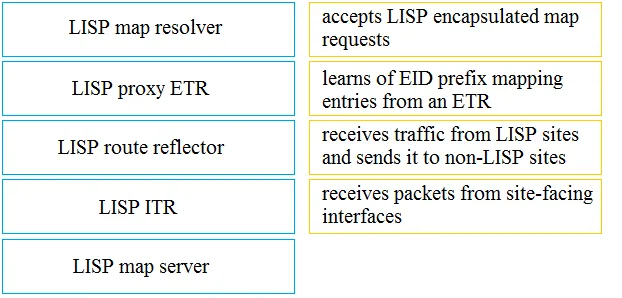
This is an interactive task on the real exam — a drag-and-drop, hotspot or ordering question. There is nothing to select here, so the answer is shown below for reference.
Answer: See figure below
Reference: https://www.cisco.com/c/en/us/td/docs/solutions/Enterprise/Data_Center/DCI/5-0/LISPmobility/DCI_LISP_Host_Mobility/LISPmobile_2.html#:~:text=% E2%80%93%20Proxy%20ITR%20(PITR)%3A%20A,devices%20deployed%20at%20LISP%20sites.
Source: Adapted from community discussion — OhBee

Which signal strength and noise values meet the minimum SNR for voice networks?
Answer: D
The correct is D Check below: Generally, a signal with an SNR value of 20 dB or more is recommended for data networks where as an SNR value of 25 dB or more is recommended for networks that use voice applications. A. signal strength -66 dBm, noise 90 dBm=24dB B. signal strength -67 dBm, noise 91 dBm=24dB C. signal strength -68 dBm, noise 89 dBm=21dB D. signal strength -69 dBm, noise 94 dBm=25dB <- Correct
Source: Adapted from community discussion — Nickplayany
A customer requires their wireless network to be fully functional, even if the wireless controller fails. Which wireless design supports these requirements?
Answer: A
FlexConnect: Provides local functionality even without the central controller with local mode and for remote or branch office deployments. Mesh: Creates a wireless backhaul network using access points as relays. Centralized: Access points rely heavily on a central controller for management and data forwarding. Embedded: Access points have built-in controller functionality to enhance resiliency.
Source: Adapted from community discussion — due
Which two conditions occur when the primary route processor fails on a switch that is using dual route processors with stateful switchover? (Choose two.)
Answer: AC
A and C from the 2nd edition OCG under SSO and NFS section, "During a switchover, the standby RP takes over as the new active RP. The new active RP uses the SSO learnt checkpoint information and keeps the interfaces on the router from flapping and the router and/or line cards from reloading, however, SSO doesn’t checkpoint any Layer 3 control plane information about any neighbor router, and due to this, the existing routing protocol adjacencies go down and begin to reestablish. During this time, since the FIB was checkpointed by NSF, the data plane is not affected by the Layer 3 control plane going down and traffic continues to be forwarded while the routing protocol adjacencies reestablish. After routing convergence is complete, the FIB is updated with new routing or topology information from the RIB if necessary."
Source: Adapted from community discussion — sam6996
Refer to the exhibit.
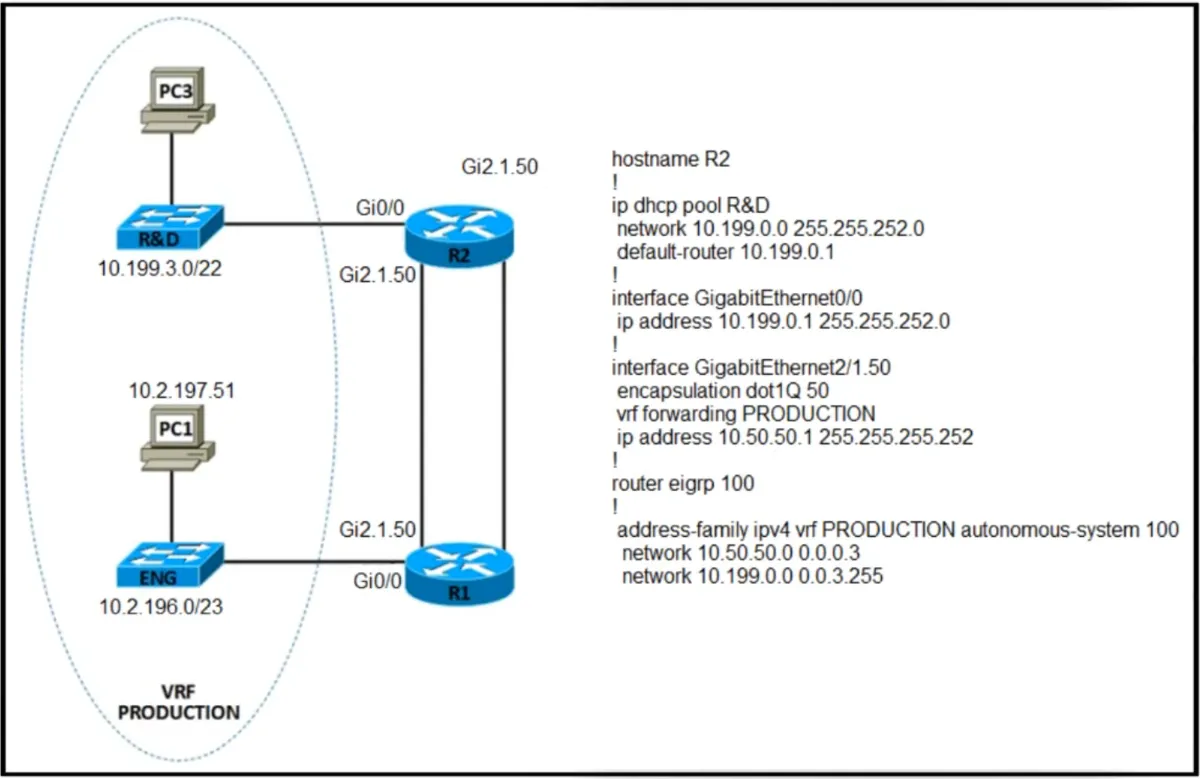
Which configuration must be added to R2 to enable PC3 to obtain a DHCP address and successfully ping PC1?
Answer: A
gi0/0 is not part of the VRF, so you have to join the interface to the VRF and then, recreate its configuration again. Answer A - does that.
Source: Adapted from community discussion — Zeruz
Keyboard:J Kmove between questionsA–Dselect an answerRshow or hide the answer← →change page
350-401 practice, question 741. 1003 questions available.
Version 1.0.0. How we source questions