Question 671 · 1003 in bank
What is a Type 2 hypervisor?
Show answer
Answer: A
Implementing Cisco Enterprise Network Core Technologies (ENCOR)1,003 questions across 101 pages are complete and free, with no account or card.
1003 questions in this bank
Free access · progress saved on this device
What is a Type 2 hypervisor?
Answer: A
What is a characteristic of a Type 1 hypervisor?
Answer: B
You memorized the wrong question. The exam asks for both type.1 and type 2. be careful EVERYTHING before answering questions. We pay for GOOD information, remember. if you arent sure. say that when you comment.
Source: Adapted from community discussion — CCNPWILL
Refer to the exhibit.
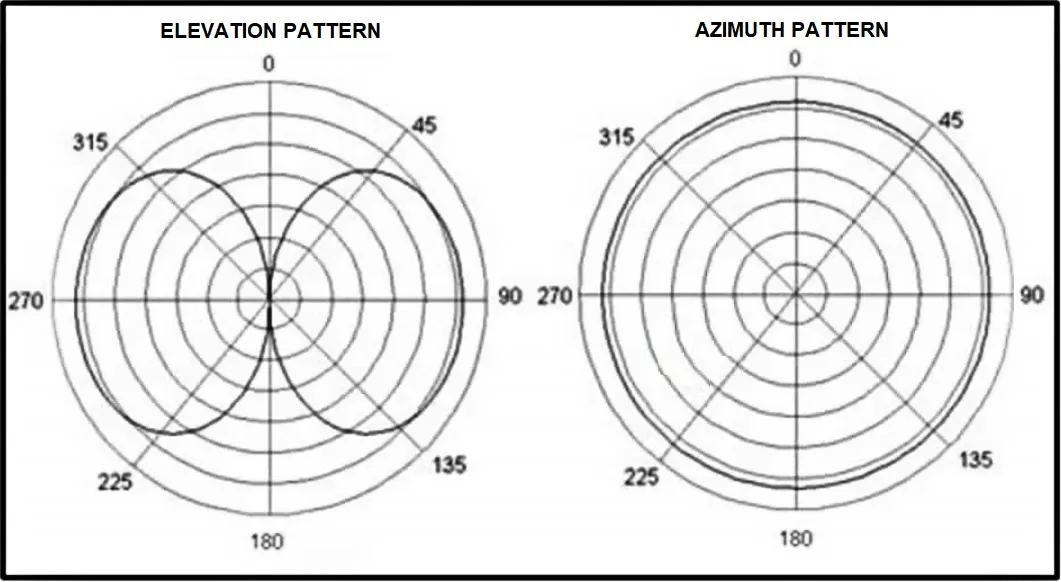
Which antenna emits this radiation pattern?
Answer: A
Refer to the exhibit.

Answer: D
The diagram is wrong. Router A resides in AS 65001. Router B resides in AS 65002. Question: An engineer must configure an eBGP neighborship to Router B on Router A. The network that is connected to GO/1 on Router A must be advertised to Router B. Which configuration should be applied? Answer is D: router bgp 65001 neighbor 10.0.1.2 remote-as 65002 network 10.0.2.0 255.255.255.0
Source: Adapted from community discussion — Tim1992
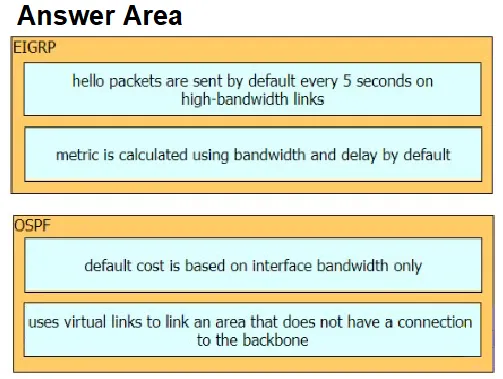
DRAG DROP - Drag and drop the characteristics from the left onto the routing protocols they describe on the right.
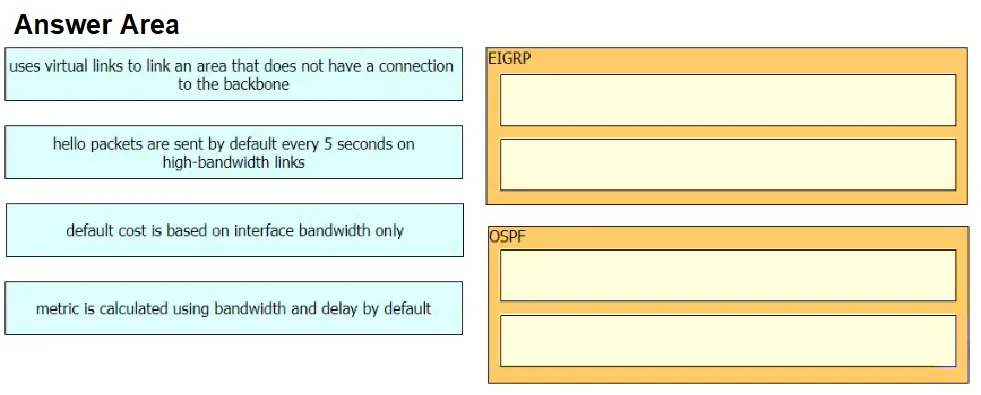
This is an interactive task on the real exam — a drag-and-drop, hotspot or ordering question. There is nothing to select here, so the answer is shown below for reference.
What are two best practices when designing a campus Layer 3 infrastructure? (Choose two.)
Answer: CD
We should not implement security features at the core as it would reduce the speed in this layer -> Answer B is not correct. It is a recommended practice to configure summarization in a large network from the distribution layers toward the core. Implementing summarization at the distribution layer optimizes the convergence process -> Answer C is correct while answer E is not correct. Reference: https://www.ccexpert.us/network-design/route-summarization.html Also in the above link, it is recommended to configure “Passive Interfaces for IGP at the Access Layer”, not “nontransit links” which makes answer A to be not correct. “As a best practice for ECMP-based Layer 3 networks, Cisco recommends fine-tuning Cisco Express Forwarding load balancing to include Layer 3 and Layer 4 tuple inclusion to compute and derive the first phase of the optimal forwarding decision process between two upstream Layer 3 MEC interfaces.” -> Answer D is correct. Reference: https://www.cisco.com/c/dam/global/shared/assets/pdf/cisco_enterprise_campus_infrastructure_design_guide.pdf
Source: Adapted from community discussion — Burik
Refer to the exhibit.

Which configuration must be applied to ensure that the preferred path for traffic from AS 65010 toward AS 65020 uses the R2 to R4 path?
Answer: B
local preference attribute is local to the AS. it will not transcend to remote AS, thus will not influence their route decisions.
Source: Adapted from community discussion — Din04
Refer to the exhibit.
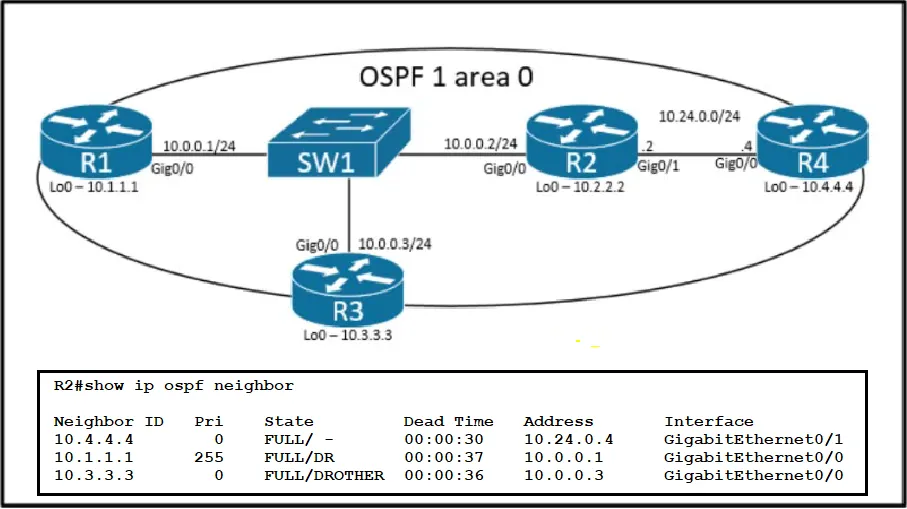
An engineer must reduce the number of Type 1 and Type 2 LSAs that are advertised to R4 within OSPF area 0. Which configuration must be applied?
Answer: A
OSPF prefix-suppression is a useful feature in order to reduce the number of Link State Advertisement (LSA) that are flooded within an area. In an OSPF area which has multiple transit links between hosts and actual communication is between the hosts. There is no need to advertise the transit link LSAs to all the routers. You can only advertise the LSAs related to end hosts. By default, OSPF advertises all the LSAs that include the transit link LSAs. OSPF prefix-suppression feature helps to overcome this behavior and reduces the number of Type 1(router) and Type 2(network) LSAs advertised. This feature can be enabled globally on a router or on per interfaces basis. OSPF prefix-suppression helps in faster Shortest Path First (SPF) calculation due to less number of prefixes in the database (DB). OSPF Type 3, Type 4, Type 5, or Type 7 LSAs are not suppressed. https://www.cisco.com/c/en/us/support/docs/ip/open-shortest-path-first-ospf/213404-open-shortest-path-first-prefix-suppress.html
Source: Adapted from community discussion — ALOVEVIKS
An engineer is connected to a Cisco router through a Telnet session. Which command must be issued to view the logging messages from the current session as soon as they are generated by the router?
Answer: B
Refer to the exhibit.
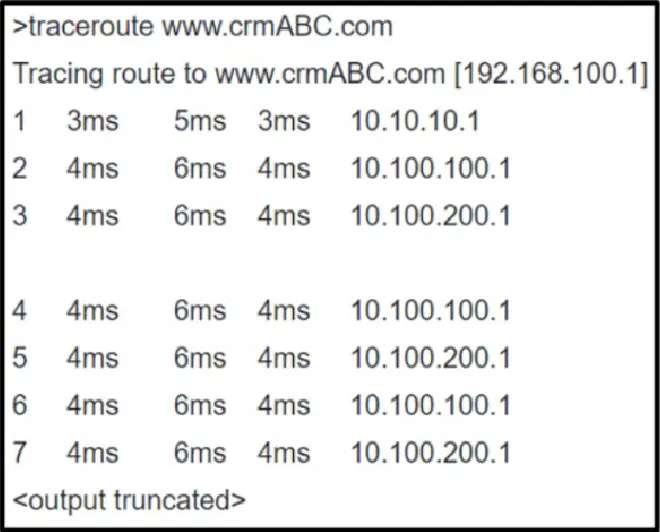
Users cannot reach the web server at 192.168.100.1. What is the root cause for the failure?
Answer: B
Keyboard:J Kmove between questionsA–Dselect an answerRshow or hide the answer← →change page
350-401 practice, question 671. 1003 questions available.
Version 1.0.0. How we source questions