Question 471 · 1003 in bank
By default, which virtual MAC address does HSRP group 14 use?
Show answer
Answer: C
Implementing Cisco Enterprise Network Core Technologies (ENCOR)1,003 questions across 101 pages are complete and free, with no account or card.
1003 questions in this bank
Free access · progress saved on this device
By default, which virtual MAC address does HSRP group 14 use?
Answer: C
Which LISP component decapsulates messages and forwards them to the map server responsible for the egress tunnel routers?
Answer: B
The function of the LISP MR is to accept encapsulated Map-Request messages from ingress tunnel routers (ITRs), decapsulate those messages, and then forward the messages to the MS responsible for the egress tunnel routers (ETRs) that are authoritative for the requested EIDs.
Source: Adapted from community discussion — kebkim
An engineer must design a wireless network for a school system based on these requirements: ✑ The network must be able to triangulate client location based on RSSI. ✑ Each client must be able to sustain 5 Mbps of throughput at all times. ✑ Each classroom has up to 30 clients. ✑ Primary coverage is 5 GHz. Which design should be used?
Answer: D
For a location management deployment, the APs are laid out in a staggered pattern. Figure 3-5 shows a typical pattern. The staggered pattern allows for more accurate estimation of the location of a device. https://www.cisco.com/en/US/docs/solutions/Enterprise/Mobility/emob30dg/RFDesign.html
Source: Adapted from community discussion — DavideDL
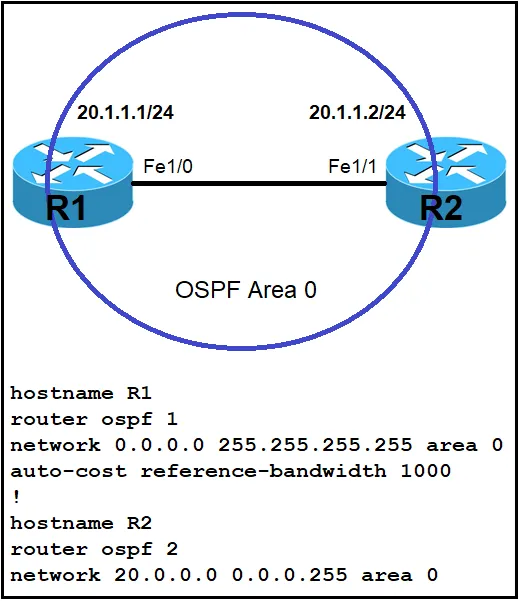
Refer to the exhibit. Which command must be applied to R2 for an OSPF neighborship to form?
Answer: B
Confirmed by test in my lab: R1#sh run | sec ospf router ospf 1 log-adjacency-changes auto-cost reference-bandwidth 1000 network 0.0.0.0 255.255.255.255 area 0 R2#sh run | sec ospf router ospf 2 log-adjacency-changes network 20.0.0.0 0.0.0.255 area 0 network 20.1.1.2 0.0.0.0 area 0 R2# R2# R2# R2#sh ip os nei Neighbor ID Pri State Dead Time Address Interface 20.1.1.1 1 FULL/DR 00:00:32 20.1.1.1 GigabitEthernet0/0 R2#
Source: Adapted from community discussion — attiko
What is one characteristic of VXLAN?
Answer: B
A. It supports a maximum of 4096 VLANs (incorrect, supports 16 million segments) B. It supports multitenant segments (correct) C. It uses STP to prevent loops in the underlay network (incorrect, STP used in traditional networking with VLANs) D. It uses the Layer 2 header to transfer packets through the network underlay (incorrect, VxLAN transfers packets apart of the network OVERLAY)
Source: Adapted from community discussion — kldoyle97
What is the function of vBond in a Cisco SD-WAN deployment?
Answer: C
C (vBond not initia connection to vEdges automatically ) WAN Edge onboarding process Upon bootup, the WAN Edge device contacts the vBond orchestrator to establish a secure transient DTLS control connection. Reference (Page 6): https://www.cisco.com/c/dam/en/us/td/docs/solutions/CVD/SDWAN/sdwan-wan-edge-onboarding-deploy-guide-2020nov.pdf
Source: Adapted from community discussion — Asymptote
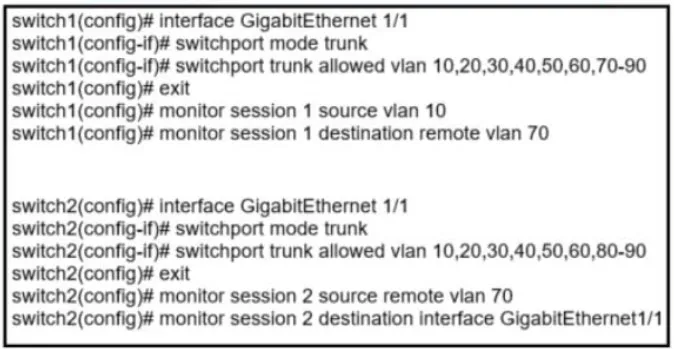
Refer to the exhibit. A network administrator configured RSPAN to troubleshoot an issue between switch 1 and switch2. The switches are connected using interface GigabitEthernet 1/1. An external packet capture device is connected to swich2 interface GigabitEthernet 1/2. Which two commands must be added to complete this configuration? (Choose two.)
Answer: AB
Switch2 is not allowing VLAN 70 which is used on Switch1 for RSPAN so we must allow it -> Option A is correct (although it would not allow VLAN 81 to 90 to go through). “An external packet capture device is connected to switch2 interface GigabitEthernet1/2” so we must configure Gi1/2 as the destination port. For your information, this is how to configure Remote SPAN (RSPAN) feature on two switches. Traffic on FastEthernet0/1 of Switch 1 will be sent to Fa0/10 of Switch2 via VLAN 40. + Configure on both switches Switch1,2(config)#vlan 40 Switch1,2(config-vlan)#remote-span + Configure on Switch1 Switch1(config)# monitor session 1 source interface FastEthernet 0/1 Switch1(config)# monitor session 1 destination remote vlan 40 + Configure on Switch2 Switch2(config)#monitor session 5 source remote vlan 40 Switch2(config)# monitor session 5 destination interface FastEthernet 0/10
Source: Adapted from community discussion — rafaelinho88
Which function does a Cisco SD-Access extended node perform?
Answer: C
An 'extended node' are Cisco switches from product lines that were not redesigned for SDA operation. As an example, the industrial ethernet product line (IE3K) Called extended because their functionality was "extended": -> they can be connected to Fabric Edge Nodes -> they can be managed by Cisco DNA Center -> they can participate in the SDA Fabric in a very limited way -> for example they don't build VXLAN tunnels -> they connect to the Fabric Edge Nodes using a 802.1q (VLAN) trunk port I guess the difference between A and C is that: A, with its phrasing, implies that 'extended' nodes are those nodes that make possible the integration of non-fabric nodes with the fabric using registraton and configuration. This is wrong because 'extended' nodes ARE BY THEMSELVES those non-fabric enabled nodes. C is correct because extended nodes allow the fabric to extend by connecting to them, non-fabric enabled nodes
Source: Adapted from community discussion — Claudiu1
Which router is elected the IGMP Querier when more than one router is in the same LAN segment?
Answer: D
Query messages are used to elect the IGMP querier as follows: 1. When IGMPv2 devices start, they each multicast a general query message to the allsystems grou address of 224.0.0.1 with their interface address in the source IP address field of the message. 2. When an IGMPv2 device receives a general query message, the device compares the source IP address in the message with its own interface address. The device with the lowest IP address on the subnet is elected the IGMP querier. 3. All devices (excluding the querier) start the query timer, which is reset whenever a general query message is received from the IGMP querier. If the query timer expires, it is assumed that the IGMP querier has gone down, and the election process is performed again to elect a new IGMP querier.
Source: Adapted from community discussion — rafaelinho88
What is the function of the fabric control plane node in a Cisco SD-Access deployment?
Answer: C
C. The control plane node’s database tracks all endpoints in the fabric site and associates the endpoints to fabric nodes, decoupling the endpoint IP address or MAC address from the location (closest router) in the network.
Source: Adapted from community discussion — gtddrf
Keyboard:J Kmove between questionsA–Dselect an answerRshow or hide the answer← →change page
350-401 practice, question 471. 1003 questions available.
Version 1.0.0. How we source questions