Question 491 · 578 in bank
What is the failure detection time with BFD?
Show answer
Answer: B
Implementing Cisco Enterprise Advanced Routing and Services (ENARSI)578 questions across 58 pages are complete and free, with no account or card.
578 questions in this bank
Free access · progress saved on this device
What is the failure detection time with BFD?
Answer: B
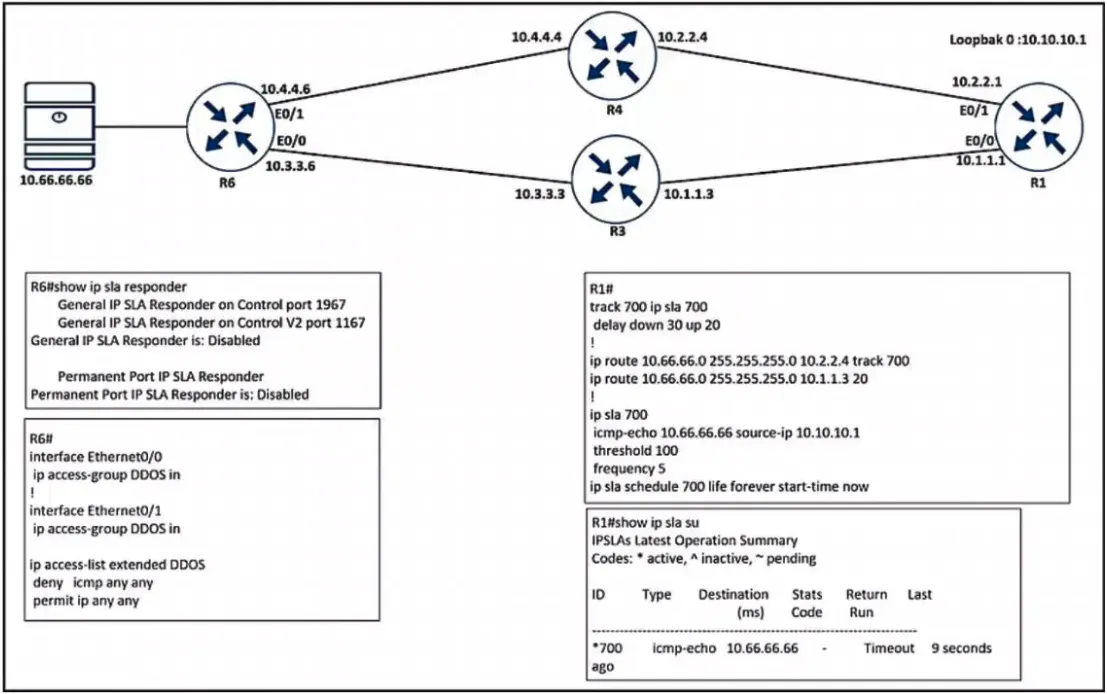
Refer to the exhibit. A network administrator is trying to switch to the privileged EXEC level on R1 but failed. Which configuration resolves the issue?
Answer: A
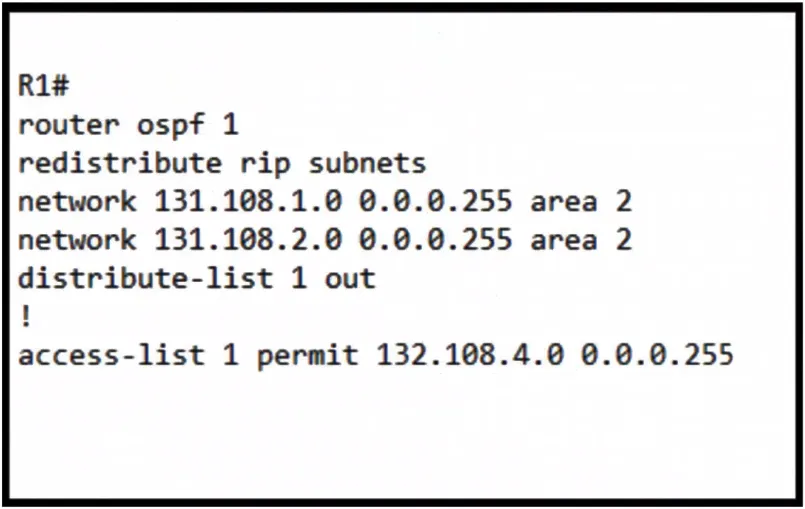
Refer to the exhibit. The R1 OSPF neighbor is not receiving type 5 external LSAs for 132.108.2.0/24 and 132.108.3.0/24 networks. Which configuration command resolves the issue?
Answer: A
Which two technologies optimize MPLS infrastructure using bandwidth protection services when experiencing slow response? (Choose two.)
Answer: AC
What is the function of penultimate hop popping?
Answer: A
its A: PHP can be performed in frame-based MPLS networks. In these networks, the last P router in the LSP tunnel pops the LDP label as previously requested by the egress PE router through LDP. So, the PE router receives a labeled packet that contains only the VPN label.
Source: Adapted from community discussion — dapardo
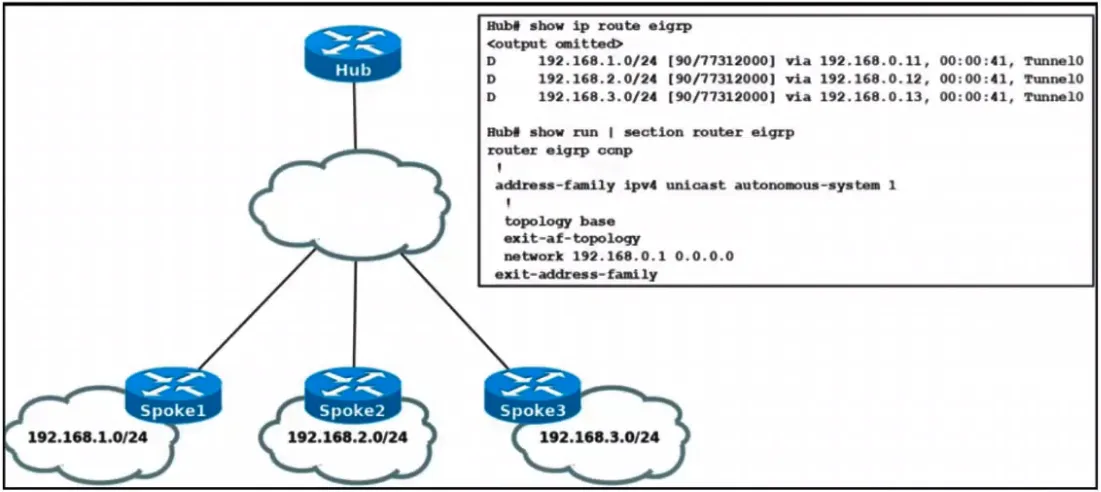
Refer to the exhibit. Spoke routers do not learn about each other's routes in the DMVPN Phase2 network. Which action resolves the issue?
Answer: A
Agree on A considering the few information we have from the topology provided and considering that EIGRP is the protocol used internally
Source: Adapted from community discussion — dapardo

Refer to the exhibit. The security department recently installed a monitoring device between routers R3 and R5, which caused a loss of network connectivity for users connected to R5. Troubleshooting revealed that the monitoring device cannot forward multicast packets. The team already updated R5 with the correct configuration. Which configuration must be implemented on R3 to resolve the problem by ensuring R3 as the DR for the R3-R5 segment?
Answer: A
A is correct: https://study-ccna.com/designated-backup-designated-router/ 1. router with the highest OSPF priority will become a DR. By default, all routers have a priority of 1.
Source: Adapted from community discussion — brownleaf
What is a characteristic of an MPLS LSP tunnel?
Answer: D
Traditional MPLS LDP - Hop by Hop forwarding. No tunnels involved MPLS LDP TE (Traffic Engineering) involves tunnels unidirectional MPLS Traffic Engineering (TE), where explicit, unidirectional tunnels are set up for traffic flow optimization, resource reservation, or meeting specific SLA requirements.
Source: Adapted from community discussion — kldoyle97
Which two reasons would cause an LSP to break between two PE routers? (Choose two.)
Answer: AC
A & C are correct The label bindings must correspond to the prefixes and subnet masks in the routing tables. If there's a mismatch, the labels will not be used properly, causing the LSP to fail. i think E is incorrect, if MPLS is not enabled on the routers, there won’t be any LSPs to break. https://www.cisco.com/c/en/us/support/docs/multiprotocol-label-switching-mpls/mpls/23565-troubleshoot-mpls-vpn.html#cause:~:text=If%20label%20bindings,devices%20will%20fail.
Source: Adapted from community discussion — [Removed]
SIMULATION -

Guidelines - This is a lab item in which tasks will be performed on virtual devices. • Refer to the Tasks tab to view the tasks for this lab item. • Refer to the Topology tab to access the device console(s) and perform the tasks. • Console access is available for all required devices by clicking the device icon or using the tab(s) above the console window. • All necessary preconfigurations have been applied. • Do not change the enable password or hostname for any device. • Save your configurations to NVRAM before moving to the next item. • Click Next at the bottom of the screen to submit this lab and move to the next question. • When Next is clicked, the lab closes and cannot be reopened. Topology -
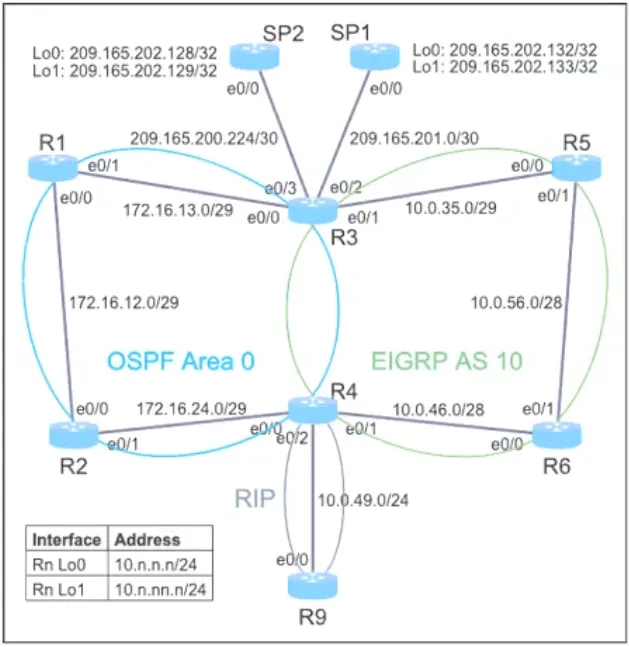
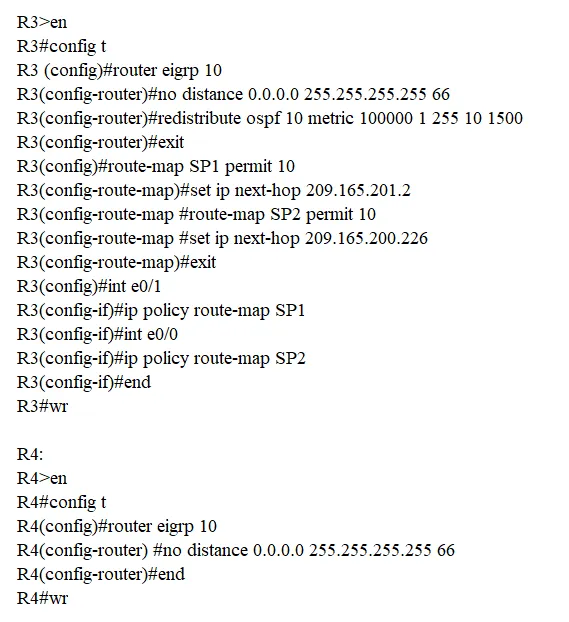
Tasks - Troubleshoot and resolve the issues to achieve these goals: 1. Ensure that R1 reaches the prefix 10.6.66.6 without any single point of failure in the path. Do not use a static route or policy-based routing to accomplish this. 2. Ensure that R1 loopback 1 reaches to R6’s loopback 1 by following the path through R1, R3, R5 to R6 and vice versa. Use metric values K1 = 100000, K2=1, K3=255, K4=10, K5=1500 to modify the default metric in EIGRP if required. Do not use a route-map. 3. Ensure that on R3, prefix 10.0.56.6/32 uses the SP1 to route to the Internet, whereas prefix 172.16.12.2/32 uses the SP2 to route to the Internet. Do not use BGP to accomplish this. Use the pre-configured route-maps SP1 and SP2 and modify to accomplish the task if required. Use the ping and trace commands from R6 and R2 to prefixes 209.165.202.132 and 209.165.202.128, respectively to verify the results.
This is an interactive task on the real exam — a drag-and-drop, hotspot or ordering question. There is nothing to select here, so the answer is shown below for reference.
Answer: See figure below
The above traceroute goes through R4 which is longer path. The question asks for R1 -->R3 --> R5 --> R6. When we issue this command on R3: R3(config)# R3(config-router)#no distance 125 0.0.0.0 255.255.255.255 66 Now R3 has 10.6.66.6 as a better route in eigrp compared to OSPF E2 route of R4, and redistributes it into OSPF 1 and installs it into LSDB. Now R3 has better route: R3#show ip ro *Jul 16 22:22:07.702: %SYS-5-CONFIG_I: Configured from console by console R3#show ip route D 10.5.5.0/24 [90/409600] via 10.0.35.5, 00:02:15, Ethernet0/1 D 10.5.55.0/24 [90/409600] via 10.0.35.5, 00:02:15, Ethernet0/1 D 10.6.6.0/24 [90/51379200] via 10.0.35.5, 00:02:15, Ethernet0/1 D 10.6.66.0/24 [90/51379200] via 10.0.35.5, 00:02:15, Ethernet0/1 And now R3 installs this into its OSPF LSDB and advertises it to R1.
Source: Adapted from community discussion — bk989
Keyboard:J Kmove between questionsA–Dselect an answerRshow or hide the answer← →change page
300-410 practice, question 491. 578 questions available.
Version 1.0.0. How we source questions