Question 331 · 578 in bank
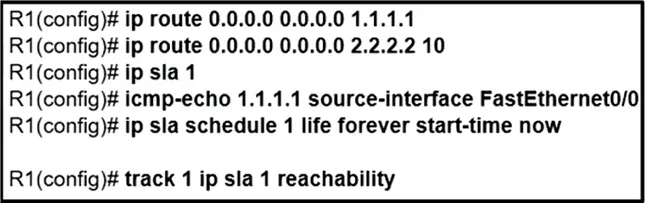
Refer to the exhibit. An IP SLA is configured to use the backup default route when the primary is down, but it is not working as desired. Which command fixes the issue?
Show answer
Answer: D
Implementing Cisco Enterprise Advanced Routing and Services (ENARSI)578 questions across 58 pages are complete and free, with no account or card.
578 questions in this bank
Free access · progress saved on this device
Refer to the exhibit. An IP SLA is configured to use the backup default route when the primary is down, but it is not working as desired. Which command fixes the issue?
Answer: D
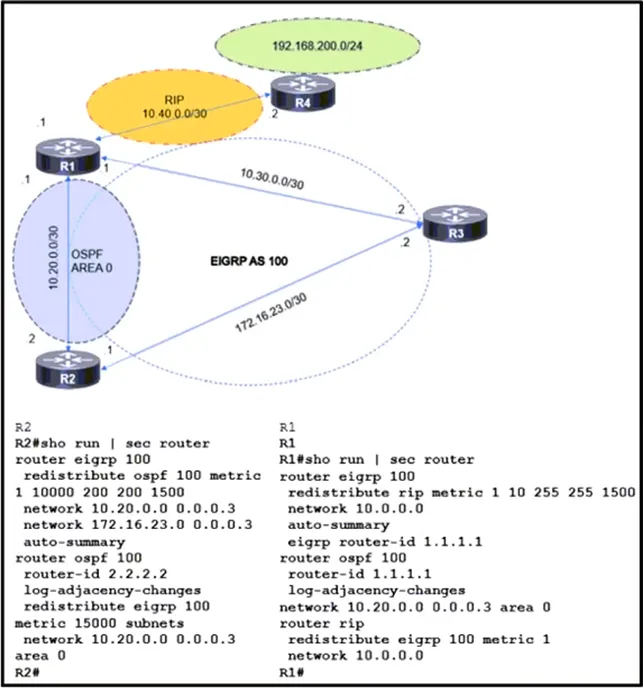
Refer to the exhibit. The route to 192.168.200.0 is flapping between R1 and R2. Which set of configuration changes resolves the flapping route?
Answer: D
D is right. R1 just redistribute RIP in EIGRP. R2 learn 192.168.200.0 route from EIGRP and R2 redistribute EIGRP in OSPF, then R2 advertive 192.168.200.0 to R1. R1 learns 192.168.200.0 from R2 via OSPF. OSPF has AD 90 and RIP 120, so OSPF route become better than RIP route, but, for a route redistribution there is a rule that says the route must be in routing table and the source of redistribution must be the source of this route in route table, in this case, the RIP. When R1 learn this route in OSPF, the OSPF route replace the RIP route in route table, so the rule is broken and the redistribution stop working, then R1 stops redistribuing 192.168.200.0 to EIGRP and R2 stop reciving this route and R2 stops redistribute this route in OSPF so R1 won't recive this route from OSPF anymore, then OSPF route is removed from LSDB and RIB so RIP route go to the route table and the redistribution to EIGRP starts again and the problem starts over and over If you redistribute RIP in OSPF in R1, R2 is gonna have this route as the best route from OSPF, so it does not matter if R2 learns it from EIGRP or NOT, because OSPF has AD 90 and External EIGRP 170.
Source: Adapted from community discussion — Malasxd
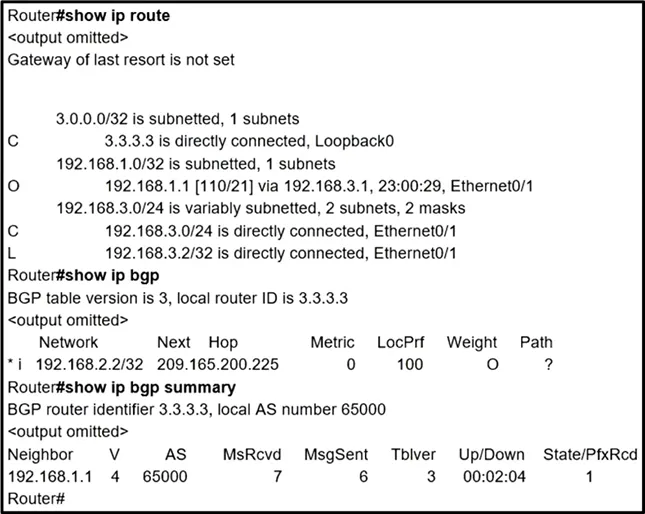
Refer to the exhibit. Which action installs route 192.168.2.2/32 in the routing table?
Answer: D
if we did command "show ip route 192.168.2.2/32" It will show the next hop address as (inaccessible) which means the router has no way to the next hop of the advertised route. So we do next-hop-self on advertising router to reach the destination. BGP advertisement doesn't overwrite the next hop.
Source: Adapted from community discussion — bk989
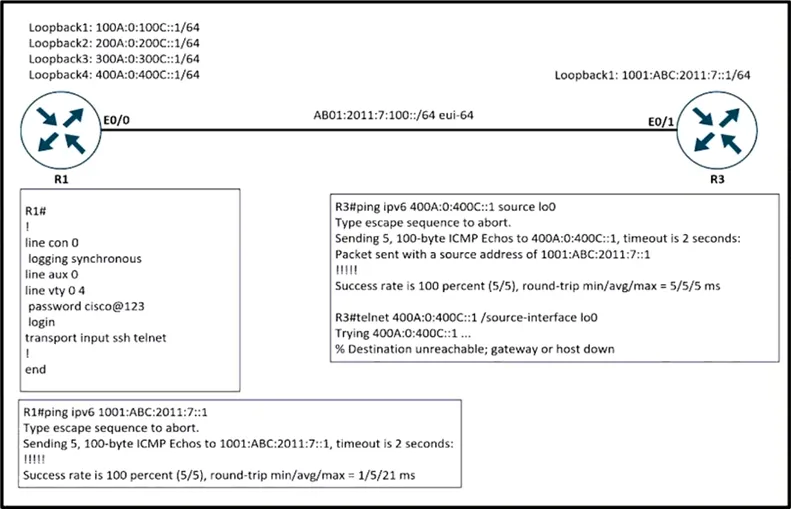
Refer to the exhibit. An engineer is trying to log in to R1 via R3 loopback address. Which action resolves the issue?
Answer: C
We don't see that in the configuration. But through process of elimination, we can see that A & D are wrong because "transport input ssh telnet" already allows remote access. So we are just left with two answers. From the image we can see the user is using "telnet" to remote access, so we must choose C. Although we cannot see an ACL, we can see all configuration looks correct and the connection is failing. So the answer is "C"
Source: Adapted from community discussion — rob899

Refer to the exhibit. Which action restores the routes from neighbors while still filtering 1.1.1.0/24?
Answer: D
wrong. "Which action restores the routes from neighbors while still filtering 1.1.1.0/24?" Wuestion wants to filter out 1.1.1.0/24 and allow other routes. We add sequence 20 to route map, with no match, to allow everything.
Source: Adapted from community discussion — bk989

Refer to the exhibit. An administrator must upload the packages.conf file to an FTP server. However, the FTP server rejected anonymous service and required users to authenticate. What are the two ways to resolve the issue? (Choose two.)
Answer: CE
ip ftp username username Example: Router(config)# ip ftp username user1 ip ftp password password Example: Router(config)# ip ftp password guessme Router# copy slot0:1:your-ios ftp://myuser:mypass@172.23.1.129/dirt/sysadmin/your-ios
Source: Adapted from community discussion — pitcholo
An engineer configured VRF-Lite on a router for VRF blue and VRF red. OSPF must be enabled on each VRF to peer to a directly connected router in each VRF. Which configuration forms OSPF neighbors over the network 10.10.10.0/28 for VRF blue and 192.168.0.0/30 for VRF red?
Answer: B
Both B & C are correct however using wild card mask is more desirable than using the subnet mask. Quote : In my network implementations, I use the network statements in three different ways: If I have to assign a specific interface into an area, I would always use network x.y.z.w 0.0.0.0 area n; If the area address ranges are nicely assigned (which also helps immensely when you have to start summarizing), you can use a single network statement to cover the whole area. If, for example, area 3 has address range 10.1.16.0/20, use network 10.1.16.0 0.0.15.255 area 3; If the router has all interfaces in a single area, I would almost always use network 0.0.0.0 255.255.255.255 area area-id (unless there is an extremely good reason that some interfaces should not be seen by the OSPF process). Correct answer is B .
Source: Adapted from community discussion — pitcholo
The network administrator must implement IPv6 in the network to allow only devices that not only have registered IP addresses but are also connecting from assigned locations. Which security feature must be implemented?
Answer: D
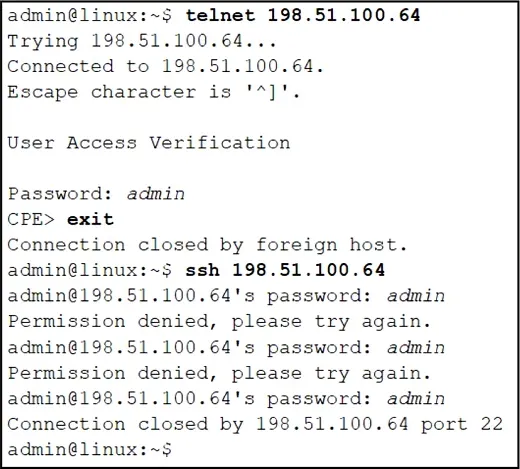
Refer to the exhibit. An administrator can log in to the device using Telnet, but the attempts to log in to the same device using SSH with the same credentials fail. Which action resolves this issue?
Answer: A
I needed to see this in my CML lab. Actually, both solutions worked fine: A) adding "login local" to the vty configuration and Zizu007's solution using AAA. The main thing was to instruct the router to use the local user database this or that way. For this, a local user was created, e.g. username admin password cisco As a solution with AAA is not listed, I choose answer "A".
Source: Adapted from community discussion — HungarianDish_111
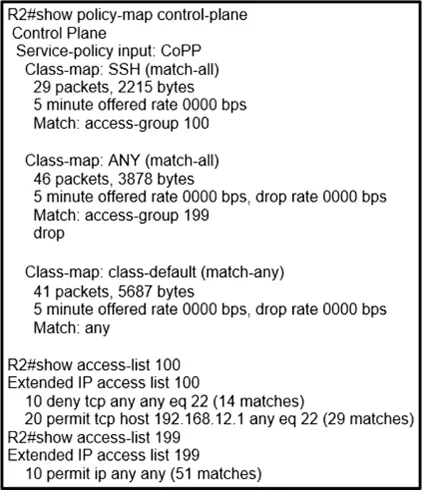
Refer to the exhibit. Which action limits access to R2 from 192.168.12.1?
Answer: B
IMHO, B or C seem to be both OK. They would like to police SSH traffic only from source 192.168.12.1. So, they need to match the traffic with an access-list: 10 permit tcp host 192.168.12.1 any eq 22 -> Police (rate-limit) this traffic 20 deny tcp any any eq 22 -> Allow this traffic unconstrained Then they use it in the class-map SSH: class-map SSH match access-group 100 policy-map CoPP class SSH This CoPP constrains traffic from 192.168.12.1 (matched by "permit"), but allows hosts with any other source address without constraint (excluded by "deny"). They have to "deny" SSH traffic from any other source addresses in the ACL so that they are excluded from "class-map SSH". They will be matched and allowed unconstrained by the “class-default” which is implemented implicitly at the end of the policy-map.
Source: Adapted from community discussion — HungarianDish_111
Keyboard:J Kmove between questionsA–Dselect an answerRshow or hide the answer← →change page
300-410 practice, question 331. 578 questions available.
Version 1.0.0. How we source questions