Question 301 · 578 in bank
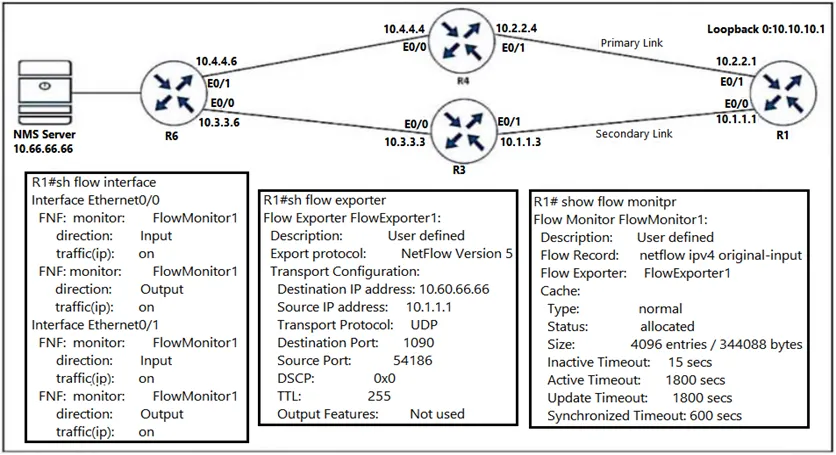
Refer to the exhibit. An engineer configured NetFlow on R1, but the flows do not reach the NMS server from R1. Which configuration resolves this issue?
Show answer
Answer: D
Implementing Cisco Enterprise Advanced Routing and Services (ENARSI)578 questions across 58 pages are complete and free, with no account or card.
578 questions in this bank
Free access · progress saved on this device
Refer to the exhibit. An engineer configured NetFlow on R1, but the flows do not reach the NMS server from R1. Which configuration resolves this issue?
Answer: D
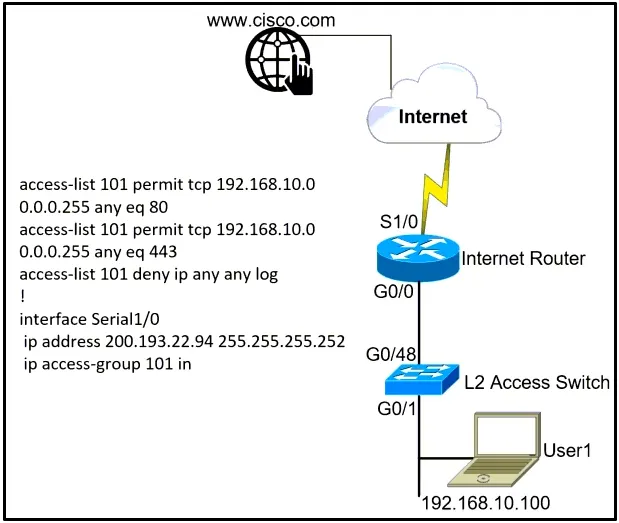
Refer to the exhibit. A network administrator is tasked to permit http and https traffic only toward the internet from the User1 laptop to adhere to company’s security policy. The administrator can still ping to www.cisco.com. Which interface should the access list 101 be applied to resolve this issue?
Answer: B
NAT should be enabled.In the S1/0 output direction, the ACL is after SNAT conversion (192.168.10.0 -> 200.193.22.94), so it does not match the ACL101 condition.
Source: Adapted from community discussion — b8os5h
An engineer configured routing between multiple OSPF domains and introduced a routing loop that caused network instability. Which action resolves the problem?
Answer: A
https://networklessons.com/cisco/ccie-routing-switching/troubleshooting-metric-redistribution Redistribution Rule: Never advertise prefixes from routing protocol X into Y and then back into X. Redistribution goes from one protocol (or routing domain) into the other protocol (or routing domain) using the redistribute command. It's easier to picture redistribution between different protocols. Answer "A" means something like this: router ospf 1 redistribute eigrp 100 subnets tag 20 route-map FILTER deny match tag 20 route-map FILTER permit router eigrp 100 redistribute ospf 1 metric 100000 1 255 1 1500 route-map FILTER 1)redistribute into ospf and set the tag 2)redistribute into eigrp and match the tag (with action deny) Set a tag so, routes originating from a routing domain will not be redistributed back into that domain.
Source: Adapted from community discussion — HungarianDish_111
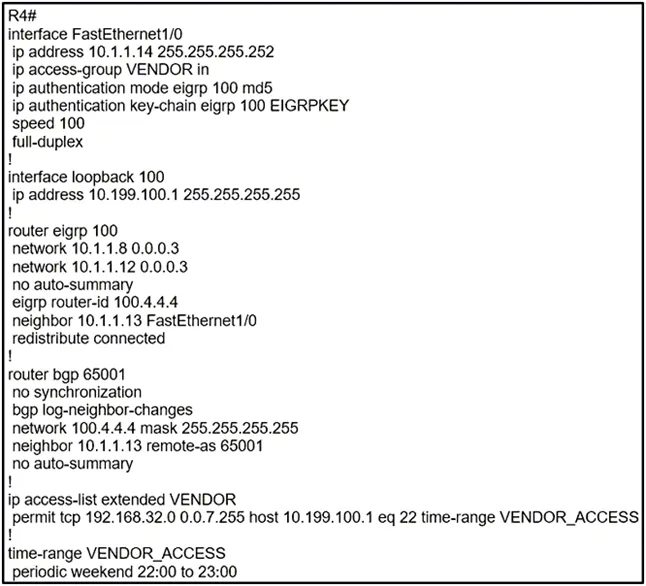
Refer to the exhibit. A network engineer received a call from the vendor for a failed attempt to remotely log in to their managed router loopback interface from 192.168.40.15. Which action must the network engineer take to resolve the issue?
Answer: A
the extended access-list VENDOR: 192.168.32.0 0.0.0.7.255 that starts at 192.168.32.1 and ends at 192.168.39.254 doesn't include the vendor ip address of 192.168.40.15
Source: Adapted from community discussion — ellen_AA
DRAG DROP - Drag and drop the descriptions from the left onto the corresponding MPLS components on the right.

This is an interactive task on the real exam — a drag-and-drop, hotspot or ordering question. There is nothing to select here, so the answer is shown below for reference.
Answer: See figure below

Network operations report issues with receiving too many external routes, which caused CPU spike on routers with smaller memories. Which action resolves the issue?
Answer: D
The primary difference between area range and summary-address is in where the command should be applied. Area range should be applied on the ABRs when you are trying to summarize routes between OSPF areas. So area range is used to summarize Type 3 LSAs. On the other hand summary-address should be applied on the ASBRs when you are trying to summarize externally redistributed routes from another protocol domain (eigrp, bgp etc). So summary-address is used to summarize Type5/7 LSAs. One exception to this rule is when you have a NSSA area, the router that is responsible for the conversion of Type7 to Type 5 LSA can have the summary-address applied.
Source: Adapted from community discussion — DUBC89x
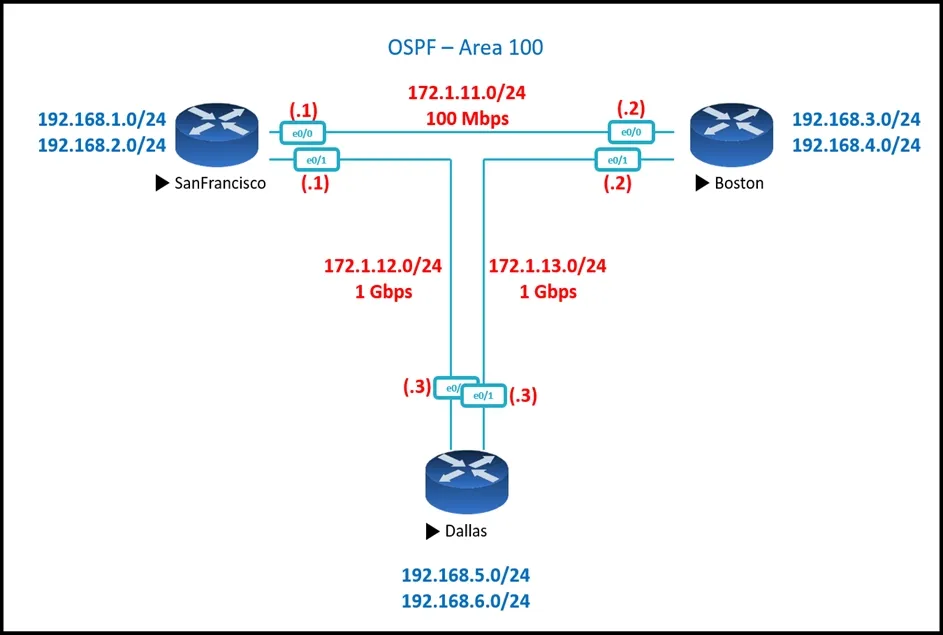
Refer to the exhibits. SanFrancisco and Boston routers are choosing slower links to reach each other despite the direct links being up.
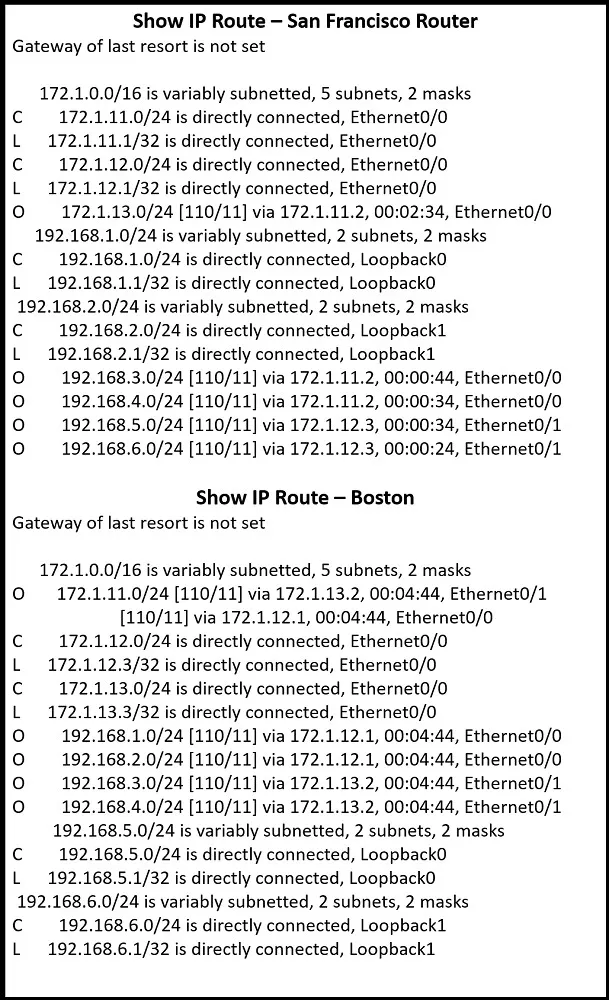
Which configuration fixes the issue?
Answer: D
D is ok : Under the OSPF process, the command auto-cost reference-bandwidth bandwidth-in- mbps changes the reference bandwidth for all OSPF interfaces associated with that process. If the reference bandwidth is changed on one router, then the reference bandwidth should be changed on all OSPF routers to ensure that SPF uses the same logic to prevent routing loops. It is a best practice to set the same reference bandwidth for all OSPF routers.
Source: Adapted from community discussion — Stivostine

Refer to the exhibit. An engineer must configure OSPF with R9 and R10 and configure redistribution between OSPF and RIP, causing a routing loop. Which configuration on R9 and R10 meets this objective?
Answer: D
r9(config-router)#do sh ip route | b Gateway Gateway of last resort is not set 1.0.0.0/8 is variably subnetted, 9 subnets, 2 masks R 1.1.11.0/24 [120/1] via 1.1.91.11, 00:00:04, GigabitEthernet0/2 [120/1] via 1.1.19.10, 00:00:10, GigabitEthernet0/3 C 1.1.19.0/24 is directly connected, GigabitEthernet0/3 L 1.1.19.9/32 is directly connected, GigabitEthernet0/3 C 1.1.59.0/24 is directly connected, GigabitEthernet0/0 L 1.1.59.9/32 is directly connected, GigabitEthernet0/0 O 1.1.61.0/24 [110/3] via 1.1.59.5, 00:00:14, GigabitEthernet0/0 O 1.1.65.0/24 [110/2] via 1.1.59.5, 00:00:14, GigabitEthernet0/0 C 1.1.91.0/24 is directly connected, GigabitEthernet0/2 L 1.1.91.9/32 is directly connected, GigabitEthernet0/2 11.0.0.0/32 is subnetted, 1 subnets R 11.11.11.11 [120/1] via 1.1.91.11, 00:00:04, GigabitEthernet0/2 r9(config-router)#
Source: Adapted from community discussion — HungarianDish_111
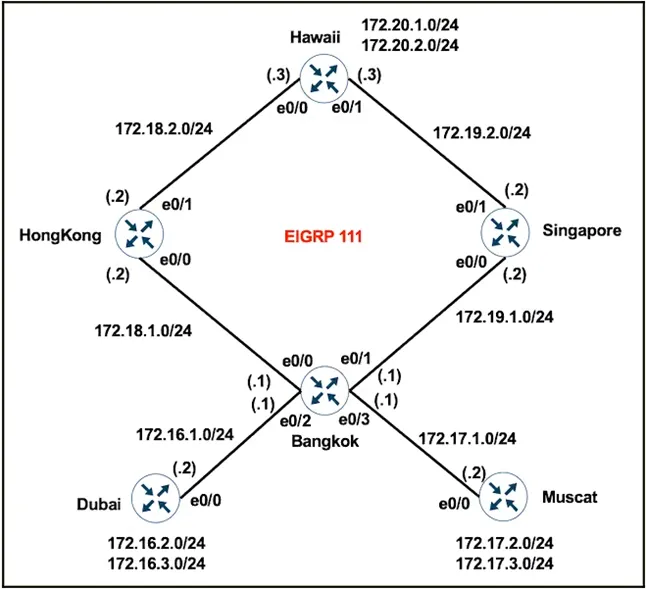
Refer to the exhibit. Bangkok is using ECMP to reach the 172.20.2.0/24 network. The network administrator must configure it in such a way that traffic from 172.16.2.0/24 network uses the Singapore router as the preferred route. Which set of configurations accomplishes this task?
Answer: C
Which label operations are performed by a label edge router?
Answer: B
B. PUSH and POP: A LER pushes a new label onto incoming packets and pops off the label from outgoing packets. The incoming label is used to determine the forwarding path for the packet, while the outgoing label is used to direct the packet to the next hop in the path.
Source: Adapted from community discussion — Titini
Keyboard:J Kmove between questionsA–Dselect an answerRshow or hide the answer← →change page
300-410 practice, question 301. 578 questions available.
Version 1.0.0. How we source questions