Question 211 · 578 in bank
Select 2In order to connect between disparate OSPF and EIGRP portions of a network, mutual route redistribution has been configured. What are two disadvantages of doing this? (Choose two.)
Show answer
Answer: AB
Implementing Cisco Enterprise Advanced Routing and Services (ENARSI)578 questions across 58 pages are complete and free, with no account or card.
578 questions in this bank
Free access · progress saved on this device
In order to connect between disparate OSPF and EIGRP portions of a network, mutual route redistribution has been configured. What are two disadvantages of doing this? (Choose two.)
Answer: AB
Which of the following statements are true regarding two EIGRP routers to become neighbors?
Answer: D
In this case D is right as networklessons is saying: Two EIGRP routers with the same router ID will still form a neighbor adjacency. So the only valid option is D. Remember that the first to options are valid if we were talking about OSPF. If the MTU does not match you will flap everytime in EXSTART/DOWN. The timers must match also otherwise the neighborship will not come UP.
Source: Adapted from community discussion — XBfoundX
Which of the following statements are true regarding two OSPF routers to become neighbors? (Choose two.)
Answer: BC
B and C are correct. There are quite a few questions about OSPF being stuck in EXSTART, which is a typical symphtom of mismatching MTU. OSPF also needs matching hello and dead timers.
Source: Adapted from community discussion — bf10690
A new site has been added to an OPSF network using area 2. Area 2 is connected only to area 1 of this OSPF network. Area 1 is used to connect area 1 to the backbone area 0. Should you expect full connectivity to the networks located in area 2 from area 0 in this scenario?
Answer: C
No it´s not a typo, since area 2 is connected only to area 1, which in turn is connected to the backbone area 0, area 2 is not directly connected to area 0. To achieve full connectivity, a virtual link is required to connect area 2 to area 0 through area 1.
Source: Adapted from community discussion — [Removed]
Router R1 is configured using VRF’s to support customer VPN’s. Some customers are using the same private IP address space. Which of the following is used to ensure that these routes are unique when advertised throughout the VPN?
Answer: A
RD is used to keep it unique when advertised throughout the VPN. Route target is used to control the import into the right VRF, the VRF being tied to a VPN via an RD.
Source: Adapted from community discussion — bk989
Two MPLS routers, R1 and R2, are not directly connected and have an established LDP session running between them. What type of LDP session is this?
Answer: D
In the context of MPLS (Multiprotocol Label Switching), when two routers that are not directly connected have an established LDP (Label Distribution Protocol) session, it is referred to as a "Targeted LDP session." So, the correct answer is: D. Targeted LDP session
Source: Adapted from community discussion — chris110
What is the total length of an MPLS header?
Answer: D
The total length of an MPLS header is 32 bits, or 4 bytes. The MPLS header is composed of several fields, including a label, experimental bits, a bottom-of-stack (BoS) bit, a time-to-live (TTL) field, and a type field. Each field is a specific length, and together they comprise the 32-bit MPLS header.
Source: Adapted from community discussion — Titini
R2 has a locally originated prefix 192.168.130.0/24 and has these configurations:

What is the result when the route-map OUT command is applied toward an eBGP neighbor R1 (1.1.1.1) by using the neighbor 1.1.1.1 route-map OUT out command?
Answer: A
I'm going with A. The as-prepend will add the additional AS identifier which in turn makes the route 2 AS hops a way. This is used with multihomed ISP configurations to determine the path of incoming traffic.
Source: Adapted from community discussion — Guitarman
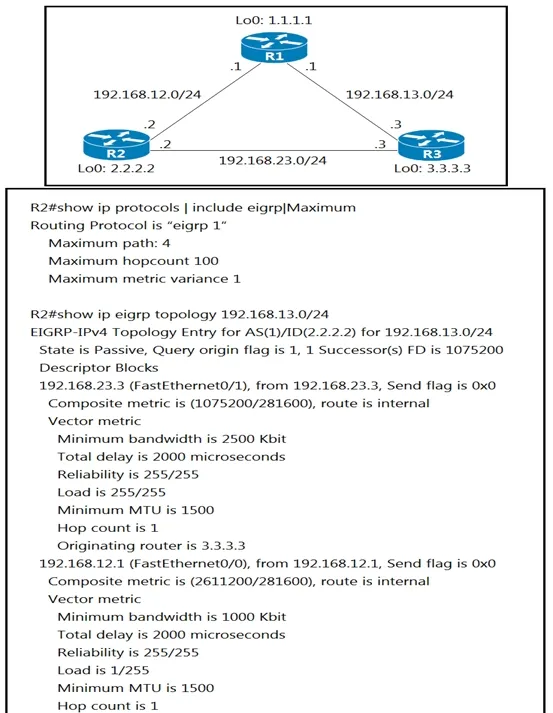
Refer to the exhibit. R2 has two paths to reach 192.168.13.0/24, but traffic is sent only through R3. Which action allows traffic to use both paths?
Answer: A
Answer = A Explanation: Feasible Distance of R3 (successor) = 1075200 Feasible Distance of R1 (feasible successor) = 2611200 Calculation: 2611200 / 1075200 = 2.4 So we need a Variance value higher than 2.4 for unequal cost load balancing to work.
Source: Adapted from community discussion — TECH3K3
Which of the following are valid fields in an MPLS header? (Choose four.)
Answer: ACDE
A C D E are correct Label: This is a 20-bit field that identifies the MPLS label for the packet. It is used to determine how the packet should be forwarded. Experimental (Exp): This 3-bit field is used for experimental purposes and can be utilized for quality of service (QoS) or other features. It is often used to carry information such as priority or class of service. Bottom of Stack (BoS): This 1-bit field indicates whether the label is the last label in the stack. If set to 1, it means this is the bottom of the label stack. Time to Live (TTL): This 8-bit field is used to prevent looping of MPLS packets by decrementing its value at each hop. If the TTL value reaches zero, the packet is discarded.
Source: Adapted from community discussion — [Removed]
Keyboard:J Kmove between questionsA–Dselect an answerRshow or hide the answer← →change page
300-410 practice, question 211. 578 questions available.
Version 1.0.0. How we source questions