Question 31 · 99 in bank
Which vSphere component provides continuous availability for mission-critical virtual machines so users experience no loss of data and no interruption in service during a host failure?
Show answer
Answer: A
VMware vSphere 7.x Associate (VCTA-DCV)99 questions across 10 pages are complete and free, with no account or card.
99 questions in this bank
Free access · progress saved on this device
Which vSphere component provides continuous availability for mission-critical virtual machines so users experience no loss of data and no interruption in service during a host failure?
Answer: A
Which two guest operating systems are supported when a virtual machine must be deployed? (Choose two.)
Answer: CD
Reference: https://www.vmware.com/resources/compatibility/pdf/VMware_GOS_Compatibility_Guide.pdf
Which virtual machine (VM) problem is solved using vSphere Storage vMotion?
Answer: C
An administrator wants to deploy virtual machines on Windows 10 desktop. Which option accomplishes this goal?
Answer: C
Reference: https://phoenixnap.com/kb/what-is-hypervisor-type-1-2
Refer to the exhibit:
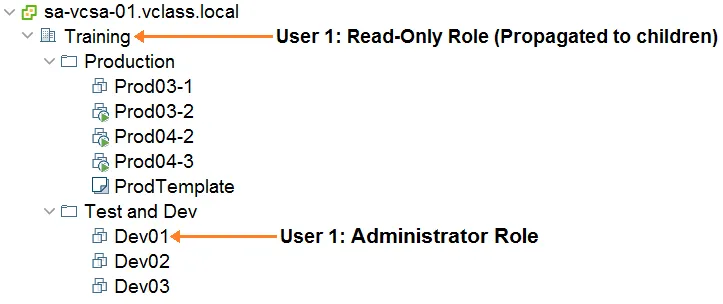
Which statement is true about the access privileges of User 1?
Answer: C
C is the correct answer. User 1 has Read-only privileges to the entire Training folder. The only VM that he has Administrator Role privilege is the Dev01 inside the Test and Dev folder because direct Role overrules the Parent.
Source: Adapted from community discussion — dinosan
Which name identifies a VMkernel port in a virtual networking configuration?
Answer: D
A vSphere cluster running a virtual machine with VMware HA and DRS enabled in fully automated mode is experiencing a catastrophic host failure. Which action can the administrator expect DRS to take?
Answer: C
In a vSphere cluster with VMware High Availability (HA) and Distributed Resource Scheduler (DRS) enabled in fully automated mode, experiencing a catastrophic host failure, the action the administrator can expect DRS to take is: C. It will move the VM to a host in the same cluster with enough resources after the HA restart. When VMware HA detects a host failure and initiates a restart of the affected virtual machines on other hosts within the same cluster, DRS, if configured in fully automated mode, will then assess the resource availability and load across the remaining hosts in the cluster. If there are hosts with sufficient resources available (CPU, memory, etc.), DRS will take the necessary action to ensure the restarted virtual machines are placed on a host that can accommodate them within the same cluster, optimizing resource usage and balancing the cluster's workload.
Source: Adapted from community discussion — playfulbear
An alarm is triggered in vSphere Client due to a failure of a host in a cluster. The host has not returned to normal state, but the administrator wants to clear the alarm. Which sequence of steps should the administrator take to accomplish this goal?
Answer: D
Which feature must an administrator use to revert back to the previous version of a VM template?
Answer: A
An operator must deploy three 0 named Win10-Template, and all three VMs must be configured with unique computer names. Which action must the operator take to achieve this goal?
Answer: A
Using a clone is not a good idea. In Windows environment each system has a SID, this one must be unique when creating vms, with cloning it will keep the same SID. The correct answer is A
Source: Adapted from community discussion — benycom
Keyboard:J Kmove between questionsA–Dselect an answerRshow or hide the answer← →change page
1V0-21.20 practice, question 31. 99 questions available.
Version 1.0.0. How we source questions