Question 131 · 578 in bank
Which configuration enables the VRF that is labeled `Inet` on FastEthernet0/0?
Show answer
Answer: C
Implementing Cisco Enterprise Advanced Routing and Services (ENARSI)578 questions across 58 pages are complete and free, with no account or card.
578 questions in this bank
Free access · progress saved on this device
Which configuration enables the VRF that is labeled `Inet` on FastEthernet0/0?
Answer: C
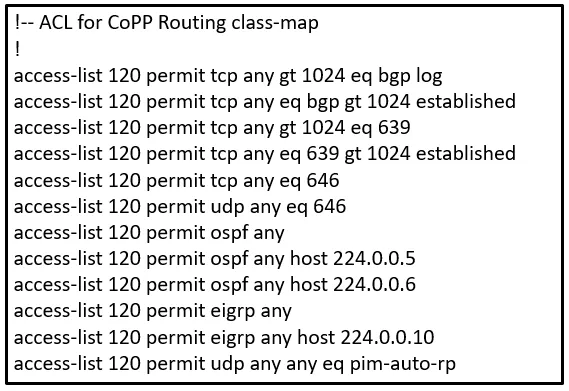
Refer to the exhibit. The control plane is heavily impacted after the CoPP configuration is applied to the router. Which command removal lessens the impact on the control plane?
Answer: A
The Real explanation here is that log option in ACL is Known to have trouble with CoPP. "•CoPP does not support ACEs with the log keyword" https://www.cisco.com/en/US/docs/general/Test/dwerblo/broken_guide/copp.html
Source: Adapted from community discussion — Koume

Refer to the exhibit. An engineer is trying to add an encrypted user password that should not be visible in the router configuration. Which two configuration commands resolve the issue? (Choose two.)
Answer: AB
I believe A & B would be a suitable answer. using "secret" HASHes the password, not encrypting it. the engineer tried to encrypt the password not HASH it so A would be good.
Source: Adapted from community discussion — guy276465281819372
A customer reports that traffic is not passing on an EIGRP enabled multipoint interface on a router configured as below:

Which action resolves the issue?
Answer: B
When split horizon is enabled, any route learned from an interface is not advertised back out the same interface. This rule is intended to stop routing loops with distance-vector protocols.
Source: Adapted from community discussion — GodFather
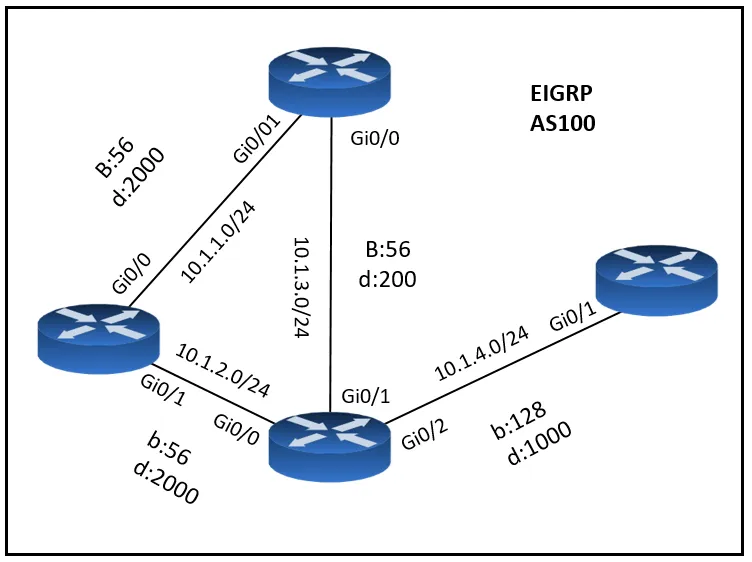
Refer to the exhibit. A loop occurs between R1, R2, and R3 while EIGRP is run with poison reverse enabled. Which action prevents the loop between R1, R2, and R3?
Answer: A
Poison Reverse is automatically enabled with Split Horizon, you cannot manually enable Poison Reverse. So if the question indicates a loop occurs while Poison Reverse is enabled, then A is not the right answer. Also, all the neighbors are form through different interfaces so the concept of SH doesn't apply anyways, it's only for multipoint interfaces e.g. DMVPN. We don't know which one is R3 to say stub receive-only can avoid the loop, even though it could help. Route tagging works with redistribution so it's not the right answer. Route filtering is the only answer I can think it's right, you can set up a prefix list and filter out routes coming from a neighbor and avoid loops.
Source: Adapted from community discussion — NicoF
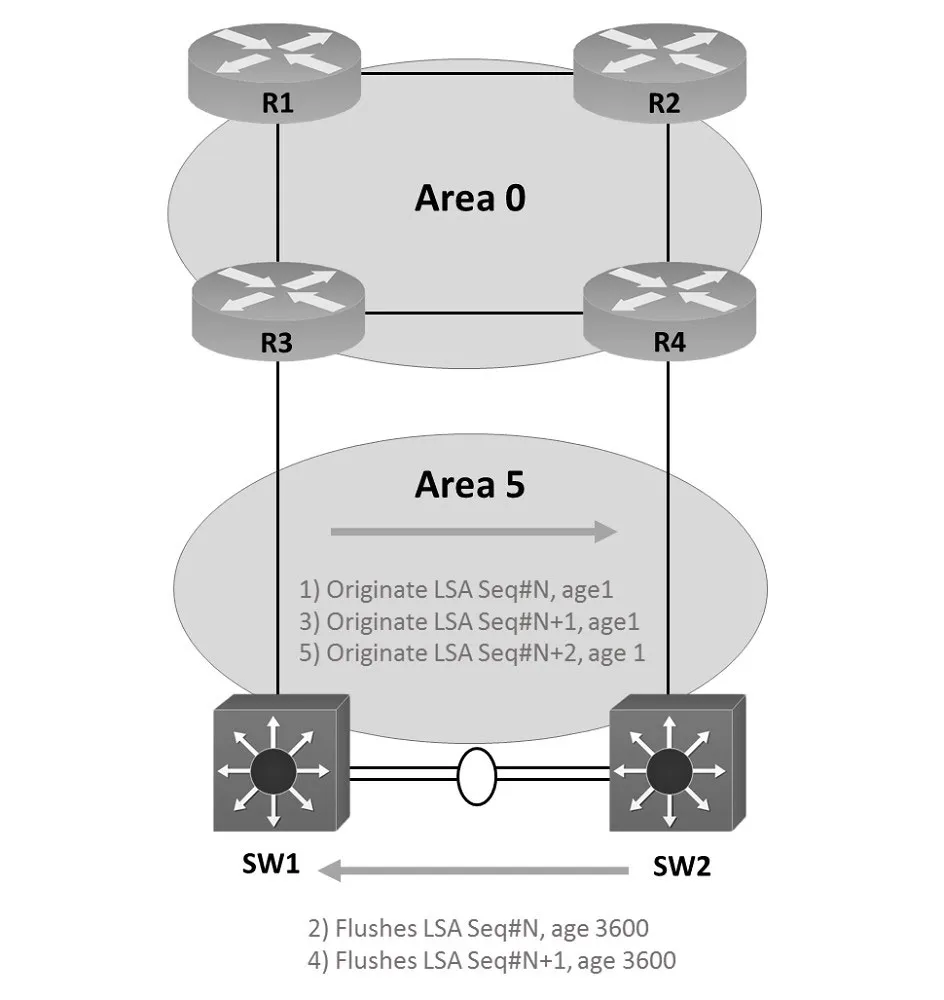
Refer to the exhibit. An error message "an OSPF-4-FLOOD_WAR" is received on SW2 from SW1. SW2 is repeatedly receiving its own link-state advertisement and flushes it from the network. Which action resolves the issue?
Answer: D
The question is based on this cisco document: https://www.cisco.com/c/en/us/support/docs/ip/open-shortest-path-first-ospf/118880-technote-ospf-00.html "This is meant to detect issues with Type-2 LSAs when duplicate IP addresses are present in the network, or with Type-5 LSAs when there is a duplicate router ID in different OSPF Areas."
Source: Adapted from community discussion — HungarianDish_111
Which two components are required for MPLS Layer 3 VPN configuration? (Choose two.)
Answer: CE
You need a RD and MP-BGP to propagate the customer routes through the MPLS. OSPF between the PE and CE *can* be used and will work fine, but is not needed. CE
Source: Adapted from community discussion — Remsync
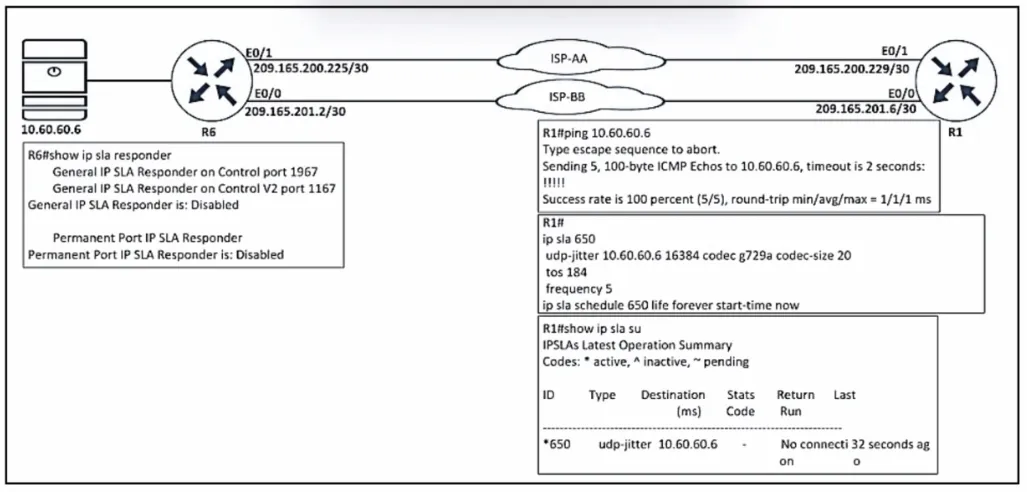
Refer to the exhibit. Which configuration resolves the IP SLA issue from R1 to the server?
Answer: A
R5#show ip sl summary IPSLAs Latest Operation Summary Codes: * active, ^ inactive, ~ pending ID Type Destination Stats Return Last (ms) Code Run ----------------------------------------------------------------------- *5 udp-jitter 6.6.6.6 RTT=6 OK 0 seconds ago ---- LOCAL: ip sla 5 udp-jitter 6.6.6.6 5000 threshold 1000 timeout 2000 frequency 2 ip sla schedule 5 life forever start-time now ----- REMOTE: ip sla responder
Source: Adapted from community discussion — Zizu007
A network administrator added a new spoke site with dynamic IP on the DMVPN network. Which configuration command passes traffic on the DMVPN tunnel from the spoke router?
Answer: C
Non-Unique Registrations If you’re experiencing DMVPN downtime due to changing public IP addresses of your DMVPN spokes, apply the ip nhrp registration non-unique interface configuration command to the DMVPN tunnel interface. This command will reduce the recovery time to less than a minute. Faster recovery is harder to achieve as the router has to execute a number of steps following a physical interface flap: Install new static routes to the hub sites; Create IPSec session with the hub sites; Register new public IP address with NHRP; Establish routing adjacency. You can fine-tune steps 1-3 on the spoke router; step 4 sometime requires coordinated changes throughout the network. https://blog.ipspace.net/2010/09/dmvpn-non-unique-nhrp-registrations.html
Source: Adapted from community discussion — jarz

Refer to the exhibit. Which configuration enables OSPF for area 0 interfaces to establish adjacency with a neighboring router with the same VRF?
Answer: C
C is correct Areas are identified through a 32-bit area field; thus, Area ID 0 is the same as 0.0.0.0 I think the whole purpose of this question is to test your knowladge of this information. https://www.sciencedirect.com/topics/computer-science/backbone-area#:~:text=Areas%20are%20identified%20through%20a%2032%2Dbit%20area%20field%3B%20thus%2C%20Area%20ID%200%20is%20the%20same%20as%200.0.0.0.
Source: Adapted from community discussion — [Removed]
Keyboard:J Kmove between questionsA–Dselect an answerRshow or hide the answer← →change page
300-410 practice, question 131. 578 questions available.
Version 1.0.0. How we source questions