Question 211 · 377 in bank
How does Cisco DNA Center enhance network automation?
Show answer
Answer: B
Implementing and Operating Cisco Service Provider Network Core Technologies (SPCOR)377 questions across 38 pages are complete and free, with no account or card.
377 questions in this bank
Free access · progress saved on this device
How does Cisco DNA Center enhance network automation?
Answer: B

Refer to the exhibit. Which type of DDoS attack will be mitigated by this configuration?
Answer: D

Refer to the exhibit. A network engineer is implementing multicast services on CPE-1 and CPE-2. CPE-1 must be configured as the preferred IGMP querier for the LAN segment. PIM-SM must be implemented on the LAN interfaces with an IGMP version that supports (*, G) joins only. Which configurations must the engineer implement on CPE-1 and CPE-2?
Answer: A
When an IGMPv2 device receives a general query message, the device compares the source IP address in the message with its own interface address. The device with the lowest IP address on the subnet is elected the IGMP querier. https://www.cisco.com/c/en/us/td/docs/ios-xml/ios/ipmulti_igmp/configuration/xe-16-9/imc-igmp-xe-16-9-book/imc-customizing-igmp.html
Source: Adapted from community discussion — Karoly
A new PE router is configured to run OSPF as an IGP with LDP on all interfaces. The engineer is trying to prevent black holes after convergence when the PERSON device loses an LDP session with other PE routers. Which action must the engineer take to implement LDP session protection on a new PE router?
Answer: C
Which condition must be met for TI-LFA to protect LDP traffic?
Answer: D
Protecting LDP traffic with TI-LFA – Restrictions • Point of Local Repair (PLR) must be SR-capable • Protected destination must have an associated prefix-SID – Advertised by itself if SR-capable – Advertised by mapping server if not SR-capable • Single-segment protection: PQ node must be SR-capable – If not, use rLFA, which requires targeted LDP session • Double-segment protection: P and Q nodes must both be SR-capable Page 56 - https://www.cisco.com/c/dam/global/zh_cn/solutions/service-provider/segment-routing/pdf/topology_independent_lfa.pdf
Source: Adapted from community discussion — ja73
The NOC team must update the BGP forwarding configuration on the network with these requirements: ✑ BGP peers must establish a neighborship with NSF capability and restart the session for the capability to be exchanged after 120 seconds. ✑ BGP peers must delete routes after 360 seconds of inactivity. Which action meets these requirements?
Answer: D
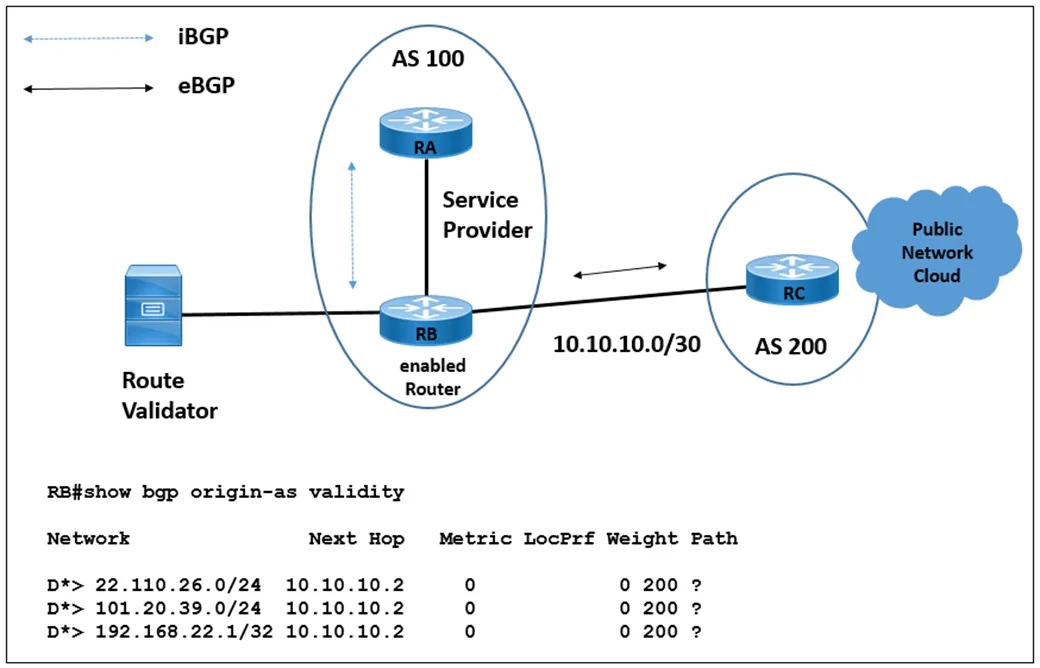
Refer to the exhibit. A network engineer is configuring router RB to secure BGP advertisements against route hijacking activity. RB must validate all prefixes that it receives from origin AS 200 before installing them in the BGP route table. Which configuration meets the requirement?
Answer: D
https://www.cisco.com/c/en/us/support/docs/ip/border-gateway-protocol-bgp/217020-bgp-rpki-with-xr7-cisco8000-whitepaper.html By default, the router fetches ROAs from the validator but does not begin using them until it is configured to do so. As a result, these prefixes are marked as ‘D’ or disabled... In order to enable the router for as-origin validity check, activate this command for the concerned address family. router bgp address-family ipv4 unicast bgp origin-as validation enable it causes the router to scan the prefixes present in its BGP table against the ROA information received from the validator and one of the three states is assigned to prefixes. In order to enable the router to use prefix validation state information while making the best path calculation, this command is needed. router bgp address-family ipv4 unicast bgp bestpath origin-as use validity I would go for D, since it just need to scan the prefix
Source: Adapted from community discussion — kelso1603
After troubleshooting multiple outages on the network due to repeated configuration errors, the network architect asked an engineer to enable NETCONF to facilitate future configurations. The configuration must enable syslog messaging to record NETCONF notifications from each of the numerous devices on the network. Which configuration must the engineer apply?
Answer: C

Refer to the exhibit. In the service provider network, routers PE1, PE2, and PE4 have access to the internet and provide access to customer networks. Router PE3 is used for access to other customer systems. In accordance with a new SLA, an engineer is updating settings on this network so that router CE1 accesses the internet via PE1 instead of PE2. Which two tasks must the engineer perform to complete the process? (Choose two.)
Answer: E
option E is correct but option A does not seems correct, instead it should be on PE1 in CE1 VRF remove import RT of 102:102
Source: Adapted from community discussion — Zee81

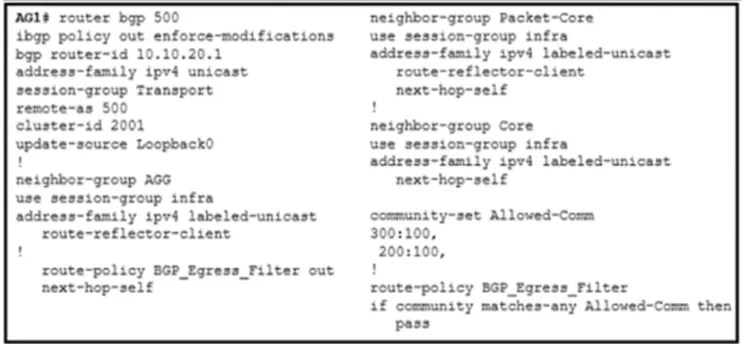
Refer to the exhibit. A NOC engineer is configuring label-based forwarding from CSR to the EPC gateway. Cell-site operation and maintenance for IPv4 traffic between 10.20.10.1 and 192.168.10.10 is already up. CR1 and CR2 are configured as route reflectors for AG1 and AG2. Which action completes the configuration?
Answer: B
ommunity-set Allowed-Comm 300:100, 200:100, !!BGP Packet Core Community=300:100 !!BGP Agg Community=200:100 route-policy BGP_Egress_Filter if community matches-any Allowed-Comm then pass neighbor-group Packet-Core use session-group infra address-family ipv4 labeled-unicast route-reflector-client next-hop-self route-policy BGP_Egress_Filter both Answer: B
Source: Adapted from community discussion — sushil_bhattacharjee
Keyboard:J Kmove between questionsA–Dselect an answerRshow or hide the answer← →change page
350-501 practice, question 211. 377 questions available.
Version 1.0.0. How we source questions