Question 191 · 377 in bank
Which type of attack is an application attack?
Show answer
Answer: C
Implementing and Operating Cisco Service Provider Network Core Technologies (SPCOR)377 questions across 38 pages are complete and free, with no account or card.
377 questions in this bank
Free access · progress saved on this device
Which type of attack is an application attack?
Answer: C

Refer to the exhibit. A network engineer observed congestion between routers R1 and R4, which are connected on a point-to-point link. Two servers that reside on networks on R1 and R4 generate heavy traffic between them with most traffic going from R4 to R1. To improve overall performance, the engineer wants to drop inbound packets that exceed a configured threshold, without disrupting traffic that passes from R4 to R3. Which action must the engineer take to resolve the issue?
Answer: A
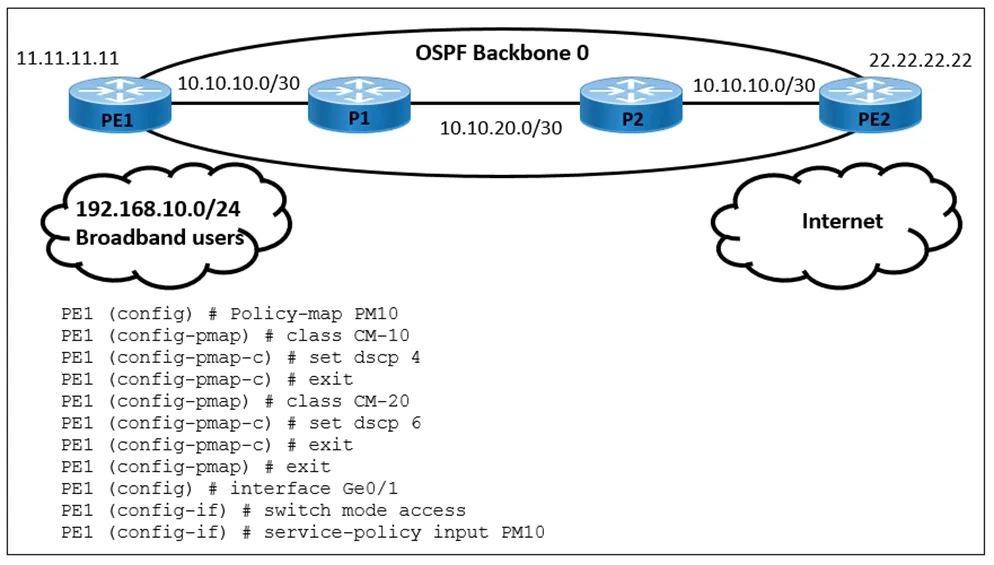
Refer to the exhibit A user is performing QoS marking on internet traffic and sending it with IPv4 and IPv6 headers on the provider edge device PE1. IPv4 traffic is classified with DSCP 4 and IPv6 traffic is classified with DSCP 6. Which action must the engineer take to begin implementing a QoS configuration on PE1 for the IPv6 traffic?
Answer: A
Wow, such a confusing question! Probably A by process of elimination In the configuration are no matches in the class for CM-10 or CM-20 but then they are only asking about IPv6 QoS so any answer relating to the IPv4 or DSCP 4 should not be correct. That leaves A, to create an IPv6 access list and apply that to CM-20.
Source: Adapted from community discussion — thejag

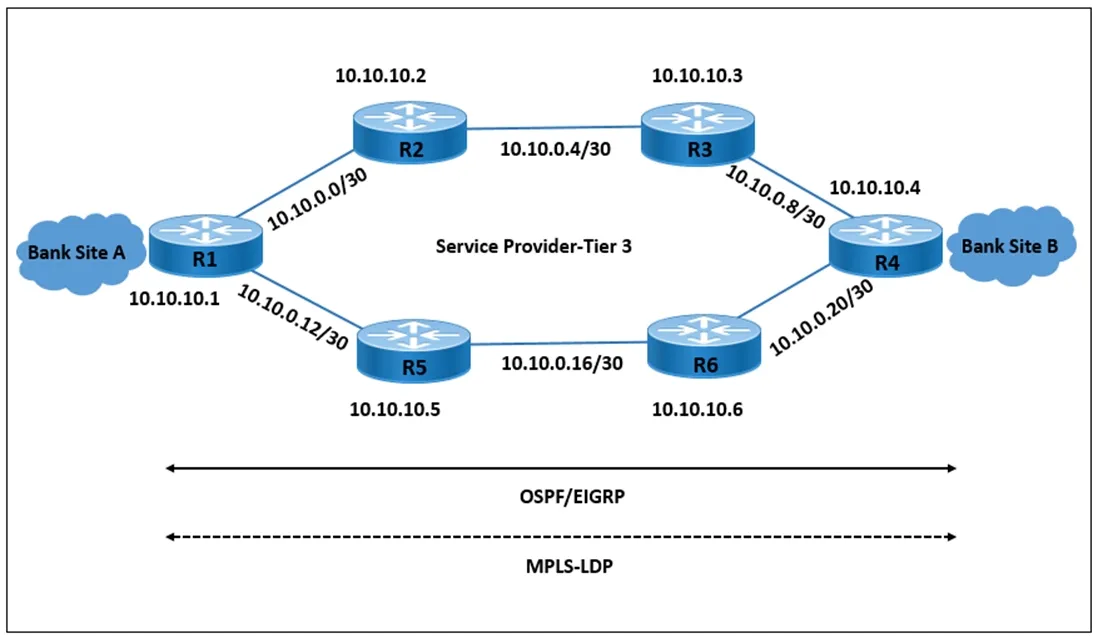
Refer to the exhibit. EIGRP is running between routers R5 and R1, and OSPF is used in the rest of the network. Users in a network attached to router R3 need to access a server connected to R5. Which task must the engineer perform so that only the users attached to R3 are able to access the server, but no other network is shared to OSPF?
Answer: A
I'm not happy to think about this question, but A is ok. We can announce in ospf the route to the server and in eigrp only networks from R3, then the packets from the rest of the clients from other networks will be discarded for the reason no route to respond. The question is a bit tricky!
Source: Adapted from community discussion — 1234512345
While an engineer deploys a new Cisco device to redistribute routes from OSPF to BGP, they notice that not all OSPF routes are getting advertised into BGP. Which action must the engineer perform so that the device allows O, OIA, OE1, and OE2 OSPF routes into other protocols?
Answer: D

Refer to the exhibit. Which statement describes this configuration?
Answer: D
A company is expanding its existing office space to a new floor of the building, and the networking team is installing a new set of switches. The new switches are running IGMPv2, and the engineers configured them for VLAN10 only. The rest of the existing network includes numerous Layer 2 switches in multiple other VLANs, all running IGMPv3. Which additional task must the team perform when deploying the new switches so that traffic is switched correctly through the entire network?
Answer: C
If all the ports are in VLAN10 only, the only option here is C to configure IGMPv3 on those VLAN10 ports. You cannot configure more than one IGMP version.
Source: Adapted from community discussion — thejag
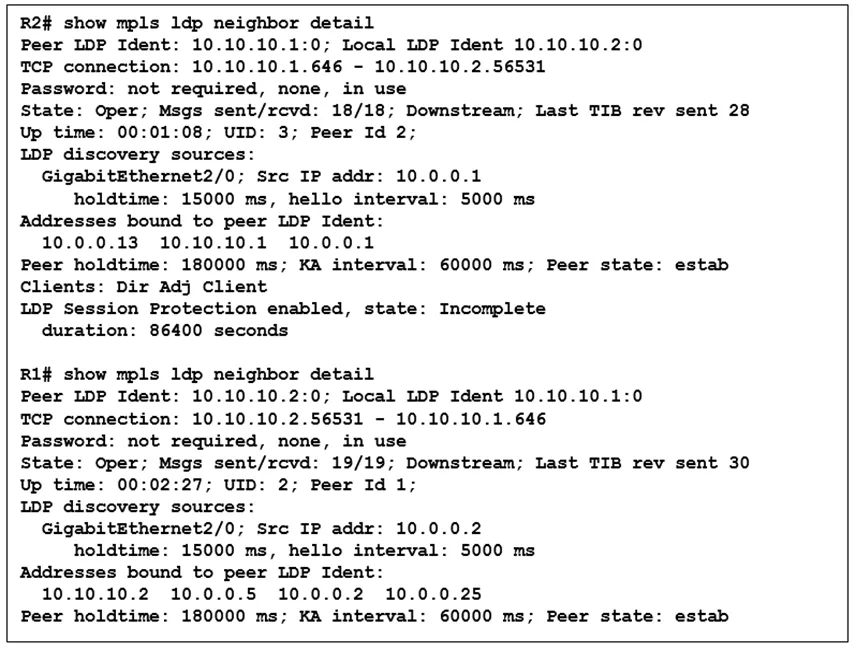
Refer to the exhibit. LDP peering between routers R1 and R2 is dropped when the link between R1 and R2 is taken offline. However, LDP peering between R2 and R3 stays up when the link between R2 and R3 is taken offline. Which action allows MPLS traffic forwarding to continue normally if the link between R1 and R2 goes down?
Answer: B

Refer to the exhibit. A network administrator implemented MPLS routing between routers R1, R2, R3, and R4. AToM is configured between R1 and R4 to allow Layer 2 traffic from hosts on RA1 and RA2. A targeted MPLS session is established between R1 and R4. Which additional action must the administrator take on all routers so that LDP synchronization occurs between connected LDP sessions?
Answer: B
The answer is B because LDP IGP Sync is only supported on OSPF and IS-IS enabled interfaces. With EIGRP not supported, answer C is incorrect. LDP-IGP sync works like this: When a new LDP neighbor is discovered on an interface, LDP checks if the remote LDP neighbor loopback IP-address is reachable via any other interface. - If yes, LDP is first established via that other interface before IGP is allowed to setup an adjacency on this interface. - If no, the IGP adjacency is established on the interface to learn the route for the LDP neighbor loopback address, but the link is advertised with max-metric to minimize the risk of blackholing user traffic. Once LDP has established, the IGP readvertises the link with its normal metric, allowing traffic to flow over the link. Disabling the holddown only limits the length of time the IGP will wait before establishing a session on the interface, so answer A is incorrect. Sync delay is used to delay the "synchronized" message from LDP to the IGP. This is not necessary for LDP-IGP sync to function, so answer D is incorrect. https://www.cisco.com/c/en/us/td/docs/routers/ios/config/17-x/mpls/b-mpls/m_mp-ldp-igp-synch.html
Source: Adapted from community discussion — gollog
Which component is similar to an EVPN instance?
Answer: D
Keyboard:J Kmove between questionsA–Dselect an answerRshow or hide the answer← →change page
350-501 practice, question 191. 377 questions available.
Version 1.0.0. How we source questions