Question 41 · 355 in bank
Select 2Which two features must be used on Cisco ISE to enable the TACACS+ feature? (Choose two.)
Show answer
Answer: CE
Implementing and Configuring Cisco Identity Services Engine (SISE)355 questions across 36 pages are complete and free, with no account or card.
355 questions in this bank
Free access · progress saved on this device
Which two features must be used on Cisco ISE to enable the TACACS+ feature? (Choose two.)
Answer: CE
Which are two characteristics of TACACS+? (Choose two.)
Answer: AE
The correct answers are It separates authorization and authentication functions and It uses TCP port 49. TACACS+ (Terminal Access Controller Access Control System Plus) is a network security protocol that provides centralized authentication, authorization, and accounting (AAA) services for network devices. TACACS+ separates authentication and authorization functions, which means that the authentication server is responsible for verifying the user's identity, and the authorization server is responsible for determining what the user is allowed to do. TACACS+ uses TCP port 49 for communication between the client and server.
Source: Adapted from community discussion — denverfly
A user reports that the RADIUS accounting packets are not being seen on the Cisco ISE server. Which command is the user missing in the switch's configuration?
Answer: C
The correct answer is aaa accounting network default start-stop group radius. The command aaa accounting network default start-stop group radius enables RADIUS accounting for all network activity on the switch. This includes both inbound and outbound traffic. The start-stop keyword tells the switch to send a RADIUS accounting packet at the beginning and end of each network activity. The group radius keyword tells the switch to send the RADIUS accounting packets to the RADIUS server that is configured in the radius-server command.
Source: Adapted from community discussion — denverfly
Which two responses from the RADIUS server to NAS are valid during the authentication process? (Choose two.)
Answer: AB
Provide answers are correct. https://www.cisco.com/c/en/us/td/docs/net_mgmt/access_registrar/1-7/concepts/guide/radius.html Types of RADIUS Messages The client/server packet exchange consists primarily of the following types of RADIUS messages: •Access-Request—sent by the client (NAS) requesting access •Access-Reject—sent by the RADIUS server rejecting access •Access-Accept—sent by the RADIUS server allowing access •Access-Challenge—sent by the RADIUS server requesting more information in order to allow access. The NAS, after communicating with the user, responds with another Access-Request. When you use RADIUS accounting, the client and server can also exchange the following two types of messages: •Accounting-Request—sent by the client (NAS) requesting accounting •Accounting-Response—sent by the RADIUS server acknowledging accounting
Source: Adapted from community discussion — Cnoteone
What is a characteristic of the UDP protocol?
Answer: C
Refer to the exhibit.

A network engineer is configuring the switch to accept downloadable ACLs from a Cisco ISE server. Which two commands should be run to complete the configuration? (Choose two.)
Answer: BC
Answer is B and D https://www.cisco.com/c/en/us/td/docs/ios-xml/ios/sec_usr_8021x/configuration/15-mt/sec-user-8021x-15-mt-book/sec-ieee-802x-acl-assign.html Configuring Downloadable ACLs To configure a switch to accept downloadable ACLs or redirect URLs from the RADIUS server during authentication of an attached host, perform this task. SUMMARY STEPS 1. enable 2. configure terminal 3. ip device tracking 4. aaa new-model 5. aaa authorization network default group radius 6. radius-server vsa send authentication 7. interface interface-id 8. ip access-group acl-id in 9. end 10. show running-config interfaceinterface-id 11. copy running-config startup-config
Source: Adapted from community discussion — DarkArmy
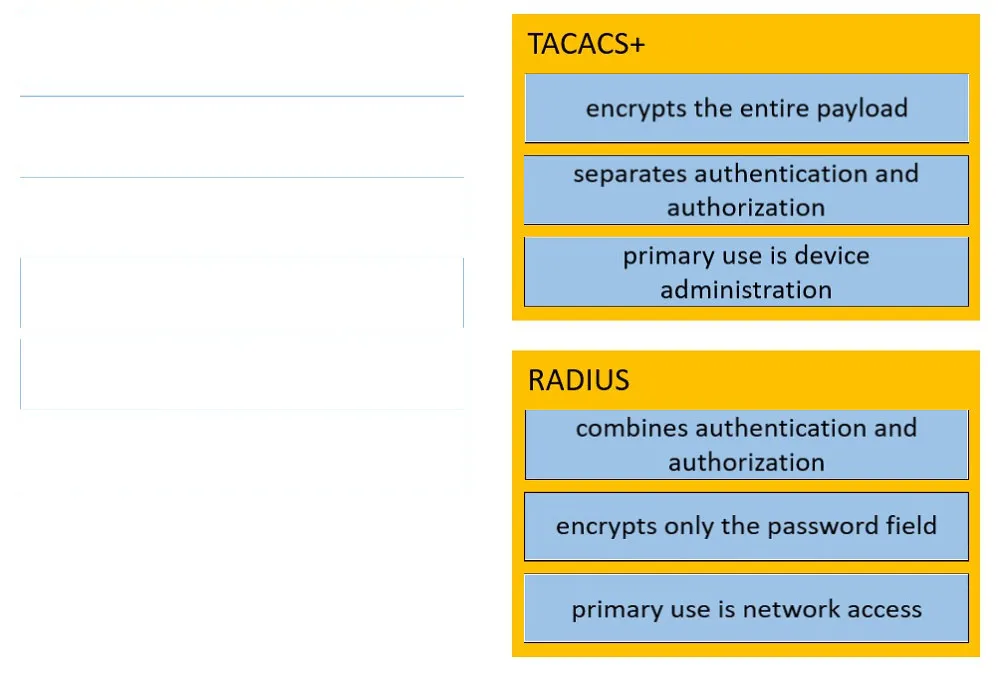
DRAG DROP - Drag and drop the description from the left onto the protocol on the right that is used to carry out system authentication, authorization, and accounting. Select and Place:
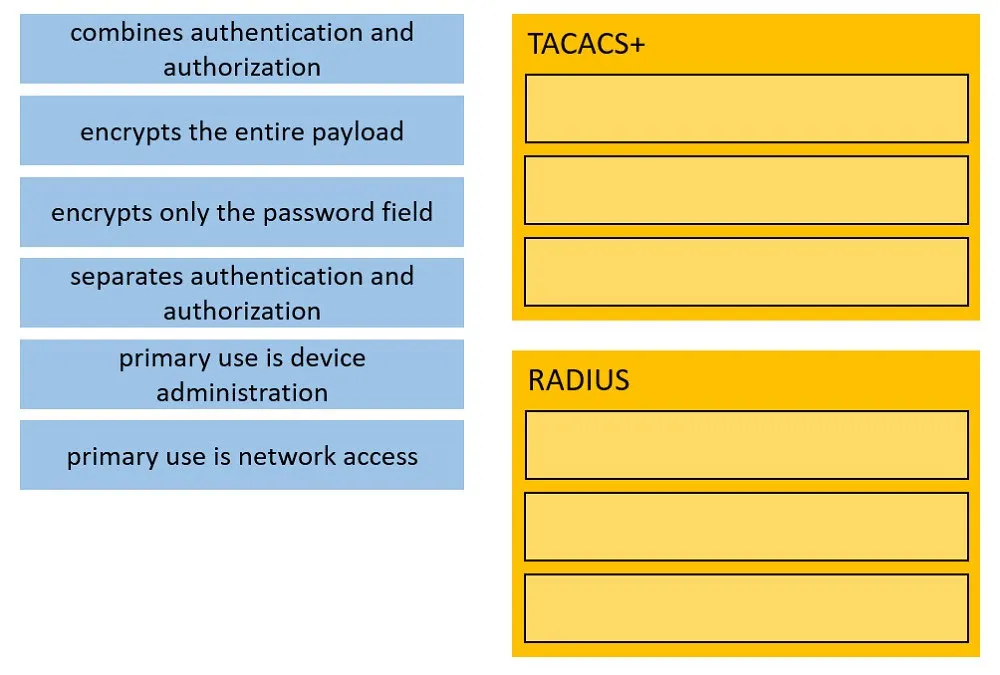
This is an interactive task on the real exam — a drag-and-drop, hotspot or ordering question. There is nothing to select here, so the answer is shown below for reference.
Answer: See figure below
Reference: https://www.cisco.com/c/en/us/support/docs/security-vpn/remote-authentication-dial-user-service-radius/13838-10.html
An administrator is configuring Cisco ISE to authenticate users logging into network devices using TACACS+. The administrator is not seeing any of the authentication in the TACACS+ live logs. Which action ensures the users are able to log into the network devices?
Answer: A
The correct answer is Enable the device administration service in the PSN persona. The device administration service is a Cisco ISE service that provides centralized authentication, authorization, and accounting (AAA) for network devices. The service must be enabled on the PSN persona in order for users to be able to log into network devices using TACACS+. The other options are not correct. The Administration persona is used to manage Cisco ISE itself, not network devices. The session services are used to manage user sessions, not network devices. The service sessions are used to manage service sessions, not network devices.
Source: Adapted from community discussion — denverfly

Refer to the exhibit. An engineer is creating a new TACACS+ command set and cannot use any show commands after logging into the device with this command set authorization. Which configuration is causing this issue?
Answer: B
The Correct Answer should be "D" show Sho?? N Second "?" intersects with the character that does not exist Check the "Command Line and Command Set List Match" Table https://www.cisco.com/c/en/us/td/docs/security/ise/2-6/admin_guide/b_ISE_26_admin_guide/b_ISE_admin_26_device_admin.html#reference_BD55BB89E9F54BCDA856F5889122A4C5
Source: Adapted from community discussion — Kavi
What does a fully distributed Cisco ISE deployment include?
Answer: C
The correct answer is C. Reference: CCNP Security Identity Management SISE 300-715 Official Cert Guide, Chapter 6, Page 117, Figure 6-4. In a fully distributed deployment each persona is on it's own dedicated node. This is the only deployment model that allows you to scale beyond the 5 PSNs.
Source: Adapted from community discussion — Nita_Mae
Keyboard:J Kmove between questionsA–Dselect an answerRshow or hide the answer← →change page
300-715 practice, question 41. 355 questions available.
Version 1.0.0. How we source questions