Question 1 · 245 in bank
Select 3A network engineer is preparing for an office site survey with a height of 2.5 meters. Which three components are recommended to complete the survey? (Choose three.)
Show answer
Answer: ABF
Designing Cisco Enterprise Wireless Networks (ENWLSD)245 questions across 25 pages are complete and free, with no account or card.
245 questions in this bank
Free access · progress saved on this device
A network engineer is preparing for an office site survey with a height of 2.5 meters. Which three components are recommended to complete the survey? (Choose three.)
Answer: ABF
Which non-Wi-Fi interferer can be identified by Metageek Chanalyzer?
Answer: B
correct Jammers: Although they should not be expected in normal networks, jammers are cheap devices and easily bought online. Their characteristic is a continuous signal with a high duty cycle across the entire affected band. They may operate in 2.4GHz or 5GHz. The presence of a jammer signal is reflective of an attack against your network. Many jammers operate in the 2.4GHz band because this band is categorized as Industrial, Scientific, and Medical (ISM) and can be used by any transmitter (under some relaxed regulatory conditions). Most of the 5GHz band is not ISM, which makes it less susceptible to interferences from non-802.11 devices. However, different countries have different rules, and you may see in non-ISM 5GHz channels devices that were designed for a country where such operation is allowed.
Source: Adapted from community discussion — skh
Which CLI command does an engineer use to validate that the redundancy peer of a Stateful Switchover pair of controllers is up and connected?
Answer: A
Explanation: rping - Check IPsec status on both controllers to check which link is broken RP or RMI. Perform rping on both controllers to check if the peer is reachable. mping - Mobility ping over UDP—Thistest runs over mobility UDPport 16666. It tests whether the mobility control packet can be reached over the management interface. eping - Mobility ping over EoIP—This test runs over EoIP (IP protocol 97). It tests the mobility data traffic over the management interface Reference: https://www.cisco.com/c/en/us/td/docs/wireless/controller/7-6/configuration-guide/b_cg76/b_cg76_chapter_010010010.pdf https://www.cisco.com/c/en/us/td/docs/wireless/controller/8-8/config-guide/b_cg88/high_availability.html
Source: Adapted from community discussion — peer1024
A wireless engineer must optimize RF performance for multiple buildings with multiple types of construction and user density. Which two actions must be taken? (Choose two.)
Answer: CD
How does AP failover priority for access points function when configured with priority 1 or 4?
Answer: B
B - Low—Assigns the access point to the level 1 priority, which is the lowest priority level. This is the default value. Medium—Assigns the access point to the level 2 priority. High—Assigns the access point to the level 3 priority. Critical—Assigns the access point to the level 4 priority, which is the highest priority level.
Source: Adapted from community discussion — EGD
A company has 10 access point licenses available on their backup Cisco WLC, and their primary Cisco WLC is at full capacity. 5 access points are set to high failover priority and 7 access points are set to critical failover priority. During a failure, not all critical access points failed over to the backup Cisco WLC. Which configuration is the cause of this issue?
Answer: D
First I thought you were correct. But after looking a bit closer I think its D as well. Reason being is that the backup controller has 10 licenses. There are only 7 Critical priority APs. In theory when fail-over occurs the WLC should disassociate the AP's that are a lower priority if it detects that higher priority APs are trying to associate. With 10 licenses that would give enough room for the 7 Critical and 3 High AP count. In order for the WLC to adhere to the AP priority functionality, you need to enter the "network ap-priority enable" command. Otherwise, it does not care what priorities are assigned. So this could only mean that the command is currently in its disabled state as its not "making room" for the critical priority APs.
Source: Adapted from community discussion — Comstock2K
A network engineer is configuring high availability on an access point. What is the maximum number of controllers available to be configured?
Answer: C
An engineer is trying to determine the most cost-effective way to deploy high availability for a campus enterprise wireless network that currently leverages three wireless LAN controllers. Which architecture should the engineer deploy?
Answer: B
I think it must be answer B Access Point Stateful Switch Over (AP SSO) functionality is not supported for N+1 HA. Source: https://www.cisco.com/c/en/us/td/docs/wireless/technology/hi_avail/N1_High_Availability_Deployment_Guide/N1_HA_Overview.html
Source: Adapted from community discussion — Liselot
An engineer is designing a wireless network to support high availability. The network will need to support the total number of APs and client SSO. Live services should continue to work without interruption during the failover. Which two requirements need to be incorporated into the design to meet these needs? (Choose two.)
Answer: AB
not sure if AE is correct, back-to-back is not needed anymore. Also starting 7.5 release client-sso is supported, so this is also a valid option. https://www.cisco.com/c/en/us/td/docs/wireless/controller/technotes/7-5/High_Availability_DG.html#pgfId-53637 I would vote for AB
Source: Adapted from community discussion — mae2k
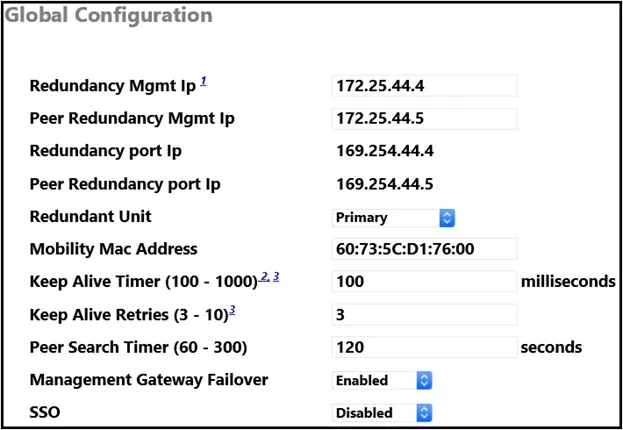
Refer to the exhibit. An enterprise is using wireless as the main network connectivity for clients. To ensure service continuity, a pair of controllers will be installed in a datacenter. An engineer is designing SSO on the pair of controllers. What needs to be included in the design to avoid having the secondary controller go into maintenance mode?
Answer: C
C, look at the comment from mohanak here: https://community.cisco.com/t5/wireless/wlc-ha-maintenance-mode/td-p/2927232 There are few scenarios where the Standby WLC may go into Maintenance Mode and not be able to communicate with the network and peer: - Non reachability to Gateway via Redundant Management Interface - WLC with HA SKU which had never discovered peer - Redundant Port is down - Software version mismatch (WLC which boots up first goes into active mode and the other WLC in Maintenance Mode) A / not correct, RP is l2 port where RMI is l3 B/ not correct keepalives doesnt matter and wont cause hotstandby to go to maintenance mode C/ correct, if RP is down that indeed causes standby to go to maintenance mode D/ incorrect, according to the phrasing of the question, engineer is just preparing the confgiuration. enabling SSO is the final step after all the rest of config is finished. Once enabled WLCs will reboot and discover the HA SSO neighbors and join the HA SSO stack. C/
Source: Adapted from community discussion — mqoltn
Keyboard:J Kmove between questionsA–Dselect an answerRshow or hide the answer← →change page
300-425 practice, question 1. 245 questions available.
Version 1.0.0. How we source questions