Question 41 · 359 in bank
Select 2When designing interdomain multicast, which two protocols are deployed to achieve communication between multicast sources and receivers? (Choose two.)
Show answer
Answer: CD
Designing Cisco Enterprise Networks (ENSLD)359 questions across 36 pages are complete and free, with no account or card.
359 questions in this bank
Free access · progress saved on this device
When designing interdomain multicast, which two protocols are deployed to achieve communication between multicast sources and receivers? (Choose two.)
Answer: CD
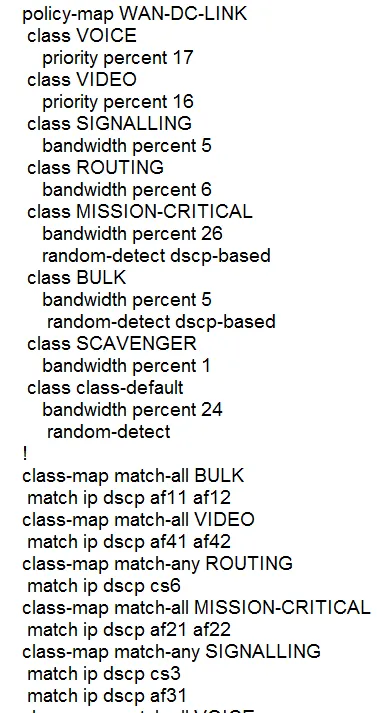
Refer to the exhibit. A customer needs to apply QoS to the network management traffic passing through the GigabitEthernet 0/2 interface. All eight queuing classes are in use, so the new requirement must be integrated into the existing policy. Which solution must the customer choose?
Answer: B
Twelve-Class Egress Queuing Model Network control traffic (marked CS6), signaling traffic (marked CS3) and network management traffic (marked CS2) is all assigned to a dedicated nonpriority queue with a 10 percent bandwidth allocation; optionally, CS7 traffic may also be mapped to this queue. https://www.ciscopress.com/articles/article.asp?p=2159353&seqNum=3
Source: Adapted from community discussion — CKL_SG
An architect must address sustained congestion on the access and distribution uplinks of a network. QoS has already been implemented and optimized, but it is no longer effective in ensuring optimal network performance. Which two solutions should the architect use to improve network performance. (Choose two.)
Answer: BD
As the question mentioned that QoS has been implemented and optimized, I can assumed A and C had been done. So I prefer B & D to upgrade the link and add new uplinks
Source: Adapted from community discussion — andrewChan
An engineer must design a QoS solution for a customer that is connected to an ISP over a 1Gbps link with a 100Mbps CIR. The ISP aggressively drops all traffic received over the CIR, which is causing numerous TCP retransmissions. The customer is not using any RTP applications but wants to maximize bandwidth usage up to the CIR. Which QoS solution should the engineer choose?
Answer: C
Policing is used for inbound traffic. The question states "The ISP aggressively drops all traffic RECEIVED.." so the traffic being dropped is traffic sent from the customer to the ISP. The ISP is using policing to drop traffic, but if wanted to control the amount of traffic being sent OUT of your network, you would use traffic shaping.
Source: Adapted from community discussion — iLikeHamburgers
The customer solution requires QoS to support streaming multimedia over a WAN. An architect chooses to use Per-Hop Behavior. Which solution should the engineer use to classify and mark traffic traveling between branch sites?
Answer: C
LLQ with EF seems way too strict for STREAMING multimedia (where one can actually take advantage of buffering). Judging by the various Cisco QoS baseline docs (even though the ones below are quite old), streaming video should be somewhere at AF3x/CS4. So I would go with C. https://www.cisco.com/en/US/technologies/tk543/tk759/technologies_white_paper0900aecd80295a9b.pdf https://community.cisco.com/t5/collaboration-voice-and-video/cisco-qos-baseline-classification-and-marking-and-mapping/ta-p/3108355
Source: Adapted from community discussion — bogd
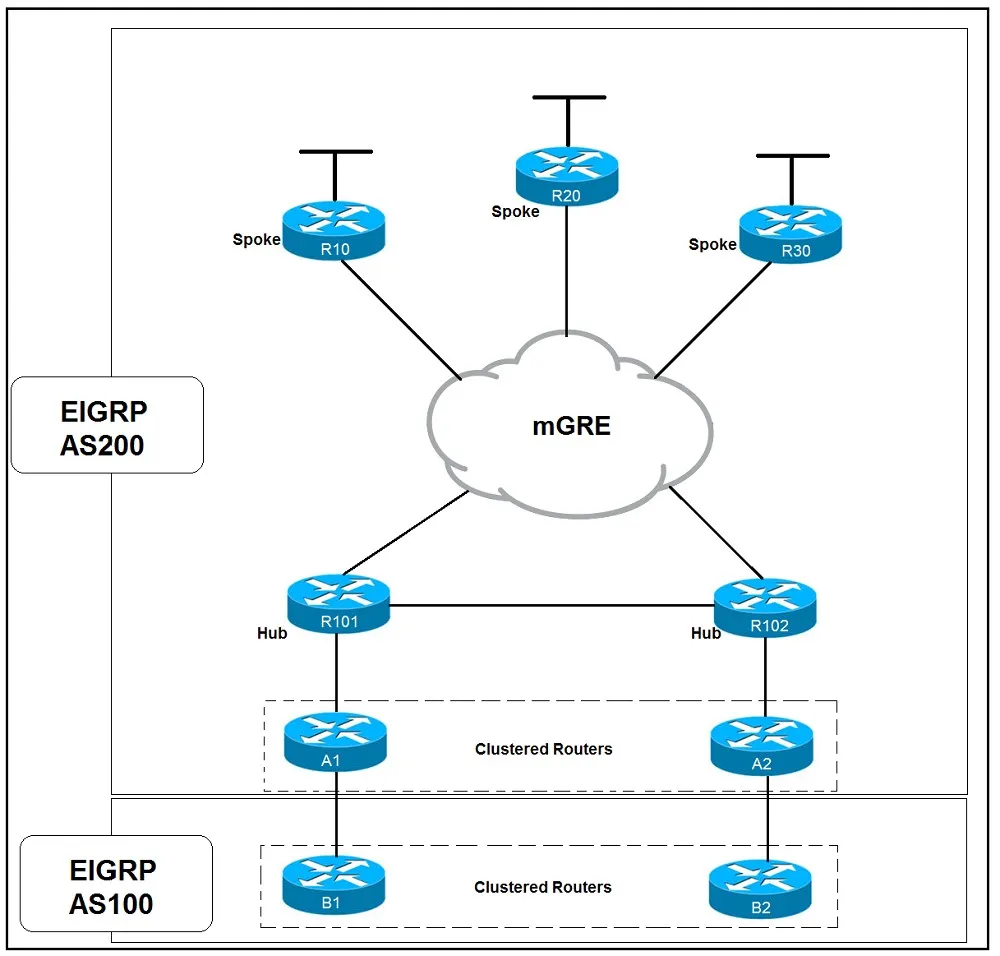
Refer to the exhibit. Which solution decreases the EIGRP convergence time?
Answer: A
I disagree with Benzzyy. I think response D is correct : Query storms are eliminated, which saves bandwidth and CPU and allows the network to converge more quickly. https://www.cisco.com/en/US/technologies/tk648/tk365/technologies_white_paper0900aecd8023df6f.html
Source: Adapted from community discussion — aymeric
An engineer must design an in-band management solution for a customer with branch sites. The solution must allow remote management of the branch sites using management protocols over an MPLS WAN. Queueing is implemented at the remote sites using these classes: ✑ Class1 equals voice traffic ✑ Class2 equals mission-critical traffic ✑ Class3 equals default traffic How must the solution prioritize the management traffic over the WAN?
Answer: D
It's D. CS2 is for OAM ('management'). Also, you wouldn't want to reduce the bandwidth for Class2 since it is specifically labeled mission-critical.
Source: Adapted from community discussion — morlu
An engineer is designing a multicast network for a company specializing in VoD content. Receivers are across the Internet, and for performance reasons, the multicast framework must be close to the receivers within each AS. For high availability, if the sources in one AS are no longer available, the receivers of that AS must be able to receive the VoD content from the sources in another AS. Which feature must the design include?
Answer: B
option D, is also used to propagate multicast sources across different domains. However, it is primarily used for source discovery, and it does not directly handle high availability as effectively as anycast RP in this context.
Source: Adapted from community discussion — PicoOstrava
An organization plans to deploy multicast across two different autonomous systems. Their solution must allow RPs to: ✑ discover active sources outside their domain ✑ use the underlying routing information for connectivity with other RPs ✑ announce sources joining the group Which solution supports these requirements?
Answer: B
Reference: https://www.cisco.com/c/en/us/td/docs/switches/lan/catalyst9500/software/release/16-10/configuration_guide/ip_mcast_rtng/ b_1610_ip_mcast_rtng_9500_cg/b_1610_ip_mcast_rtng_9500_cg_chapter_010001.pdf
Source: Adapted from community discussion — Lungful
Which type of rendezvous point deployment is standards-based and supports dynamic RP discovery?
Answer: A
Keyboard:J Kmove between questionsA–Dselect an answerRshow or hide the answer← →change page
300-420 practice, question 41. 359 questions available.
Version 1.0.0. How we source questions