Question 121 · 359 in bank
Which function do reverse path forwarding mechanisms perform in a multicast deployment?
Show answer
Answer: B
Designing Cisco Enterprise Networks (ENSLD)359 questions across 36 pages are complete and free, with no account or card.
359 questions in this bank
Free access · progress saved on this device
Which function do reverse path forwarding mechanisms perform in a multicast deployment?
Answer: B
How does a model-driven telemetry dial-out approach function?
Answer: A

Refer to the exhibit. Which method must an architect use to provide connectivity between the mail servers?
Answer: B
B. 6to4 In this scenario, an architect should use the 6to4 method to provide connectivity between the mail servers. 6to4 is an IPv6 transition mechanism that allows IPv6 hosts to communicate with each other over an IPv4 network using a dual-stack router. The dual-stack routers automatically encapsulate IPv6 packets inside IPv4 packets for transmission over the IPv4 network and then decapsulate them when they reach the destination IPv6 network.
Source: Adapted from community discussion — SpicyMochi
A network engineer must optimize a campus OSPF deployment. Currently, each time a type 1 or type 2 LSA is generated within an area, the OSPF process must recompute the entire SPT. Which solution improves the recomputation process?
Answer: D
https://www.cisco.com/c/en/us/td/docs/ios-xml/ios/iproute_ospf/configuration/15-sy/iro-15-sy-book/iro-incre-spf.pdf OSPF uses Dijkstra’s SPF algorithm to compute the shortest path tree (SPT). During the computation of the SPT, the shortest path to each node is discovered. The topology tree is used to populate the routing table with routes to IP networks. When changes to a Type-1 or Type-2 link-state advertisement (LSA) occur in an area, the entire SPT is recomputed. In many cases, the entire SPT need not be recomputed because most of the tree remains unchanged. Incremental SPF allows the system to recompute only the affected part of the tree.
Source: Adapted from community discussion — masker
An engineer is designing a BGP solution supporting a VXLAN environment over a Layer 3 IPv4 network fabric with these requirements: • provide Layer 2 adjacency • allow VM migration of workloads between sites • IGP is OSPF Which BGP address family must the engineer choose?
Answer: B
Which protocol is deployed through LAN automation to build node-to-node underlay adjacencies in SDA?
Answer: A

Refer to the exhibit. A customer requires maximum uptime for the data plane between R1 and R3 running OSPF. Which solution must the design include for high availability if the routing process on R2 requires maintenance?
Answer: B
The graceful restart feature in OSPFv3 allows nonstop data forwarding along routes that are already known while the OSPFv3 routing protocol information is being restored. https://www.cisco.com/c/en/us/td/docs/ios-xml/ios/iproute_ospf/configuration/xe-16/iro-xe-16-book/ip6-route-ospfv3-gr-rest-xe.html#:~:text=The%20graceful%20restart%20feature%20in%20OSPFv3%20allows%20nonstop,helper%20mode%20%28such%20as%20in%20a%20graceful-restart-aware%20device%29.
Source: Adapted from community discussion — musclehamster
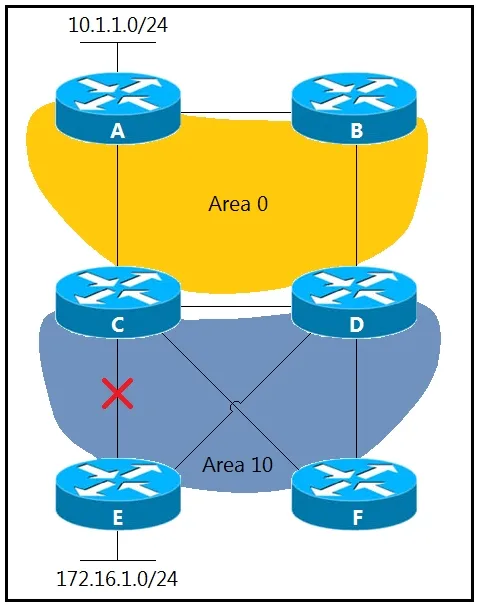
Refer to the exhibit. Area 10 is a regular OSPF area, and networks 10.1.1.0/24 and 172.16.1.0/24 are internal. Which design provides optimal routing between both networks when the link between routers C and E fails?
Answer: A
Because of the SPF algorithm. OSPF calculates intra-area routes before inter-area routes. If the link between C and D was in area 0, C would calculate C-F-D-E as the shortest route, which isn't true. If the link between C and D is in area 10, C will calculate C-D-E as the shortest route.
Source: Adapted from community discussion — funkeymonkey

Refer to the exhibit. A customer has two eBGP peerings from a single CE router toward two service providers. The customer has hired an architect to design a solution to ensure certain traffic enters the customer’s network through interface gig0/0. Which solution must the architect include in the design?
Answer: A
Just playing devils advocate, I think this would work as well. Lower MED wins on the exact same route. router bgp 100 neighbor 1.1.1.1 remote-as 200 neighbor 2.2.2.2 remote-as 300 address-family ipv4 neighbor 1.1.1.1 route-map MED100 out neighbor 1.1.1.1 activate neighbor 2.2.2.2 route-map MED10 out neighbor 2.2.2.2 activate maximum-paths 2 exit exit ip access-list standard 200Host permit 200.200.200.200 exit route-map MED100 permit 10 match ip address 200Host set metric 100 exit route-map MED10 permit 10 match ip address 200Host set metric 10 exit
Source: Adapted from community discussion — TheGorn
An engineer is designing a campus network with Cisco Catalyst 9500 switches in the aggregation layer. The design requires running nonblocking Layer 2 MEC from the aggregation layer to the access layer. The Catalyst switches are located on different campus floors for availability reasons, and each access switch will contain a single VLAN. Which technology must the engineer choose for the aggregation switches in the design?
Answer: D
Keyboard:J Kmove between questionsA–Dselect an answerRshow or hide the answer← →change page
300-420 practice, question 121. 359 questions available.
Version 1.0.0. How we source questions