Question 771 · 1334 in bank
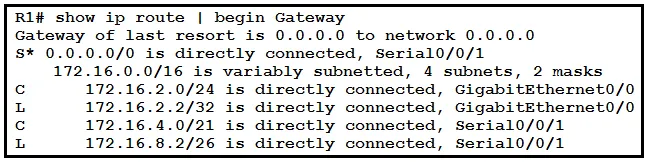
Refer to the exhibit. What is the subnet mask for route 172.16.4.0?
Show answer
Answer: C
Cisco Certified Network Associate (CCNA)1,334 questions across 134 pages are complete and free, with no account or card.
1334 questions in this bank
Free access · progress saved on this device
Refer to the exhibit. What is the subnet mask for route 172.16.4.0?
Answer: C

Refer to the exhibit. A static route must be configured on R14 to forward traffic for the 172.21.34.0/25 network that resides on R86. Which command must be used to fulfill the request?
Answer: B
Ah, no. The destination network (172.21.34.0/25) is not displayed/defined - well, not on the graphic I see anyway. If anything, we should be stating that this breaks the rule of aggregation - "Never advertise a network you don't own." :-)
Source: Adapted from community discussion — PaddyInNZ
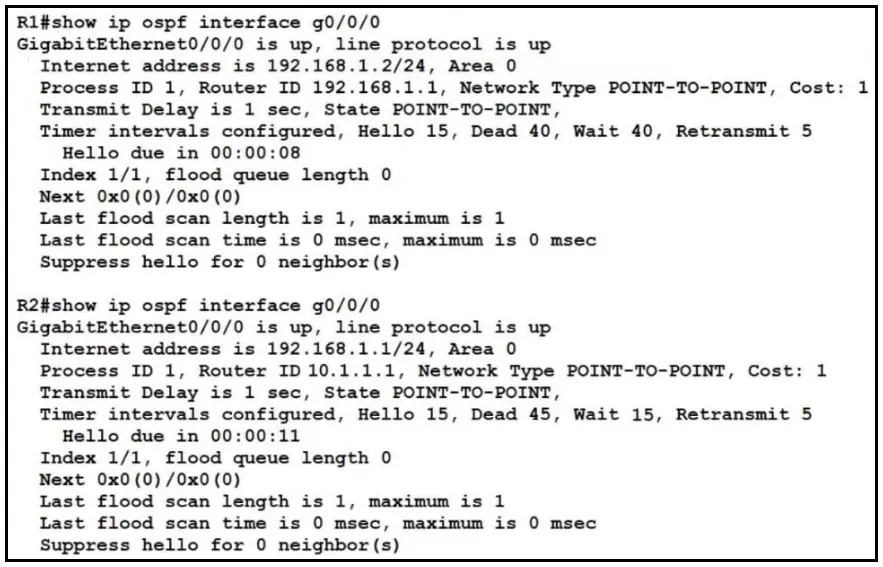
Refer to the exhibit. The network engineer is configuring router R2 as a replacement router on the network. After the initial configuration is applied, it is determined that R2 failed to show R1 as a neighbor. Which configuration must be applied to R2 to complete the OSPF configuration and enable it to establish the neighbor relationship with R1?
Answer: C
Since every task needed us to match timers answer is C For the guys getting complicated about router ID-s compare my comment to the picture: R1#192.168.1.1 R2#10.1.1.1 RID is NOT the same. Even the internet address is different on the two router
Source: Adapted from community discussion — TmNvrWts

Refer to the exhibit. All interfaces are configured with duplex auto and ip ospf network broadcast. Which configuration allows routers R14 and R86 to form an OSPFv2 adjacency and act as a central point for exchanging OSPF information between routers?
Answer: D
Going with D A is wrong because ip mtu of R14 and R86 are different B is wrong because because ip ospf priority is configured inside router-config, it should be on the interface C is wrong because ip ospf priority is 0 on R14 and it makes R14 not participate on ospf dr/bdr election, the network type is broadcast so i assume dr/bdr should be elected otherwise the network type should be point-to-point D is correct answer - because mtu are same for both routers, participates in dr/bdr election
Source: Adapted from community discussion — joondale
A packet from a company's branch office is destined to host 172.31.0.1 at headquarters. The sending router has three possible matches in its routing table for the packet: prefixes 172.31.0.0/16, 172.31.0.0/24, and 172.31.0.0/25. How does the router handle the packet?
Answer: C
Answer: C how a router makes a forwarding decision by a Longest match >>b Administrative distance >>c Routing protocol metric, in this order
Source: Adapted from community discussion — Goh0503
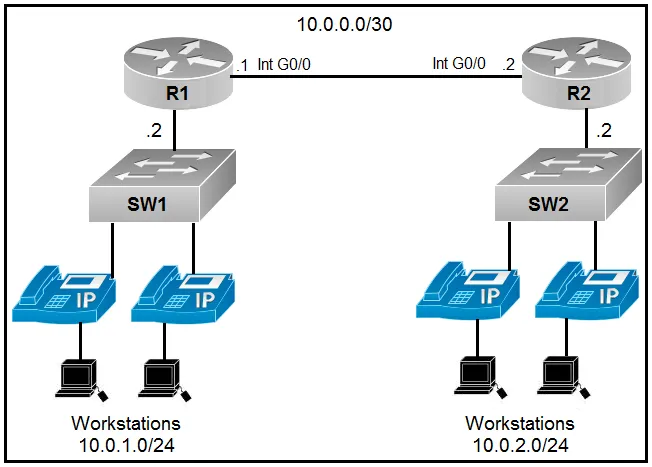
Refer to the exhibit. An engineer is asked to configure router R1 so that it forms an OSPF single-area neighbor relationship with R2. Which command sequence must be implemented to configure the router?
Answer: C
Answer C: Configure route to 10.0.0.0/30 with wildcard 0.0.0.3 Confugure route to 10.0.1.0/24 with wildcard 0.0.0.255 router ospf 10 network 10.0.0.0 0.0.0.3 area0 network 10.0.1.0 0.0.0.255 area0
Source: Adapted from community discussion — Goena

Refer to the exhibit. All routers in the network are configured. R2 must be the DR. After the engineer connected the devices, R1 was elected as the DR. Which command sequence must be configured on R2 to be elected as the DR in the network?
Answer: A
R1 was initially elected as the DR because they would have the same priority by default (1). The next step in the election process would be the highest IP address which R1 has over R2. Thus, setting the priority of R2 to 100 would elect it as DR. The highest priority wins for DR once it is within scope.
Source: Adapted from community discussion — all4one

Refer to the exhibit. The router R1 is in the process of being configured. Routers R2 and R3 are configured correctly for the new environment. Which two commands must be configured on R1 for PC1 to communicate to all PCs on the 10.10.10.0/24 network? (Choose two.)
Answer: AB
A is 100% correct while the confusion between B and E is down to people missing two important differences for those two options. B is a direct host route and it will show up in the routing table as 10.10.10.10/32 and it is called a host route. Hence subnet mask being 255.255.255.255. Whereas, E option does NOT cover the host 10.10.10.10 address as if you calculate the subnet range for the subnet in option E it only goes up to 10.10.10.0 - 10.10.10.6 and .7 being its broadcast address. It's incrementing in blocks of 8 as the subnet mask clearly states 255.255.255.248 or /29. So, how exactly the router would send traffic to host .10 which is NOT even in the subnet range. Therefore, option E route will NEVER reach .10 host hanging off that router. Correct answer is A is the network route and B is direct host route, hope this helps :)
Source: Adapted from community discussion — Freddy01
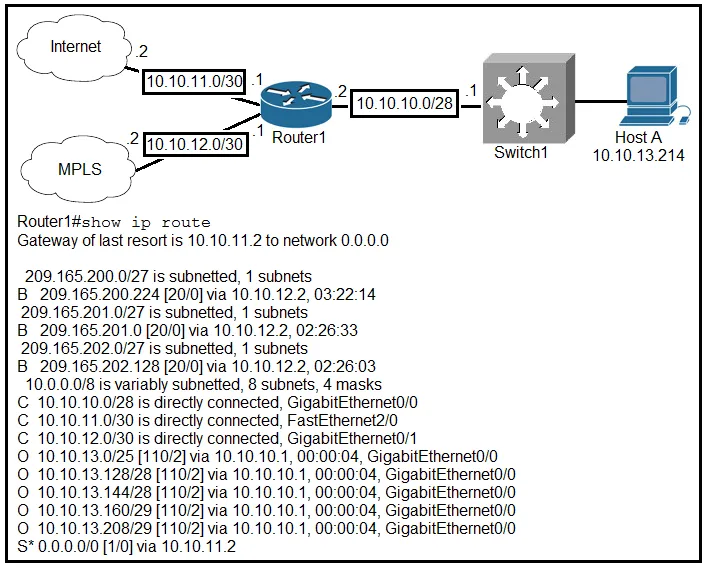
Refer to the exhibit. What is the subnet mask of the route to the 10.10.13.160 prefix?
Answer: D
D THE DESTINATION IS THE NETWORK 10.10.13.160 WITH MASK /29 WHICH IS THE ANSWER D. THE OTHER ROUTES DO NOT COVER THE NETWORK.160
Source: Adapted from community discussion — dozer86
You are configuring your edge routers interface with a public IP address for Internet connectivity. The router needs to obtain the IP address from the service provider dynamically. Which command is needed on interface FastEthernet 0/0 to accomplish this?
Answer: D
D is correct, means that the router will act as a DHCP client. Should a router be set as a DHCP server commands are as follows: conf t service dhcp ip dhcp pool network default-router dns-server exit
Source: Adapted from community discussion — xsp
Keyboard:J Kmove between questionsA–Dselect an answerRshow or hide the answer← →change page
200-301 practice, question 771. 1334 questions available.
Version 1.0.0. How we source questions