1Z0-071AssociateOracleAll questions freePage 14 of 24
1Z0-071 practice questions 131–140
Oracle Database SQL238 questions across 24 pages are complete and free, with no account or card.
Official study references
238 questions in this bank
Free access · progress saved on this device
Question 132 · 238 in bank
Select 4Which four statements are true about constraints on Oracle tables? (Choose four.)
Show answer
Answer: ABEF
References
Question 133 · 238 in bank
In your session, the NLS_DATE_FORMAT is DD-MM-YYYY. There are 86400 seconds in a day. Examine this result: DATE - ----------- 02-JAN-2020 Which statement returns this?
Show answer
Answer: C
Explanation
Option C is the statement that returns the result 02-JAN-2020. The statement converts the string '29-10-2019' to a date using the TO_DATE function, then adds an interval of 2 months and an interval of 5 days, and subtracts an interval of 120 seconds. The resulting date is then converted to a string using the TO_CHAR function with the format model 'DD-MON-YYYY', which produces the result 02-JAN-2020. Here is the calculation: TO_DATE('29-10-2019') = October 29, 2019 + INTERVAL '2' MONTH = December 29, 2019 + INTERVAL '5' DAY = January 3, 2020 - INTERVAL '120' SECOND = January 2, 2020
Source: Adapted from community discussion — zouve
Question 134 · 238 in bank
User HR has CREATE SESSION, CREATE ANY TABLE and UNLIMITED TABLESPACE privileges. User SCOTT has CREATE SESSION, CREATE TABLE and UNLIMITED TABLESPACE privileges. HR successfully executes this statement:

HR attempts to execute: 1. INSERT INTO scott.products VALUES (1, 'LAPTOP'); SCOTT attempts to execute: 2. SELECT * FROM products; 3. INSERT INTO scott.products VALUES (2, 'HDD'); 4. CREATE SYNONYM prod FOR products; Which will execute successfully?
Show answer
Answer: D
Explanation
Tested, you cannot create synonyms nor views without premission even if you are trying to do it for a object in your schema or if you want to use your schema table as a underlying table for view.
Source: Adapted from community discussion — AlexAFJ
References
Question 135 · 238 in bank
Examine the contents of the EMP table:

Examine this query that executes successfully:

What is the result?
Show answer
Answer: A
Explanation
Option A tested in DB. If the salary contain like the below example: id Salary 1 12000 2 15000 3 16000 4 16000 5 17000 in this case, with ties option return extra rows select id,salary from emp order by salary fetch first 3 rows with ties; o/p: 1 12000 2 15000 3 16000 4 16000
Source: Adapted from community discussion — Shrimathi
Question 136 · 238 in bank
Select 2You create a table by using this command: CREATE TABLE rate_list (rate NUMBER(6,2)); Which two are true about executing statements? (Choose two.)
Show answer
Answer: BF
Explanation
100% BF correct. Have a try. CREATE TABLE rate_list (rate NUMBER(6,2)); INSERT INTO rate_list VALUES (0.999); select * from rate_list; INSERT INTO rate_list VALUES (-.9); select * from rate_list; INSERT INTO rate_list VALUES (87654.556); select * from rate_list; INSERT INTO rate_list VALUES (-10); select * from rate_list; INSERT INTO rate_list VALUES (-99.99); select * from rate_list; INSERT INTO rate_list VALUES (0.551); select * from rate_list;
Source: Adapted from community discussion — WingL
Question 137 · 238 in bank
Select 2Examine this list of queries:

Which two statements are true? (Choose two.)
Show answer
Answer: BD
Explanation
BD tested SELECT ROUND (TRUNC (15.193, 1)) "Results" FROM DUAL; SELECT ROUND (15.193, -1) "Results" FROM DUAL; SELECT TRUNC (15.193, -1) "Results" FROM DUAL; SELECT TRUNC (ROUND (15.193, 1)) "Results" FROM DUAL;
Source: Adapted from community discussion — zouve
Question 138 · 238 in bank
Examine the data in the EMPLOYEES table:
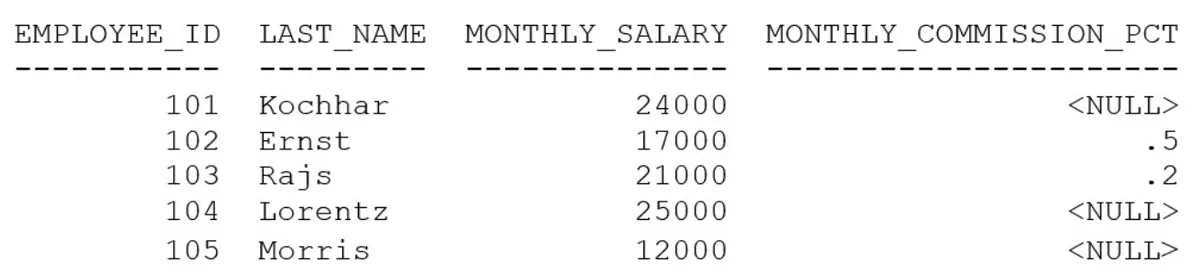
Which statement will compute the total annual compensation for each employee?
Show answer
Answer: A
Question 139 · 238 in bank
Examine the data in the PRODUCTS table:

Examine these queries:
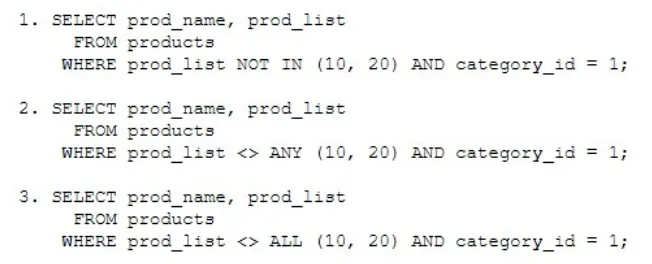
Which queries generate the same output?
Show answer
Answer: A
Question 140 · 238 in bank
Select 2Examine these statements which execute successfully:
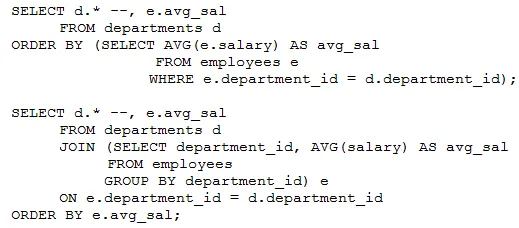
Both statements display departments ordered by their average salaries. Which two are true? (Choose two.)
Show answer
Answer: BC
Explanation
Correct Answer: BC Tested A->The first select returns ORA-00904 D ->Wrong because both statement have d.* in the select list, so both will display departments with no employees E-> Wrong like D F -> Wrong like A
Source: Adapted from community discussion — khaleesi89
Keyboard:J Kmove between questionsA–Dselect an answerRshow or hide the answer← →change page
1Z0-071 practice, question 131. 238 questions available.
About this question bank
Version 1.0.0. How we source questions