Question 91 · 178 in bank
Select 3Which three are true about recovering tables using RMAN? (Choose three.)
Show answer
Answer: CDG
Oracle Database Administration II178 questions across 18 pages are complete and free, with no account or card.
178 questions in this bank
Free access · progress saved on this device
Which three are true about recovering tables using RMAN? (Choose three.)
Answer: CDG
Examine this configuration: 1. CDB1 is an Oracle container database from an older release. 2. PDB1, PDB2, PDB3, and PDB4 are pluggable databases in CDB1. A priority list UpgrdList has these entries: 1, pdb2 2, pdb1, pdb3 You execute this command: $ /u01/app/oracle/product/18.1.0/db_1/rdbms/admin/dbupgrade -L UpgrdList In which order will the upgrade occur?
Answer: C
c as x docs Upgrades PDBs using a priority list during an Oracle Database upgrade, and specifies the priority list name. The priority list updates priority status in the database during upgrade. This priority listing is maintained in future upgrades. By default the CDB$ROOT and PDB$SEED databases are always processed first. They are processed first even if they are not added to a priority list. All PDBs in the priority list are processed before PDBs not in the priority list
Source: Adapted from community discussion — ilputto
Which two are true about changing the LOCAL_UNDO_ENABLED property to false in a CDB? (Choose two.)
Answer: AB
A is correct B is wrong, because PDBs must be reopened to recognize the central UNDO C is wrong because as the database is RAC and enabled with LOCAL UNDO, you need to assign specific Undo tablespace to each PDB on node-1 & node-2 by executing below commands. On node-1: alter system set undo_tablespace=UNDOTBS1 container=current sid='DBCDB1' scope=spfile; >>>> sid=First Instance On Node-2 alter system set undo_tablespace=UNDOTBS2 container=current sid='DBCDB2' scope=spfile; >>>> sid=Second Instance D is wrong becuase as long as LOCAL UNDO used you cant create UNDO in PDB E is wrong F is correct
Source: Adapted from community discussion — ama
While backing up to an SBT channel, you determine that the read phase of your compressed Recovery Manager (RMAN) incremental level 0 backup is a bottleneck. FORCE LOGGING is enabled for the database. Which two could improve read performance? (Choose two.)
Answer: DE
No, you are totally wrong… Synchronous and Asynchronous Disk I/O When a channel reads from or writes to disk, the I/O is either synchronous I/O or asynchronous I/O. When the disk I/O is synchronous, a server process can perform only one task at a time. When the disk I/O is asynchronous, a server process can begin an I/O operation and then perform other work while waiting for the I/O to complete. RMAN can also begin multiple I/O operations before waiting for the first to complete. Take a look at https://docs.oracle.com/database/121/BRADV/rcmtunin.htm#BRADV90067 and Focus on the Read-Phase
Source: Adapted from community discussion — ama
Which two are true about SQL Performance Analyzer (SPA)? (Choose two.)
Answer: BC
I think BC B: Oracle Real Application Testing ... enables businesses to fully assess the outcome of a system changes in test or production. Oracle Real Application Testing is comprised of the following features: Performance Analyzer (SPA), SPA ... C: SQL Performance Analyzer executes the SQL statements captured in the SQL Tuning Set and generates execution plans and execution statistics for each statement For D , though group (summary) view is shown during analysis, i dont think that what they mean by fine grained
Source: Adapted from community discussion — dacoben415lywenw
A user complains about poor database performance. You want to verify if the user's session has waited for certain types of I/O activity. Which view displays all waits waited on by a session at least once?
Answer: A
The most correct answer is A. V$SESSION_EVENT, but C. V$SESSION_WAIT can displays the current or last wait for each session. https://docs.oracle.com/en/database/oracle/oracle-database/19/refrn/V-SESSION_EVENT.html#GUID-5723D404-83F7-4C8D-8BF2-031B3FFEAAA8 https://docs.oracle.com/en/database/oracle/oracle-database/19/refrn/V-SESSION_WAIT.html#GUID-4EDAB293-F3FC-40FE-BC75-4FEE6A4D7705
Source: Adapted from community discussion — flaviogcmelo
Which two are true about gathering optimizer statistics? (Choose two.)
Answer: BC
BC test: SQL> select count(*) from sys.dba_tab_statistics where last_analyzed is not null; COUNT(*) ---------- 3610 SQL> EXEC DBMS_STATS.GATHER_DATABASE_STATS; PL/SQL procedure successfully completed. SQL> select count(*) from sys.dba_tab_statistics where last_analyzed is not null; COUNT(*) ---------- 3649 SQL> alter session set container=ORCLPDB1; Session altered. SQL> select count(*) from sys.dba_tab_statistics where last_analyzed is not null; COUNT(*) ---------- 3507 SQL> EXEC DBMS_STATS.GATHER_DATABASE_STATS; PL/SQL procedure successfully completed. SQL> select count(*) from sys.dba_tab_statistics where last_analyzed is not null; COUNT(*) ---------- 3598
Source: Adapted from community discussion — antoniomariano1983
Examine this output:
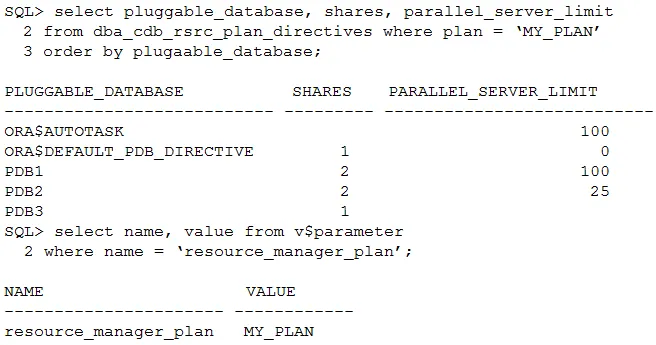
Which two are true? (Choose two.)
Answer: AB
A and B for me. A) PDB not specified in the Plan will be assigne to the DEFAULT_PDB_DIRECTIVE. This directive set PARALLEL_SERVER_LIMIT to zero. (No parallel server). B) PARALLEL_SERVER_LIMIT is not set for PDB3 Resource plan directive. The default value of 100% is used in this case.
Source: Adapted from community discussion — SMagny
Which two are true about the execution of operating system scripts starting from Oracle Database 19c? (Choose two.)
Answer: AF
I think you are referring to this document , this is not related to oracle s/w installation https://docs.oracle.com/cd/E89154_01/STAIS/silentmode002.htm#STAIS1938 Correct Answer : AF You can not mention root password in response file ** With or without response file(put all arguments in the command line $ORACLE_HOME/runInstaller -silent ....) you have to input root password when prompted ** using OUI - You can mention either enter root password or sudo file in installation page You continue to have the option to run the root configuration scripts manually.
Source: Adapted from community discussion — Kishor123
Automatic Shared Memory Management is disabled for one of your database instances. Some SQL statements perform poorly due to excessive hard parse activity, thereby degrading performance. What would be your next step?
Answer: B
Memory advisors are available under the following conditions: AMM - Memory Advisor, ASMM - SGA Advisor & PGA Advisor, If MSMM (manual shared memory management) & Automatic PGA Memory Management - Buffer Cache Advisor & PGA Advisor. And, APMM is the default for Oracle databases. A is wrong. SQL Access Advisor is normally run after the SQL Tuning Advisor, if the latter does not give the required results. B is wrong. You cannot run the memory advisor for the shared pool only. C is correct. This is the logical first step in tuning SQL statements when no memory advisors are available to use. D is wrong. Hard parsing indicates that the statement in not cached in the shared pool, part of the SGA, and has nothing to do with the PGA. E is wrong. The SGA advisor is only available when running in ASMM mode.
Source: Adapted from community discussion — Franky_T
Keyboard:J Kmove between questionsA–Dselect an answerRshow or hide the answer← →change page
1Z0-083 practice, question 91. 178 questions available.
Version 1.0.0. How we source questions