Question 31 · 291 in bank
Your company needs to design a database that illustrates the relationships between utilization levels of individual network devices across a local area network. Which type of data store should you use?
Show answer
Answer: A
Microsoft Azure Data Fundamentals291 questions across 30 pages are complete and free, with no account or card.
291 questions in this bank
Free access · progress saved on this device
Your company needs to design a database that illustrates the relationships between utilization levels of individual network devices across a local area network. Which type of data store should you use?
Answer: A
You manage an application that stores data in a shared folder on a Windows server. You need to move the shared folder to Azure Storage. Which type of Azure Storage should you use?
Answer: C
Azure file shares can be mounted concurrently by cloud or on-premises deployments of Windows, Linux, and macOS. Azure file shares can also be cached on Windows Servers with Azure File Sync for fast access near where the data is being used. Reference: https://azure.microsoft.com/en-us/services/storage/files/
Source: Adapted from community discussion — sumitkela1
Your company is designing a database that will contain session data for a website. The data will include notifications, personalization attributes, and products that are added to a shopping cart. Which type of data store will provide the lowest latency to retrieve the data?
Answer: C
Column-family database is the low latency store type. Examples • Recommendations • Personalization • Sensor data • Telemetry • Messaging • Social media analytics • Web analytics • Activity monitoring • Weather and other time-series data
Source: Adapted from community discussion — jasu
DRAG DROP - Your company plans to load data from a customer relationship management (CRM) system to a data warehouse by using an extract, load, and transform (ELT) process. Where does data processing occur for each stage of the ELT process? To answer, drag the appropriate locations to the correct stages. Each location may be used once, more than once, or not at all. You may need to drag the split bar between panes or scroll to view content. NOTE: Each correct selection is worth one point. Select and Place:

This is an interactive task on the real exam — a drag-and-drop, hotspot or ordering question. There is nothing to select here, so the answer is shown below for reference.
Answer: See figure below
Box 1: The CRM system - Data is extracted from the CRM system. Box 2: The data warehouse - Data is loaded to the data warehouse. Box 3: An in-memory data integration tool The data transformation that takes place usually involves various operations, such as filtering, sorting, aggregating, joining data, cleaning data, deduplicating, and validating data. Reference: https://docs.microsoft.com/en-us/azure/architecture/data-guide/relational-data/etl
Source: Adapted from community discussion — ANath


You have an application that runs on Windows and requires access to a mapped drive. Which Azure service should you use?
Answer: A
Azure Files is Microsoft's easy-to-use cloud file system. Azure file shares can be seamlessly used in Windows and Windows Server. To use an Azure file share with Windows, you must either mount it, which means assigning it a drive letter or mount point path, or access it via its UNC path. Reference: https://docs.microsoft.com/en-us/azure/storage/files/storage-how-to-use-files-windows
Source: Adapted from community discussion — mabianco
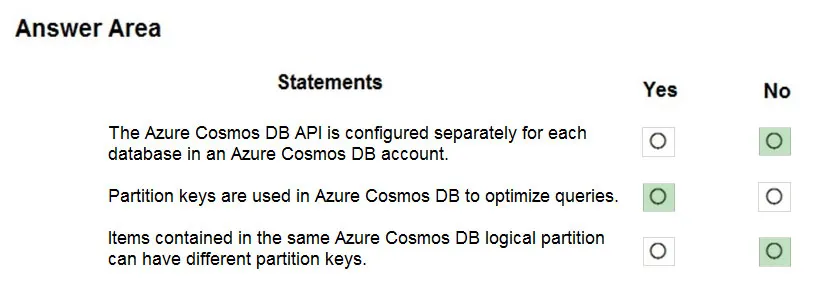
HOTSPOT - For each of the following statements, select Yes if the statement is true. Otherwise, select No. NOTE: Each correct selection is worth one point. Hot Area:
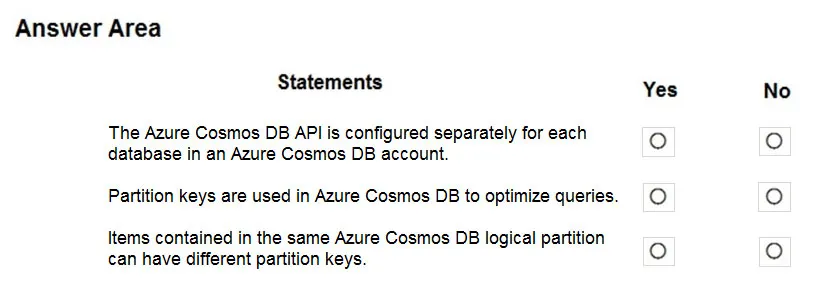
This is an interactive task on the real exam — a drag-and-drop, hotspot or ordering question. There is nothing to select here, so the answer is shown below for reference.
Answer: See figure below
Box 1: No - The API determines the type of account to create. Azure Cosmos DB provides five APIs: Core (SQL) and MongoDB for document data, Gremlin for graph data, Azure Table, and Cassandra. Currently, you must create a separate account for each API. Box 2: Yes - Azure Cosmos DB uses partitioning to scale individual containers in a database to meet the performance needs of your application. In partitioning, the items in a container are divided into distinct subsets called logical partitions. Logical partitions are formed based on the value of a partition key that is associated with each item in a container. Box 3: No - Logical partitions are formed based on the value of a partition key that is associated with each item in a container. Reference: https://docs.microsoft.com/en-us/azure/cosmos-db/partitioning-overview
Source: Adapted from community discussion — chigar
Your company is designing an application that will write a high volume of JSON data and will have an application-defined schema. Which type of data store should you use?
Answer: C
Not only Document databases can store JSON files. From link https://docs.microsoft.com/en-us/azure/architecture/guide/technology-choices/data-store-overview Document - "Each document type can use its own schema." Key/Value - "Any schema information must be provided by the application." So a document store is a document defined schema, while the question specifically refers to an application defined schema which makes the answer key/value.
Source: Adapted from community discussion — user54321
You need to recommend a non-relational data store that is optimized for storing and retrieving text files, videos, audio streams, and virtual disk images. The data store must store data, some metadata, and a unique ID for each file. Which type of data store should you recommend?
Answer: C
Object storage is optimized for storing and retrieving large binary objects (images, files, video and audio streams, large application data objects and documents, virtual machine disk images). Large data files are also popularly used in this model, for example, delimiter file (CSV), parquet, and ORC. Object stores can manage extremely large amounts of unstructured data.
Source: Adapted from community discussion — gabo
Your company is designing a data store for internet-connected temperature sensors. The collected data will be used to analyze temperature trends. Which type of data store should you use?
Answer: B
Link for time series https://docs.microsoft.com/en-us/azure/architecture/data-guide/technology-choices/analytical-data-stores Telemetry and time series databases are an append-only collection of objects. Telemetry databases efficiently index data in a variety of column stores and in-memory structures, making them the optimal choice for storing and analyzing vast quantities of telemetry and time series data.
Source: Adapted from community discussion — [Removed]
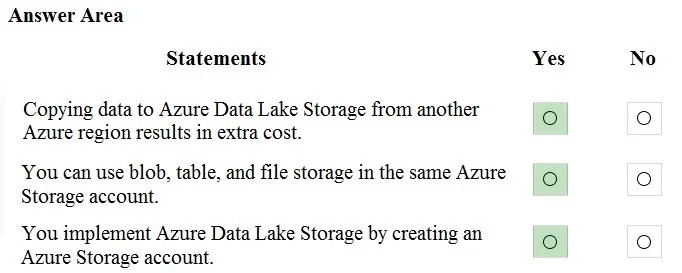
HOTSPOT - For each of the following statements, select Yes if the statement is true. Otherwise, select No. NOTE: Each correct selection is worth one point. Hot Area:
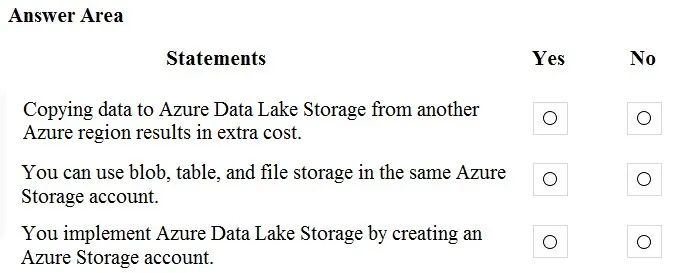
This is an interactive task on the real exam — a drag-and-drop, hotspot or ordering question. There is nothing to select here, so the answer is shown below for reference.
Answer: See figure below
Reference: https://docs.microsoft.com/en-us/azure/data-lake-store/data-lake-store-get-started-portal https://docs.microsoft.com/en-us/azure/storage/common/storage-account-overview https://azure.microsoft.com/en-us/pricing/details/bandwidth/
Source: Adapted from community discussion — JA2018
Keyboard:J Kmove between questionsA–Dselect an answerRshow or hide the answer← →change page
DP-900 practice, question 31. 291 questions available.
Version 1.0.0. How we source questions