Question 221 · 236 in bank
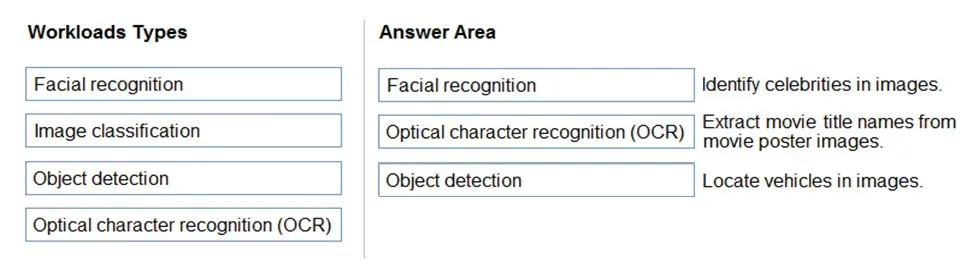
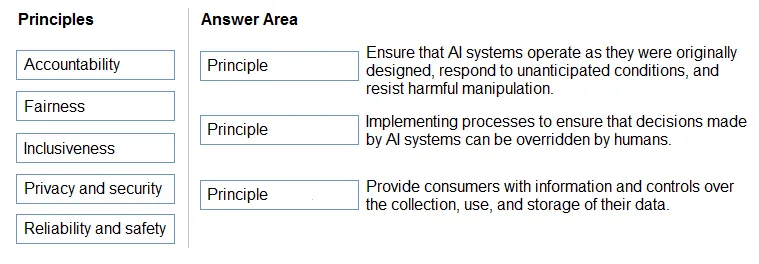
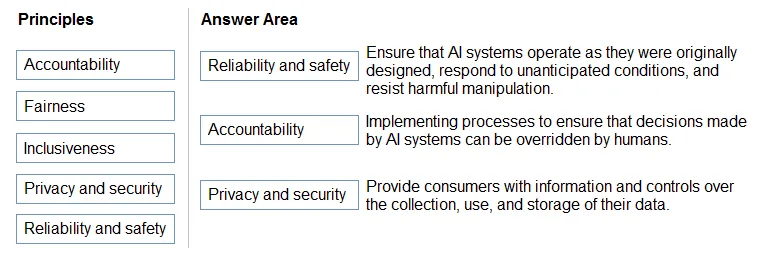
DRAG DROP - Match the types of computer vision workloads to the appropriate scenarios. To answer, drag the appropriate workload type from the column on the left to its scenario on the right. Each workload type may be used once, more than once, or not at all. NOTE: Each correct selection is worth one point. Select and Place:
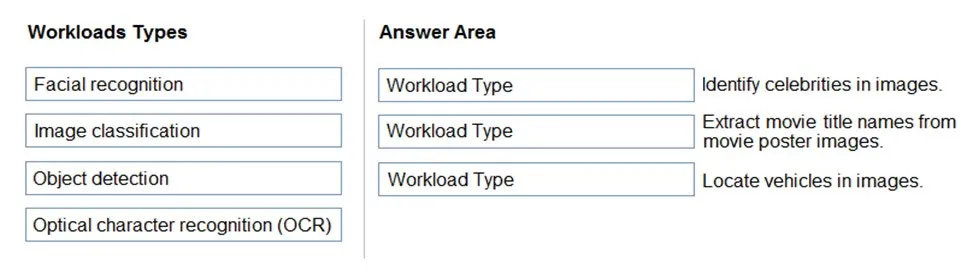
This is an interactive task on the real exam — a drag-and-drop, hotspot or ordering question. There is nothing to select here, so the answer is shown below for reference.
Show the answer figure
Answer: See figure below
Explanation
Box 1: Facial recognition - Face detection that perceives faces and attributes in an image; person identification that matches an individual in your private repository of up to 1 million people; perceived emotion recognition that detects a range of facial expressions like happiness, contempt, neutrality, and fear; and recognition and grouping of similar faces in images. Box 2: OCR - Box 3: Objection detection - Object detection is similar to tagging, but the API returns the bounding box coordinates (in pixels) for each object found. For example, if an image contains a dog, cat and person, the Detect operation will list those objects together with their coordinates in the image. You can use this functionality to process the relationships between the objects in an image. It also lets you determine whether there are multiple instances of the same tag in an image. The Detect API applies tags based on the objects or living things identified in the image. There is currently no formal relationship between the tagging taxonomy and the object detection taxonomy. At a conceptual level, the Detect API only finds objects and living things, while the Tag API can also include contextual terms like "indoor", which can't be localized with bounding boxes. Reference: https://azure.microsoft.com/en-us/services/cognitive-services/face/ https://docs.microsoft.com/en-us/azure/cognitive-services/computer-vision/concept-object-detection