Question 11 · 377 in bank
An engineer working for a private service provider with employee Id: 1234:56:789 is configuring a Cisco device to redistribute OSPF into BGP. Which task enables the device to filter routes?
Show answer
Answer: B
Implementing and Operating Cisco Service Provider Network Core Technologies (SPCOR)377 questions across 38 pages are complete and free, with no account or card.
377 questions in this bank
Free access · progress saved on this device
An engineer working for a private service provider with employee Id: 1234:56:789 is configuring a Cisco device to redistribute OSPF into BGP. Which task enables the device to filter routes?
Answer: B

Refer to the exhibit. An engineer is configuring multitopology IS-IS for IPv6 on router R1. Which additional configuration must be applied to the router to complete the task?
Answer: A

Refer to the exhibits. Which information is provided for traceback analysis when this configuration is applied?
Answer: A
I'm voting for A based on this paragraph from Cisco. It specifically talks about tracing the source of an attack and using NetFlow to know the source interface. Keywords are in all caps. "The originator of DoS attacks cannot be easily identified because the IP source address of the device sending the traffic is usually forged. However, you can easily TRACE the traffic BACK through the network to the router on which it is arriving by using the NetFlow Layer 2 and Security Monitoring Exports feature to capture the MAC address and VLAN-ID fields. If the router on which traffic is arriving supports NetFlow, you can configure the NetFlow Layer 2 and Security Monitoring Exports feature on it to identify the INTERFACE on which the traffic is ARRIVING." https://www.cisco.com/en/US/docs/ios-xml/ios/netflow/configuration/15-2s/nf-detct-analy-thrts.html
Source: Adapted from community discussion — karen1337
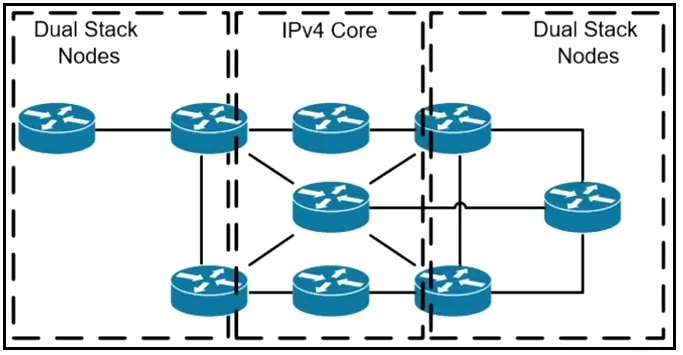
Refer to the exhibit. A network operator has two IPv4 and IPv6 dual-stacked networks on each side of the IPv4 core network. The operator must be able to provide connectivity between them while using specific assigned IPv6 space provided from the company IP administrator team. Which technology should the network operator use to accomplish this goal?
Answer: A
Correct answer is A. 6rd is a mechanism to facilitate IPv6 rapid deployment across IPv4 infrastructures of Internet service providers (ISPs). It is derived from 6to4, a preexisting mechanism to transfer IPv6 packets over the IPv4 network, with the significant change that it operates entirely within the end-user's ISP's network, thus avoiding the major architectural problems inherent in the original design of 6to4.
Source: Adapted from community discussion — craterman

Refer to the exhibit. An engineer is trying to implement BGP configuration on a router. Which configuration error prevents the ASBR from establishing a BGP neighborship to a directly connected BGP speaker?
Answer: C
The question says "Establishing BGP Neighborship" so if the RPL is not configured the 2 eBGP Peers still have to form an adjacency but routes will not be propagated between them due to the default drop policy !! IDK this is weird question
Source: Adapted from community discussion — sherlock0

Refer to the exhibit. An engineer is reviewing the BGP configuration. Which routes must be advertised to 10.10.10.1?
Answer: D
D is correct. There is distribute list configured for neighbor. Where do you see any configured access-lists? AS-PATH filtering configures by "neighbor filter-list "
Source: Adapted from community discussion — craterman

Refer to the exhibit. An engineer is implementing BGP selective prefix suppression. The router must advertise only 10.16.4.0/24, 10.16.5.0/24, and summarized route 10.16.0.0/21, and suppress 10.16.6.0/24. Which configuration must the engineer apply to the router?
Answer: C
The aggregate-address 10.16.0.0 255.255.248.0 command creates the summary route 10.16.0.0/21 itself but the more specific routers are allowed. So then the suppress-map is used to suppresses the 10.16.6.0/24 route.
Source: Adapted from community discussion — thejag

Refer to the exhibit. Which BGP attribute should be manipulated to have CE1 use PE1 as the primary path to the internet?
Answer: B
A - Local Preference is not attached to eBGP updates and it only stays within the AS (iBGP) so UNLESS the routers are all in the same AS it's not going to help here. B - if we modify the origin of ALL routes on each router inbound and outbound we can make the path to PE1 preferred. This is definitely a possible but horrible option. C - The MED attribute is 0 by default so modifying it on inbound routes from PE1 can not make it preferred D - the weight is only local to PE1, not advertised to CE1 I think the answer is actually B?
Source: Adapted from community discussion — thejag

Refer to the exhibit. CE1 and CE2 require connectivity to the internet through the ISP connected to PE3. What should an engineer configure to complete this task?
Answer: C
The only logical answer is D: D. PE2 must be configured to serve as a route reflector for PE3 routes learned from the internet. PE2 then shares the routes with CE1 and CE2.
Source: Adapted from community discussion — Milanello
An engineer is implementing a route map to support redistribution within BGP. The route map must be configured to permit all unmatched routes. Which action must the engineer perform to complete this task?
Answer: D
D is correct. route-map has implicit deny at the end unless you configure a permit catch-all for unmatched statements that fall to it.
Source: Adapted from community discussion — NetworkYoda72
Keyboard:J Kmove between questionsA–Dselect an answerRshow or hide the answer← →change page
350-501 practice, question 11. 377 questions available.
Version 1.0.0. How we source questions