Question 871 · 1334 in bank
Which command must be entered to configure a DHCP relay?
Show answer
Answer: D
Cisco Certified Network Associate (CCNA)1,334 questions across 134 pages are complete and free, with no account or card.
1334 questions in this bank
Free access · progress saved on this device
Which command must be entered to configure a DHCP relay?
Answer: D
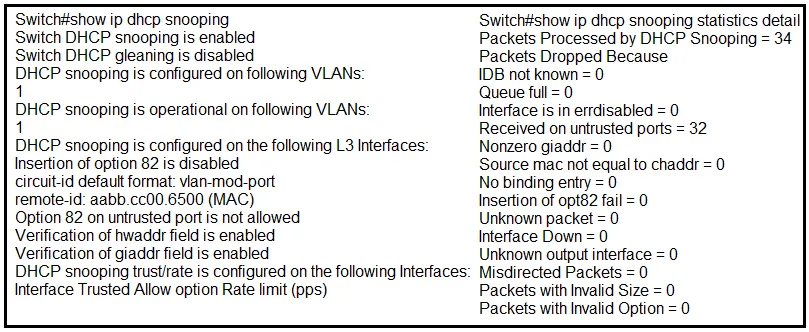
Refer to the exhibit. The DHCP server and clients are connected to the same switch. What is the next step to complete the DHCP configuration to allow clients on VLAN 1 to receive addresses from the DHCP server?
Answer: C
If a Layer 2 LAN port is connected to a DHCP server, configure the port as trusted by entering the ip dhcp snooping trust interface configuration command. https://www.cisco.com/en/US/docs/general/Test/dwerblo/broken_guide/snoodhcp.html#wp1073367
Source: Adapted from community discussion — RougePotatoe
A network analyst is tasked with configuring the date and time on a router using EXEC mode. The date must be set to January 1, 2020 and the time must be set to 12:00 am. Which command should be used?
Answer: D
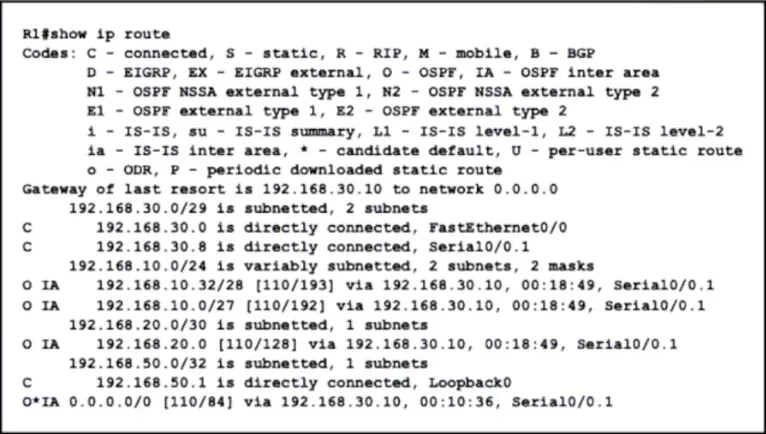
Refer to the exhibit. What is the metric of the route to the 192.168.10.33/28 subnet?
Answer: D
he metric of the route to the 192.168.10.32/28 subnet is 110, not 193. The metric is the administrative distance, which is a value that indicates the preference of a route. The lower the metric, the more preferred the route is. In this case, the metric of 110 is the sum of the administrative distance of the serial interface (84) and the cost of the path to the next hop (26). The administrative distance of a serial interface is typically 84, while the cost of the path to the next hop is typically the number of hops to the next hop. In this case, the next hop is 192.168.30.10, which is one hop away. Therefore, the metric of the route to the 192.168.10.32/28 subnet is 110. "this is because the output is using a Cisco IOS-style format" **Cisco IOS-style format:** [metric]/[administrative distance] [destination network] [via next hop] **Other styles:** [administrative distance]/[metric] [destination network] [via next hop]
Source: Adapted from community discussion — ZeroK
Which command creates a static NAT binding for a PC address of 10.1.1.1 to the public routable address 209.165.200.225 assigned to the PC?
Answer: A
What prevents a workstation from receiving a DHCP address?
Answer: A
I think its STP, specifically portfast. I found this one the cisco white pages, under the DHCP troubleshooting section. "...verify that the port has STP portfast enabled and trunking/channeling disabled. The default configuration is STP portfast disabled and trunking/channeling auto, if applicable. For the 2900XL/3500XL/2950/3550 switches, STP portfast is the only required configuration. These configuration changes resolve the most common DHCP client issues that occur with an initial installation of a Catalyst switch." from https://www.cisco.com/c/en/us/support/docs/ip/dynamic-address-allocation-resolution/27470-100.html#anc72
Source: Adapted from community discussion — Ghugs
What is a feature of TFTP?
Answer: A
B: TFTP uses Port 69...heh C: FTP uses TCP Ports 20 & 21 D: Neither FTP nor TFTP provide secure data transfer on their own A: TFTP does not support authentication. Maybe no login ability at all offers anonymity..?
Source: Adapted from community discussion — nicombe
Which QoS forwarding per-hop behavior changes a specific value in a packet header to set the class of service for the packet?
Answer: D
Answer is correct: Chatgpt: Marking is a QoS technique where a value is modified or added to a specific field in the packet header to indicate the class or priority of the packet. This marking can be used to differentiate and prioritize different types of traffic based on their specific requirements. For example, in IP-based networks, the Differentiated Services Code Point (DSCP) field in the IP header can be modified to set the class of service for a packet. By changing the value of the DSCP field, the packet is marked with a specific priority or class, allowing routers and switches along the network path to apply appropriate QoS policies and forwarding behaviors. Marking is crucial in QoS implementation as it enables network devices to identify and treat packets differently based on their class of service, ensuring that higher-priority traffic, such as voice or real-time applications, receives preferential treatment and appropriate QoS handling.
Source: Adapted from community discussion — YetiPatty
Which WAN access technology is preferred for a small office / home office architecture?
Answer: A
Ref: Connecting Networks v6 Companion Guide “Chapter 4 WAN Concepts … Selecting a WAN Technology … WAN Link Connection Options … Public WAN infrastructure:… Broadband connections are typically used to connect small offices and telecommuting employees to a corporate site over the Internet. …” A. broadband cable access Correct answer B. frame-relay packet switching Wrong answer. C. dedicated point-to-point leased line Wrong answer. D. Integrated Services Digital Network switching Wrong answer.
Source: Adapted from community discussion — [Removed]
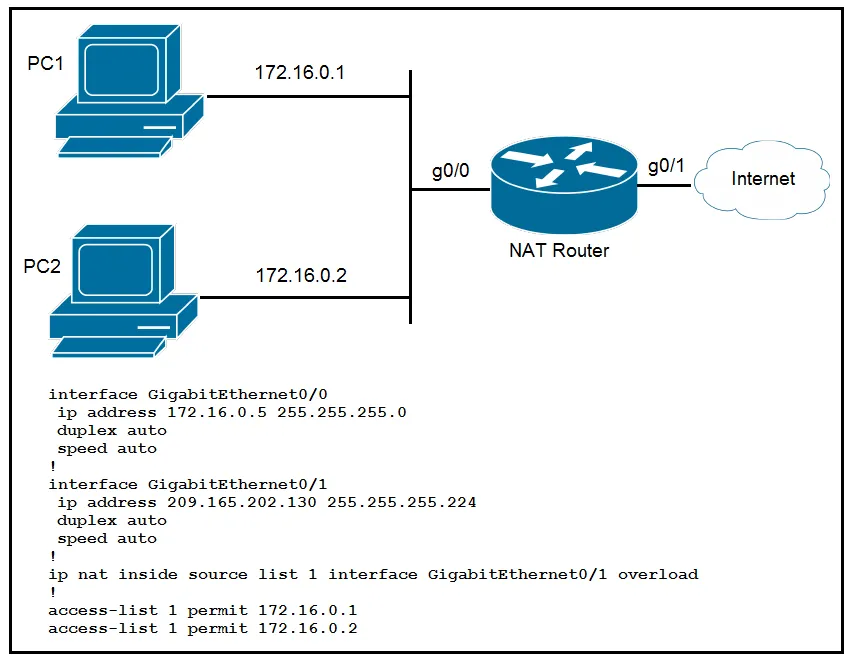
Refer to the exhibit. How should the configuration be updated to allow PC1 and PC2 access to the Internet?
Answer: D
First we need to specify the inside and outside interface and then we can use the ip nat inside source list 1 interface GigabitEthernet0/0 overload command So D is necessary for B to happen
Source: Adapted from community discussion — Cyber15
Keyboard:J Kmove between questionsA–Dselect an answerRshow or hide the answer← →change page
200-301 practice, question 871. 1334 questions available.
Version 1.0.0. How we source questions